On construction sites, the worst accidents tend to follow four patterns: a fall (from a roof edge or ladder), a tool dropped from above, a trench wall that caves in, or a crane that swings too close to a power line. The Occupational Safety and Health Administration (OSHA), calls them the Focus Four hazards.
Focus Four hazards get their name because OSHA counts them as the top four causes of construction deaths: falls, struck-by, caught-in or -between, and electrocution. Every OSHA 10 and OSHA 30 construction class (the 10-hour and 30-hour OSHA safety courses many site workers take) teaches them.
In this article, you'll learn how to spot each Focus Four hazard on a construction site, the practical ways to avoid it, and what to do when you see one.
Key Takeaways
- OSHA's Focus Four hazards are falls, struck-by, caught-in or -between, and electrocution, which OSHA names as the top four causes of death in US construction.
- To avoid falls, OSHA requires guardrails, safety nets or a harness system on unprotected edges 6 feet or higher above a lower level.
- To avoid being struck, keep people on foot and machines apart: wear high-visibility clothing, stay out of blind spots and swing areas, and make eye contact with operators.
- To avoid caught-in hazards, use a protective system in trenches 5 feet deep or more, such as a trench box (a steel shield that holds back the walls while workers are inside) or shoring (braces that hold up the walls), unless it is dug in stable rock.
- To avoid electrocution, keep cranes at least 20 feet from power lines (50 feet for lines over 350 kilovolts, or kV) unless the utility has switched the lines off and grounded them.
- If you spot an unguarded edge, an unprotected trench or equipment near a power line, stop work at that spot and tell your supervisor.
What Are OSHA's Focus Four Hazards in Construction?
According to Bureau of Labor Statistics (BLS) data published in February 2026, OSHA's Focus Four hazards together caused 644 of the 1,034 deaths in private US construction in 2024 (not counting government workers), or about 6 in 10.
These hazards are also called OSHA’s Fatal Four hazards.
1. Fall Hazards
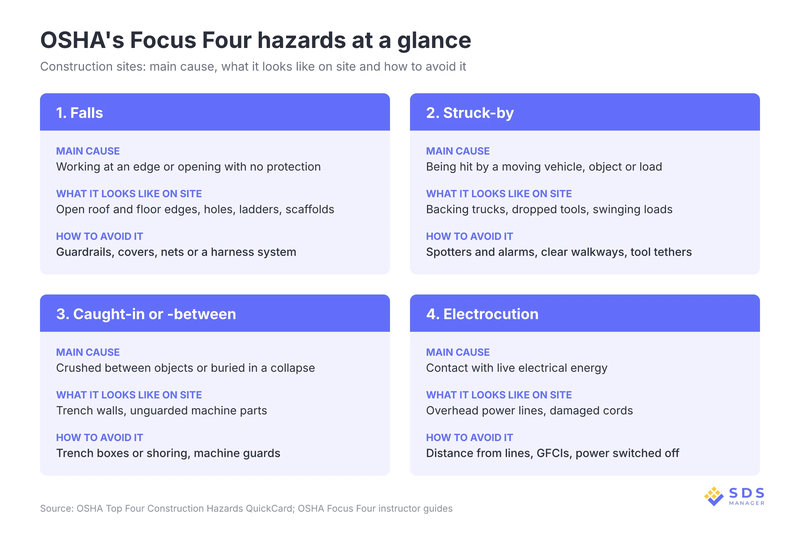
A fall hazard is any place where you could drop to a lower level. Falls to a lower level killed 373 construction workers in 2024, more than a third of all construction deaths and more than any other cause, according to the BLS report.
What Causes Falls in Construction
About three in four fatal falls in construction are from roofs, ladders and scaffolds, according to CPWR, the construction industry's safety research center. They often happen at an edge or opening with nothing to stop the worker: an unprotected roof or floor edge, a hole or skylight with no cover, a ladder set on soft ground, or a scaffold missing guardrails or planks.
How to Spot Fall Hazards
On a construction site, fall hazards include unprotected roof and floor edges, holes and skylights, ladders, scaffolds, and the open edges of floors being built. Look again every shift, because each new floor level opens a new edge, and have a supervisor or the competent person walk the site to find them.
OSHA's fall protection rule for construction (29 CFR 1926.501) requires fall protection on unprotected sides and edges 6 feet or more above a lower level; scaffolds, ladders, steel erection and some other work have their own rules.
How to Prevent Falls
You can avoid most falls by putting protection in place before anyone works near the edge. Under OSHA's construction standards (29 CFR 1926), your employer must provide it.
- Put up guardrails or cover holes before work starts, so nobody can step off an open edge.
- Use safety nets or a personal fall arrest system (a harness, lanyard and anchor point) where guardrails are not possible.
- Set ladders on firm, level ground, extend them at least 3 feet above the landing, and keep three points of contact (two hands and a foot, or two feet and a hand) while you climb.
- Inspect harnesses, guardrails and scaffold planks before each shift.
The right fall protection systems for a job depend on how high the work is and where an anchor point can be attached.
Missing fall protection is the violation OSHA cited most often in fiscal year 2026 (October 2025 to August 2026), according to its preliminary list of most-cited standards, and scaffolding and ladder violations come 4th and 5th.
2. Struck-By Hazards
A struck-by hazard is anything that can hit a worker hard enough to cause serious injury: a flying, falling, swinging or rolling object, or a moving vehicle. Struck-by incidents caused 163 construction deaths in 2024. In 67 of those deaths, a vehicle hit a person on foot, and 30 of those 67 happened in road work zones.
What Causes Struck-By Incidents
Struck-by deaths come from vehicles and equipment whose drivers can't see behind them, tools and materials dropped from height, crane loads that swing, and pieces thrown by saws and nail guns.
How to Spot Struck-By Hazards
Common struck-by hazards include backing dump trucks and loaders, traffic driving past road work zones, tools and materials dropped from above, swinging crane loads, and flying pieces from saws and nail guns.
How to Prevent Struck-By Incidents
Most struck-by protection keeps people on foot and machines apart:
- Wear high-visibility clothing near traffic and equipment, so drivers and operators can see you.
- Stay out of blind spots and out of the area where a machine's arm or a crane load swings.
- Make eye contact with the operator before you walk near a running machine.
- Use toeboards, debris nets and tool tethers to stop tools and materials from falling, especially on scaffolding and roof edges.
- Wear a hard hat and eye protection.
Under OSHA's construction rules for motor vehicles and earthmoving equipment, a truck or machine with a blocked rear view may back up only if it has a working reverse alarm or a spotter signals that it is safe.
3. Caught-In or -Between Hazards
A caught-in or -between hazard is any situation where a worker can be squeezed, crushed or pinched between objects, or buried when a trench collapses. These hazards caused 56 construction deaths in 2024, and 13 of those deaths came from trench and excavation collapses.
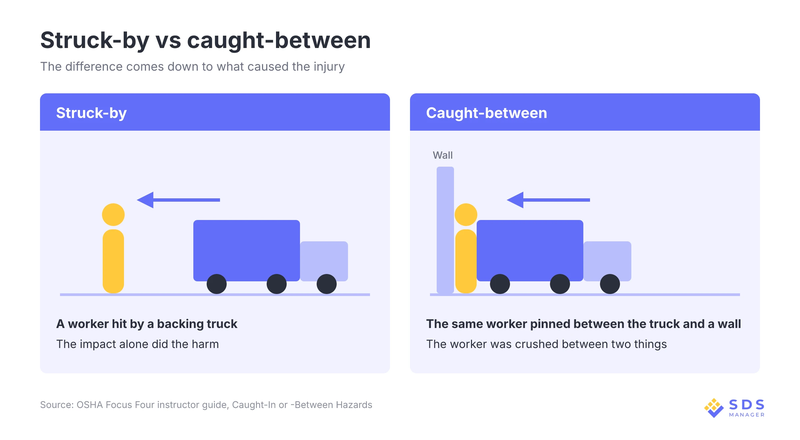
If the impact alone did the harm, the incident is struck-by. If the worker was crushed between two things, it is caught-in or -between. A worker hit by a backing truck is struck-by, while the same worker pinned between the truck and a wall is caught-between.
What Causes Caught-In or -Between Incidents
These deaths come from trench walls that collapse, moving machine parts with no guard, equipment that starts while someone is clearing or fixing it, and workers caught between moving equipment and a wall or another vehicle.
How to Spot Caught-In or -Between Hazards
On site, look for trench and excavation walls, unguarded gears, belts and rollers, the gap between moving equipment and a wall, and loose clothing near rotating parts.
How to Prevent Caught-In or -Between Incidents
Stay out of the spaces where crushing and burial happen:
- Never enter a trench 5 feet deep or more without trench cave-in protection, such as sloping (cutting the walls back at a safe angle), shoring (braces that hold up the trench walls) or a trench box (a steel shield that holds back the walls while workers are inside). If a competent person (someone who can spot the hazards on a job and has the authority to fix them right away) sees signs that a shallower trench could cave in, protect it the same way.
- Keep a ladder, stairway or ramp within 25 feet of every worker in a trench 4 feet deep or more, so there is always a way out.
- Keep spoil piles (the dirt dug out of the trench) and equipment at least 2 feet back from the trench edge.
- Keep machine guarding in place on moving machine parts.
- Before you reach in to clear a jam or do maintenance, shut down the equipment and lock its power off by following your lockout/tagout procedure.
4. Electrocution Hazards
An electrocution hazard is any source of live electricity that a worker, a tool or a machine can touch, from an overhead power line to a damaged extension cord. Electrocutions caused 52 construction deaths in 2024.
What Causes Electrocutions
Contact with power lines, often through a crane, dump-truck bed, ladder or long material, and live wiring in buildings caused about three in four construction electrocutions from 2011 to 2015, according to CPWR. Damaged cords, wet ground and work on circuits that are still switched on add to the risk.
How to Spot Electrocution Hazards
On site, watch for cranes, dump-truck beds, ladders or scaffolds near overhead lines, exposed live wiring, damaged extension cords, and wet ground around power tools. Panels, generators and wet conditions also create electrical hazards on the job.
How to Prevent Electrocutions
Keeping your distance and switching the power off prevent most electrocutions:
- Look up and find power lines before you move equipment, ladders or long materials.
- Plug tools into ground-fault circuit interrupters (GFCIs), devices that cut the power when current leaks.
- Check cords and tools before each use, and take damaged ones out of service.
- Switch circuits off before you work on them.
If any part of a crane or its load could get within 20 feet of a power line, the employer must take one of three steps. It can have the utility switch off and ground the line (connect it to the earth), keep everything at least 20 feet away, or determine the line's voltage and keep the minimum distance OSHA sets for it. OSHA's minimum is 10 feet for lines up to 50 kilovolts (kV), and more for higher voltages.
For lines over 350 kV, the 20-foot distance becomes 50 feet.
What to Do When You Spot a Focus Four Hazard
Protection has to be in place before work starts, so work stops when it is missing. When you find an open edge, a truck backing with no spotter or alarm, an unprotected trench or a crane working near a power line, react the same way each time:
- Stop work at that spot.
- Keep other people and equipment back.
- Block off the area.
- Tell your supervisor or the competent person.
For any other hazard, follow your site's usual process for reporting workplace hazards.
Does OSHA 10 Training Cover the Focus Four?
Yes. Every OSHA 10 construction class covers the Focus Four, with at least 4 hours on the four hazards, and an OSHA 30 class spends at least 6 hours. Because these four hazards cause most construction deaths, the Focus Four module is the largest required topic in the class. Falls get the most time, at least 90 minutes, and each of the other three hazards gets at least 30 minutes.
OSHA's Outreach Training Program, the program behind OSHA 10 and 30 classes and the course-completion cards students receive, sets the Focus Four time minimums in its current procedures, which took effect on October 1, 2024.
Supervisors can keep crews alert to the Focus Four hazards with a toolbox talk: a short safety talk before the shift about a hazard in that day's work, such as new edge work or a newly opened trench. OSHA's free Focus Four lesson materials include instructor guides, slides and handouts for each hazard, and its Top Four Construction Hazards QuickCard lists the main prevention steps for all four hazards on one card.
Start Every Shift With No Hazards Unchecked
A pre-shift walk-around protects the crew only when every gap it finds is fixed before work starts.
With paper checklists, someone notes a missing guardrail or an unprotected trench gets noted, filed in a folder and often not followed up.
Before every shift, check the Focus Four: edges and openings, vehicles and loads, trenches and moving parts, power lines and cords. Assign an owner to each gap and set a date to fix it.
EHS Solutions by SDS Manager turns the Focus Four check into an inspection checklist with it’s the Audit & Inspection module, and every gap it finds gets a photo, an owner and a due date.
Start a free trial and close every Focus Four gap before the next shift.
Frequently Asked Questions
What Does the OSHA 10 Focus Four Test Cover?
The OSHA 10 Focus Four test covers four learning objectives for each hazard: identifying it, describing its types, explaining how to protect yourself, and recognizing what your employer must do. Testing is optional, and OSHA gives the answer sheets only to trainers.
Do the Focus Four Hazards Apply Outside Construction?
No, the Focus Four hazards are a construction-specific concept. OSHA's 10- and 30-hour classes for general industry (most work outside construction) have no Focus Four module. Falls, struck-by, caught-in and electrical hazards still happen in warehouses, factories and utilities, where OSHA's general industry rules cover them.
Is Electrocution the Same as an Electrical Shock?
No. Electrocution means death caused by electrical energy, while an electrical shock can injure without killing. Shocks, burns, arc flash (a sudden release of electrical energy through the air that gives off intense heat and light) and electrical fires make up the wider group of electrical hazards, and electrocution is the fatal outcome.
Do Focus Four Rules Apply to Small Contractors?
Yes, the Focus Four rules apply to small contractors the same way they apply to large ones. OSHA says employers must keep the workplace free of recognized serious hazards regardless of the size of the business, and must follow OSHA standards. A two-person roofing crew needs the same edge protection as a large firm.
What Happens If OSHA Finds a Focus Four Hazard on Your Site?
When OSHA finds a Focus Four hazard on your site, it can issue a citation (a written notice of a violation), propose a penalty for each violation, and set a date by which the hazard must be fixed. The employer can also be fined for each day the hazard stays unfixed past that date.

Arysha Alif Khan

Arysha Alif Khan is an EHS and chemical safety specialist with a background in biochemistry, biotechnology, and public health. She works closely with the product and regulatory teams to turn complex chemical regulations, SDS requirements, and workplace safety standards into clear, practical guidance for people.