What is a safety data sheet?
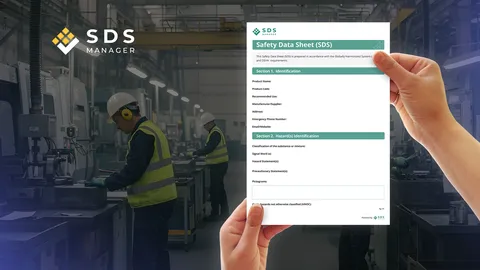
A safety data sheet (SDS) is a standardized document that describes a chemical's hazards and how to handle, store and respond to it safely. It replaced the older material safety data sheet (MSDS) in the US when OSHA aligned its Hazard Communication Standard with the UN's Globally Harmonized System (GHS) in 2012. The main change is the format: an MSDS could follow any layout, while an SDS must follow the same 16 sections in the same order.
Who has to write an SDS?
Under 29 CFR 1910.1200(g), chemical manufacturers and importers must create an SDS for each hazardous chemical they produce or import. Distributors must pass it on to their customers. Employers who only use chemicals don't write SDSs, but they must keep one for each hazardous chemical and make it readily accessible to employees during every shift.
How many sections are in a safety data sheet?
Sixteen. OSHA's Appendix D to 1910.1200 sets the order:
- Identification
- Hazard(s) identification
- Composition/information on ingredients
- First-aid measures
- Fire-fighting measures
- Accidental release measures
- Handling and storage
- Exposure controls/personal protection
- Physical and chemical properties
- Stability and reactivity
- Toxicological information
- Ecological information
- Disposal considerations
- Transport information
- Regulatory information
- Other information, including the date of preparation or last revision
OSHA doesn't enforce sections 12 to 15, because other agencies regulate those topics. They must still be present for the SDS to follow the GHS format.
Filling in an SDS template
Start with classification
Classify the product's hazards before you write anything else. The classification drives the signal word, pictograms and hazard statements in Section 2, and much of the advice in Sections 4 to 8.
Be specific in Sections 4 to 8
Avoid generic advice such as "use appropriate PPE." Section 8 should name the glove material, the respirator type and the exposure limits. Section 4 should say how long to flush eyes or skin.
Keep it consistent
The label and the SDS must match. If Section 2 lists "Causes serious eye damage," the label must carry the same statement and the corrosion pictogram.
Date every revision
Record the revision date in Section 16. Under 1910.1200(g)(5), you must add new significant hazard information to the SDS within three months of learning about it.
The 2024 HazCom update
OSHA updated the Hazard Communication Standard in May 2024 to align with a later GHS revision. Manufacturers and importers have until January 19, 2026, to update SDSs for substances and until July 19, 2027, for mixtures. If you're writing a new SDS now, use the updated requirements.
A template or an SDS authoring tool?
A blank safety data sheet template suits a handful of simple products. If you manage many products or sell in several countries, SDS authoring software can classify mixtures and generate compliant SDSs in multiple languages.
Download the free SDS template to start your first safety data sheet. If you need SDSs for the products you buy, search the free SDS Manager database.