What are flammable chemicals?
Flammable chemicals are substances that ignite easily and burn quickly. They include:
- Gases, such as hydrogen and propane
- Liquids, such as ethanol, acetone and gasoline
- Solids, such as sulfur and magnesium powder
- Aerosols, such as spray paints and lubricant sprays
With liquids, it's the vapor that burns, not the liquid itself. A liquid with a low flash point gives off enough vapor to ignite at room temperature.
How GHS classifies flammable liquids
Under GHS, which OSHA has adopted, flammable liquids fall into four categories based on flash point and initial boiling point:
| GHS category | Flash point | Initial boiling point | Examples |
|---|---|---|---|
| Category 1 | Below 23°C (73.4°F) | At or below 35°C (95°F) | Diethyl ether, gasoline |
| Category 2 | Below 23°C (73.4°F) | Above 35°C (95°F) | Acetone, ethanol |
| Category 3 | 23–60°C (73.4–140°F) | Any | Xylene, kerosene |
| Category 4 | Above 60°C and up to 93°C (140–199.4°F) | Any | Some diesel fuels |
Category 1 liquids are the most dangerous. Check Section 2 and Section 9 of each product's safety data sheet for its category and flash point.
Class 1, 2 and 3: other systems you'll see
Older OSHA rules and NFPA codes use classes instead of categories. A "Class I" flammable liquid has a flash point below 100°F (37.8°C) and is split into IA, IB and IC. Classes II and III are combustible liquids with higher flash points.
Transport rules use another system again. "Class 3" in DOT and UN transport regulations covers flammable liquids generally, with a flash point of 60°C (140°F) or below. When building your list, record the GHS category and note the transport class separately if you ship the product.
Why keep a flammable chemicals list?
A flammable chemicals list shows where your fire risk is. The list helps you:
- Stay within storage limits for cabinets and rooms
- Plan ventilation and control ignition sources
- Give firefighters accurate information in an emergency
- Keep incompatible materials, such as oxidizers, away from flammables
Are all chemicals flammable?
No. Many chemicals don't burn, including most water-based cleaners, many acids and bases, and most salts. Some non-flammable chemicals still make fires worse. Oxidizers such as hydrogen peroxide and nitrates release oxygen and can intensify a fire, so keep them away from your flammables. Section 9 of the SDS gives the flash point, if there is one.
Where should flammable chemicals be stored?
Store flammable liquids in approved safety cans and flammable storage cabinets, away from heat, sparks and oxidizers. OSHA limits each cabinet to 60 gallons of Category 1, 2 or 3 liquids (29 CFR 1910.106(d)(3)). Keep only the amount needed for the day or shift at workstations, and return the rest to the cabinet. Bond and ground metal containers when transferring liquids.
How to fill in the template
For each chemical, record the product name, GHS category, flash point, quantity, container size, storage location and SDS reference. Update the list whenever a new product arrives or one is discontinued, and review it at least once a year.
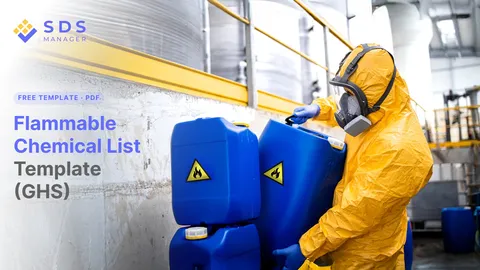
Download the free flammable chemical list template to map your site's flammables. For storage controls, use it with the Chemical Storage Risk Assessment.