What is a manual handling risk assessment?
Manual handling means moving loads by hand or bodily force: lifting, lowering, carrying, pushing, pulling and holding. A manual handling risk assessment looks at a specific task and asks whether it could injure the people doing it, especially their backs, shoulders and arms.
Musculoskeletal disorders build up over time, so a task that seems fine on day one can still cause injury after months of repetition.
Avoid, assess, reduce
In the UK, the Manual Handling Operations Regulations 1992 set out three steps, which this template follows:
- Avoid hazardous manual handling where reasonably practicable, for example by using a conveyor or delivering goods closer to where they're used
- Assess any hazardous manual handling that can't be avoided
- Reduce the risk of injury as far as reasonably practicable
In the US, OSHA has no specific manual handling standard, but it can cite serious ergonomic hazards under the General Duty Clause. The NIOSH Lifting Equation is a widely used tool for assessing lifting tasks.
How to assess a manual handling task
Use the TILE factors.
Task
Does the task involve twisting, stooping, reaching up, carrying long distances, frequent lifting or holding loads away from the body?
Individual
Does it need unusual strength or height? Are any workers new, pregnant, returning from injury or untrained?
Load
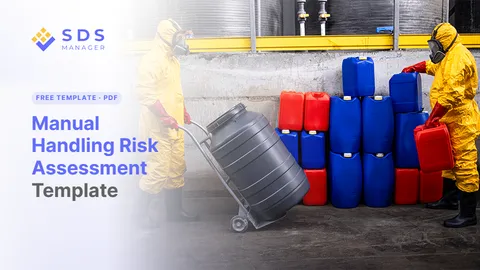
Is the load heavy, bulky, unstable, hard to grip, sharp, hot or hazardous? Chemical containers can add splash risk. Check the safety data sheet for the PPE you need when handling them.
Environment
Are there space constraints, uneven or slippery floors, stairs, poor lighting or extreme temperatures?
Who is responsible for conducting a manual handling risk assessment?
The employer is responsible. In practice, a supervisor or safety professional usually leads it, working with the people who do the task. They know which loads are awkward and where the shortcuts happen.
Manual handling risk assessment example
- Task: Lifting 25-kg sacks of powder from a pallet on the floor into a mixer hopper 1.2 m high, 40 times per shift
- Risk factors: Lifting from floor level, twisting, frequent repetition, dust when tipping
- Risk: High
- Controls: Raise the pallet with a scissor lift table, add a bag-tipping station at the hopper, switch to 15-kg sacks, rotate the task between operators, and provide dust masks as listed in the SDS
- Residual risk: Low
Reducing the risk
Look for engineering solutions first: lift tables, trolleys, conveyors, vacuum lifters and smaller pack sizes. Training in lifting technique helps, but it shouldn't be the main control for a task that's badly designed. Ask workers which tasks leave them sore at the end of a shift; their answers often point to the highest-risk tasks.
When to review
Review the assessment when the task, load, equipment or workplace changes, after an injury or complaint of pain, and at regular intervals.
Download the free manual handling risk assessment template to assess your next task. To record broader workplace risks, use the Health and Safety Risk Assessment Template.