EHS stands for environment, health and safety. It brings together three types of work: reducing the environmental harm caused by operations, preventing work-related illness, and preventing workplace injuries and incidents.
Organizations manage the three together because one activity can affect all of them. A chemical spill can injure a worker, expose other employees to harmful vapor, and contaminate nearby water. That overlap is why EHS is one field rather than three separate responsibilities.
In the United States, 5,070 workers died from work-related injuries in 2024, according to the Bureau of Labor Statistics' census of fatal occupational injuries. That toll is what EHS exists to prevent. By the end of this article, you will know what the field covers, who is legally responsible for it, which regulators enforce it, and where programs usually break down.
Key Takeaways
- EHS stands for environment, health, and safety. It is the combined work of protecting people from workplace injury and illness while reducing the harm an organization's operations can cause to air, water, and land.
- The three parts address different kinds of harm. Environmental work deals with releases and waste, health work with exposures that make people ill over time, and safety work with events that injure someone on the spot.
- An EHS program runs as a cycle: find the hazard, judge the risk, control it, then check that the control still works.
- The employer remains legally responsible for EHS even when managers, specialists, consultants or workers carry out parts of the program.
- EHS is called HSE in the UK, WHS in Australia, and OHS or SHE elsewhere. The letter order follows whichever regulator or standard shaped local practice.
- EHS laws and regulators differ by country and, in some places, by state or territory, so one corporate process may need local changes.
- A program is what an organization does. A management system is how it directs that work, through named owners, dated objectives, written processes and regular management review.
What Is EHS?
In everyday practice, EHS is really just one job: keeping people and the planet safe from harm that a workplace might cause. Companies do this by asking four simple questions, in order.
First, what could go wrong here? Like, what might hurt a worker or damage the environment? Second, what should we put in place to stop that from happening? Third, do the people involved know how to stay safe? And fourth, are the things we put in place still working the way they should?
Think of a coffee shop. What could go wrong? A wet floor could cause a slip. So they put down a "caution" sign and a non-slip mat, they show staff how to clean up spills quickly, and the manager keeps an eye out to make sure the mat is actually there and being used. That's EHS in miniature.
This same cycle happens whether a business has a whole EHS department or simply asks a few employees to handle it as part of their regular jobs.
Which Organizations Require EHS Work?
Organizations of every size and industry require some EHS work, because every workplace carries health and safety risks even where its environmental duties are limited.
For example, an accountant's office won't pollute a river, but someone could still trip on a loose cable or strain their back lifting a box.
How much EHS work is needed by an organization depends on the hazards, activities, workforce, locations, and legal requirements involved.
However, needing EHS work is not the same as needing an EHS department. A small office may hand risk assessment, emergency planning and incident reporting to an owner or operations manager. On the other hand, a manufacturer handling chemicals, machinery, waste and emissions usually needs specialists to coordinate it.
How Does EHS Relate to Compliance?
Compliance simply means following the rules that apply to your organization. That includes the laws, the permits, and the reports you're legally required to file.
For example, you are legally required to keep all the records of workplace injuries, or report a chemical spill to the authorities before a set deadline. All of that is compliance.
But EHS goes beyond compliance alone, because not every risk is governed by a rule.
An organization might notice a new kind of hazard, a process that keeps breaking down, or the same "close call" happening over and over, even when no law specifically mentions that situation.
A good EHS approach means dealing with those problems anyway, because the goal is to prevent harm, not just to check a legal box.
So think of it this way. Compliance is the legal minimum; the floor you're not allowed to go below. EHS builds on top of that with the practical, everyday work of actually keeping people and the environment safe.
The Three Pillars of EHS: Environment, Health and Safety
EHS is built on three pillars, and each one deals with a different way an organization's work can cause harm. The easiest way to tell them apart is to ask who gets hurt, how, and how fast.
Environment is about harm that reaches outside the workplace, such as the air, water, land, and wildlife around it. A factory letting waste seep into a nearby stream is an environmental problem.
Health is about harm that builds up slowly inside a person's body, usually from being exposed to something over time. A worker who breathes in dust or fumes for years and develops a lung illness is a health problem. You often don't see the damage right away.
Safety is about harm that happens right now, in an instant. A worker who slips off a ladder and breaks an arm is a safety problem. The injury is immediate and obvious.
These categories are useful because they tell an organization what kind of expert it needs to handle a given danger. But here's the catch: real-world hazards rarely fit neatly into just one box.
A chemical spill, for example, can poison the soil (environment), make a worker sick from the fumes (health), and cause a slip on the wet floor (safety) all at once. So the pillars are a helpful way to think, not a set of walls between separate problems.
The Environment Pillar
The environment pillar covers how an organization's operations affect air, water, and land, including effects that continue after materials leave the site. Most environmental responsibilities fall into three areas:
- Air: the gases and particles an organization releases into the sky. This can come from burning fuel, from vents where a process lets out fumes, or from accidental leaks.
- Water: anything that could end up in a drain, a river, or the ocean. That includes used water from the company's processes (wastewater) and even rainwater that runs off the site and picks up pollutants along the way (stormwater).
- Waste: the leftover materials an organization has to get rid of. This covers how waste is stored, how it's transported, and where it finally ends up. Each step usually comes with permits (official permission to do it) and records (proof of what was done).
The key thing is, an organization's responsibility doesn't stop at the front gate. Even after waste is hauled away, the company still has to show where it went and prove it followed the rules the whole way. That's what all the paperwork is for.
Waste transfer records, disposal documents, and monitoring results together tell the story of where materials ended up and whether the company stayed within the limits it was allowed.
The Health Pillar
The health pillar is about the things in a workplace that can slowly make people sick, usually after they're exposed to them again and again over a long time. Some of the most common health concerns are:
- Chemicals: harmful substances that can get into the body in three ways: by breathing them in, by touching them so they soak through the skin, or by accidentally swallowing them.
- Noise: working around loud sounds for long periods, which can gradually damage a person's hearing.
- Physical strain: the wear and tear on the body from doing the same motion over and over, lifting things the wrong way, or working in awkward positions. (This is often called "ergonomic" strain. Ergonomics is just the science of fitting the job to the body so it causes less harm.)
- Germs and living things: bacteria, viruses, and other biological agents a worker might be exposed to. Companies often keep an eye on the health of workers who face these risks, checking in over time to catch problems early.
Health risks are much harder to spot than safety hazards. With a safety accident, there's a clear moment to point to. For example, someone slipped, right there, at 2 p.m.
But Health problems don't work that way. There's often no single event to investigate. Instead, the clues show up slowly: a measurement showing how much of something a worker breathed in, a group of people all reporting similar symptoms, or an illness that doesn't appear until years down the road.
The Safety Pillar
The safety pillar covers events and conditions that cause immediate physical injury, including contact with energy, equipment, or unsafe work areas. Common workplace safety hazards include:
- Machinery: moving parts that aren't covered up, a machine switching on when no one expects it, or equipment moving through a space where people are working.
- Falls, slips, and trips: falling from a height like a ladder or rooftop, or the more everyday danger of slipping and tripping on the ground.
- Energy that can burst out: electricity that can shock, fires and explosions, or pressure suddenly releasing from something like a tank or pipe.
- Risky places and activities: working inside tight, enclosed spaces (called "confined spaces"), moving vehicles like forklifts sharing the floor with people, and outside contractors working on site who may not know all the local risks.
An incident has a time, a place, and an immediate result, which makes safety problems easier to report than health risks.
Being easy to report is not the same as being prevented. An organization can be excellent at writing up accidents after they happen and still be doing a poor job of stopping them in the first place.
The goal of reporting is to prevent such accidents in the first place.
How Do the Three EHS Pillars Overlap?
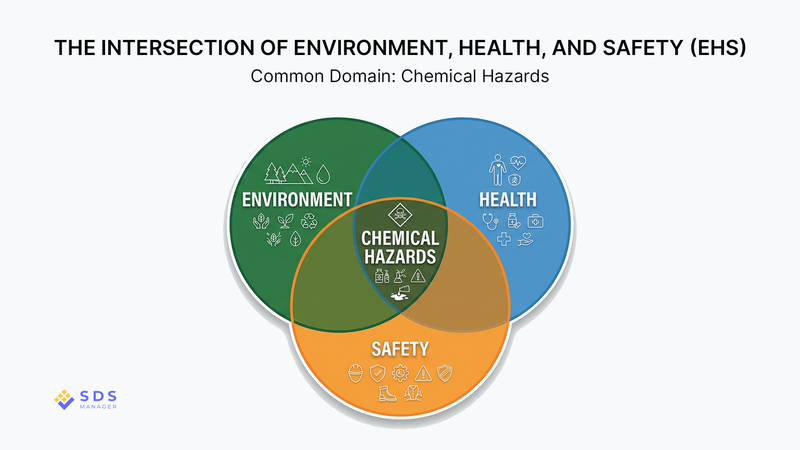
Chemical hazards show the overlap clearly, because one substance can create all three risks at once. With a drum of solvent, breathing the vapor harms health, ignition causes a fire and immediate injury, and a spill that reaches a drain damages the environment.
Managing that drum through three unconnected processes would duplicate work and leave gaps between teams. One assessment can identify all three forms of harm, so storage controls, worker protection, spill response, and disposal get chosen together. Skip the assessment and the harm still arrives, which is the practical case for taking EHS seriously.
Why Does EHS Matter?
EHS matters because workplace and environmental harm reaches people first and the organization second, through legal action, cost, and interrupted work.
These consequences also tend to arrive in a chain, one triggering the next.
Picture a worker getting hurt on a machine. First, production stops. Then the company has to report the injury to a regulator (a government body that enforces safety rules).
That report leads to an investigation. And if the same dangerous setup exists at the company's other locations, the fixes now have to be rolled out everywhere, not just where the accident happened. One injury in one building can end up reshaping how the whole company operates.
What Is the Human Cost of Weak EHS?
When EHS isn't done well, people get hurt. Sometimes it's a minor injury. Sometimes it's an illness, a disability that lasts a lifetime, or even death.
In 2024, private companies in the US reported 2.5 million cases of workplace injury and illness. Behind each number is a real person, and usually a family and coworkers who feel it too.
Illness is harder to track than injury, because it doesn't always show up right away. Someone can be exposed to something harmful at work and not get sick until years later. That's why companies have to keep health and exposure records for decades. If someone does get sick down the road, those old records are what let doctors trace the illness back to the job that caused it.
What Can an EHS Failure Cost an Organization?
When EHS fails, it costs an organization in two ways: fines from regulators, and the work that has to stop.
OSHA can fine an organization up to $16,550 for a serious safety violation. If the violation is willful or happens again after a warning, that fine can climb to $165,514, with a minimum of $11,823. And these fines apply per violation, so if an inspection turns up several problems at once, the total adds up fast.
But the fine is only part of the cost. A serious incident also brings work to a stop. The company has to treat anyone who got hurt, secure the area, figure out what went wrong, and fix it. Workers' compensation, legal fees, and repairs can keep costing money long after the work has started back up.
Avoiding all of that takes more than writing a safety policy. It takes an actual program that turns hazards and incidents into real decisions, real actions, and records that prove the work got done.
What an EHS Program Does Day to Day
An EHS program runs on a simple, repeating cycle: find a problem, figure out how risky it is, put something in place to control it, then check whether that control actually worked.
But this cycle only protects people when every step is connected to the next. If someone reports a hazard and nobody looks into it, that report doesn't help anyone. And if an investigation happens but nobody finishes the fix or checks that it worked, nothing really changes.
How Do Organizations Find Hazards and Assess Risk?
Organizations find hazards in a few different ways: by inspecting the workplace, listening to what workers report, reviewing how a task is actually done, looking at near-misses (times something almost went wrong), and checking in whenever new equipment or a new process is introduced.
Each of these catches a different kind of problem. That's why relying on just one of them leaves gaps, and an organization ends up missing hazards the others would have caught.
Where Hazards Come to Light
| Source | What It Tends to Catch |
|---|---|
| Planned inspections | Conditions that have drifted away from the standard |
| Worker reports | Problems only the person doing the job can see |
| Task and job reviews | Hazards built into the way the work is designed |
| Near-miss reports | Failures that came close but have not injured anyone yet |
| Change assessments | New risks from new equipment, chemicals or methods |
Once a hazard is found, risk assessment weighs two things: how likely it is to cause harm, and how bad that harm could be. That ranking is what decides what gets dealt with first. Teams using a risk assessment tool can keep the hazard, its controls, its owner, and its review date all connected, from the first assessment all the way through to the review.
How Are Controls Put Into Practice?
Putting a control into practice means changing the equipment, the way the work gets done, and how people behave, all at the same time. A control only protects people when it's actually installed right, understood, and used.
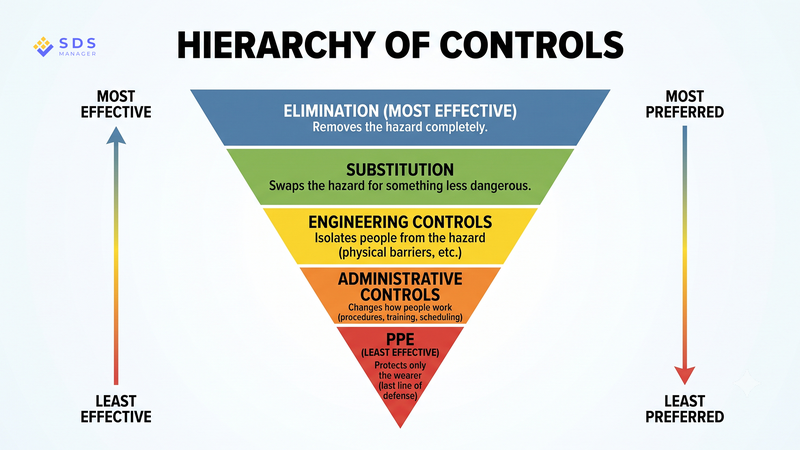
Controls also work best when they're used in a set order, known as the hierarchy of controls:
- Remove the hazard completely.
- Swap it for something less dangerous.
- Add engineering controls, like guarding, ventilation, or isolation.
- Change how people work, through procedures, training, and scheduling.
- Use personal protective equipment, which only protects the person wearing it, and only when it's worn correctly.
The first few options don't depend on anyone remembering to do something. That's exactly why they're tried first.
Hazard communication shows a few controls working together at once. OSHA's Hazard Communication Standard requires three things for hazardous chemicals: labeled containers, safety data sheets that workers can actually get to, and training. A safety data sheet is a 16-section document from the supplier that covers a chemical's hazards, how to handle it, what to do to control exposure, and what to do in an emergency. Having a reliable process for managing safety data sheets keeps it current and easy to find during every shift.
The label gives the first warning right away. The safety data sheet gives the full detail. Training teaches workers how to actually use both. Take away any one of the three, and the other two get weaker.
What Happens After an Incident Is Reported?
Once an incident is reported, the company records what happened, looks into why it happened, and assigns fixes to put in place. A good investigation doesn't stop at the mistake itself. It looks for the reason the mistake was possible in the first place, like a guard that was easy to bypass, or a procedure that never really matched how the job actually gets done.
Each fix needs three things to actually work: an owner, a due date, and a later check to make sure it holds up. Preventive action takes it one step further, and asks whether that same weakness shows up on similar equipment, in similar tasks, or at other sites. An incident management system can keep the report, the investigation, the fixes, and the check that they worked all connected, as the work passes from person to person.
How Do Audits and Records Support an EHS Program?
Audits and records are how an organization knows whether its EHS program is actually working, and whether problems that were found actually got fixed. An inspection checks one area against a checklist. An audit looks at a wider program. Both turn up findings, and those findings should go through the same fix-it process used after an incident.
Records are what hold the proof that follow-up depends on. Injury logs, training records, exposure results, inspection findings, and permit data all show what happened over time. Some of that stays inside the company, but some reports have to reach the right agency by a set deadline. Audit and inspection software can assign findings, track the fixes, and keep the proof needed to show they were actually completed.
This whole cycle only works when every decision has an owner with enough say to actually act on it. Those owners sit across operations, engineering, HR, and management, which is why keeping people safe isn't just the EHS team's job. It's everyone's.
Who Is Responsible for EHS Work?
The employer is always the one legally responsible for EHS. But the actual day-to-day work gets shared out. Senior leaders provide the authority and the resources. Specialists coordinate the program. Managers handle the day-to-day work. And workers report hazards and follow the controls that cover their own tasks.
That responsibility stays with the employer even when an EHS manager or an outside consultant is the one doing the work. Only the wording of the law changes depending on the country.
In the US, it comes from the general duty clause of the Occupational Safety and Health Act. In the UK, the Health and Safety at Work etc. Act 1974 places general duties on employers. Australia's WHS laws call it the "primary duty of care." And in the EU, a law called Framework Directive 89/391/EEC makes employers responsible for worker safety.
Hiring a safety specialist doesn't get the employer out of that duty. The employer still has to give that person the authority, the time, the equipment, and the budget needed to actually control hazards, and then check whether all of it is working.
How Is EHS Work Shared Across an Organization?
How an organization splits up EHS work depends on its hazards, its size, how many sites it has, and what the law requires. And what really drives that is the hazards, more than the headcount. A 40-person shop doing electroplating might need more EHS support than a 400-person software company, simply because it deals with chemical exposure, hazardous waste, machinery, and emissions from its processes.
At a small site, an owner or operations manager might handle the program alongside their other duties. Bigger companies often set up a central EHS team to set the common rules, with someone at each site handling inspections, training, incidents, and local reporting.
But coordinating a program is one job. Actually doing the work is another, and that work belongs to people across the whole business:
- Engineering: chooses the equipment and designs the process, which settles a lot of hazards before anyone even starts work.
- Operations: sets how the work gets done, how fast, and with how many people.
- Human resources: handles training, health information, and getting people back to work after time off.
- Supervisors: put controls into practice shift by shift, and they're the ones who notice when a method has quietly changed.
- Workers: see the near-misses, the workarounds, and the awkward steps that a scheduled inspection walks right past.
- EHS specialists: coordinate all the work, set the common rules, and keep the records.
An EHS specialist can coordinate all of that, but can't do the job instead of each of the people with their own roles. And an organization can't settle its own duties on its own either, because the rules that define those duties come from outside the company.
Who Regulates EHS and Which Rules Apply?
No single agency regulates all of EHS. Environmental agencies deal with releases, waste, and pollution. Occupational health and safety agencies deal with risks to workers. Knowing which is which matters, because it stops an organization from assuming that one regulator, or one company-wide process, covers everything it's supposed to do.
Which Authorities Regulate Environmental Risk?
Environmental risk gets regulated at the national, regional, state, or territory level, depending on the country and the type of permit or release:
- In the US, the Environmental Protection Agency sets the federal rules for air, water, waste, and chemical releases, and state agencies run many of the actual programs.
- England uses the Environment Agency, with separate agencies covering Scotland, Wales, and Northern Ireland.
- EU environmental law gets written centrally, then carried out by each country's own agencies.
- Australia keeps most environmental regulation at the state and territory level.
Which Authorities Regulate Workplace Health and Safety?
Workplace health and safety is regulated by labor or safety agencies that can inspect a workplace and enforce legal duties. Which one applies depends on where the work happens:
- United States: OSHA covers most private-sector workers. Twenty-two states and territories run their own OSHA-approved plans that cover private employers, and seven more only cover state and local government workers.
- Great Britain: the Health and Safety Executive.
- European Union: each member state has its own national labor inspectorate.
- Australia: state and territory regulators, working from model laws written by Safe Work Australia.
An inspection can start for a few different reasons: a planned enforcement program, a worker complaint, a reportable incident, a permit issue, or an earlier violation. Whatever kicks it off, the regulator's job is the same, comparing what the company wrote down against what actually happened.
Those same regulators are also why the field goes by different names in different places. The UK's Health and Safety Executive is exactly why a British safety team calls its work HSE.
What Is EHS Called Outside the United States?
Outside the US, this same field usually goes by a different name: HSE (health, safety and environment), OHS (occupational health and safety), or WHS (work health and safety). How much each one covers depends on the local law. HSE usually includes the environment side of things. OHS and WHS mostly focus on worker health and safety, unless environmental duties get added on separately. OHS is also the term used in Canada, and in the ISO standards.
Which term an organization uses usually comes down to local law, the name of the regulator, or just what an industry is used to calling it. The label changes, but the legal task underneath it doesn't. So it still comes down to figuring out the laws, the regulators, and the reporting deadlines that apply wherever the work happens.
EHS Terms and Regulations Across Four Markets
| Market | Common Term | Main Worker-Safety Regulator | Serious Incident Reporting | Chemical Framework |
|---|---|---|---|---|
| United States | EHS | OSHA and approved state plans | Fatality within 8 hours; hospitalization, amputation or eye loss within 24 hours | OSHA Hazard Communication Standard |
| European Union | Varies by country | National inspectorates, supported by EU-OSHA | Set by each member state | REACH and CLP |
| United Kingdom | HSE | Health and Safety Executive | Deadlines set by RIDDOR | COSHH and GB CLP |
| Australia | WHS | State and territory regulators | Notifiable incidents reported to the local regulator | WHS regulations and GHS-based chemical rules |
Each market works a little differently underneath that table:
- United States: worker-safety duties and environmental duties come from two separate sets of laws, so one single event might need an injury report filed with one agency and a release report filed with another.
- European Union: a law called Framework Directive 89/391/EEC requires every employer to assess risks and act on them, but each member state then writes its own procedures and runs its own enforcement.
- United Kingdom: the Health and Safety at Work etc. Act 1974 sets the general duties, and a separate system called RIDDOR sets the reporting deadlines, which differ depending on what happened. A death, a specified injury, or a dangerous occurrence has to be reported without delay, with the written report following within 10 days. An injury that keeps someone off work for more than seven days gets reported within 15 days of the accident.
- Australia: Safe Work Australia writes the model WHS laws, but each state or territory has to pass its own version of them before they take effect. Victoria kept its own separate law, the Occupational Health and Safety Act 2004, so employers there follow whatever law applies where the work actually happens.
How Do Local Rules Affect Multi-Site EHS Programs?
Local rules can change the deadline, the threshold, or even who's allowed to report an event, even when every site is technically following the same company-wide process. A US employer with a site in a state-plan state has to follow that state's own program, which has to be at least as strict as federal OSHA, and sometimes is stricter. Local fire codes, building rules, and wastewater limits then add another layer on top of that.
Trouble starts the moment a corporate checklist flattens all of those differences out. A reporting deadline runs out while people are still waiting on approval from someone else. Or a procedure gets built around a threshold that actually belongs to a different country's rules.
That's why a workable EHS compliance checklist names four things for every single site: the event, the agency it goes to, the deadline, and the person who's actually allowed to file the report. Keeping those four things steady across every location is where a management system starts to actually matter.
What Is the Difference Between an EHS Program and an EHS Management System?
An EHS program is just the actual work an organization does: inspections, training, incident investigations. An EHS management system is the structure that directs that work and makes it better over time. It names who's responsible for what, sets goals that can actually be measured, writes the processes down, and puts the results in front of senior managers.
A program can have plenty of useful activity happening and still leave leaders unable to answer simple questions: Is it clear who's responsible for what? Did the fixes actually get finished? Do all the sites follow the same standard? That's exactly the gap a management system is meant to close.
EHS Program and Management System Compared
| Area | EHS Program | EHS Management System |
|---|---|---|
| Main purpose | Carry out EHS activities | Direct, measure and improve those activities |
| Responsibility | May depend on informal assignments | Roles and authority are documented |
| Objectives | Tasks may be completed as they arise | Objectives have measures, owners and dates |
| Review | Findings are handled one at a time | Trends and system performance reach management review |
| Improvement | Changes may stay local | Lessons are applied across the system |
Standards bodies don't write or enforce actual law, but their voluntary standards can still supply this kind of structure:
- ISO 45001 covers occupational health and safety management systems.
- ISO 14001 covers environmental management systems.
- ISO 31000 gives broader guidance on managing risk.
An organization can use any of these without getting certified. Certification just means an outside body has checked the system and confirmed it actually matches the standard.
When Does an Organization Need More EHS Structure?
An organization needs more EHS structure as its hazards, its number of sites, its reporting duties, or the outside oversight it faces all start to grow. Informal coordination can work fine for one small, low-risk operation. But it stops being reliable once several locations all need the same definitions, the same reporting rules, and the same records.
The warning sign usually isn't a failed audit. It's that nobody can quickly answer a simple question: which fixes are overdue, and who's supposed to be handling them?
How Should an Organization Choose EHS Software?
An organization should choose EHS software by first figuring out which processes, responsibilities, and evidence the system actually needs to support, and only then testing options against that list. Buying features before figuring out the process is exactly how an organization ends up with a tool that nobody actually uses.
Platforms also differ a lot in how much they cover. Some only handle one area, like incidents or audits. Broader EHS software platforms connect risk, training, inspections, and reporting into one single process, which matters most when the same fix needs to stay visible to several teams at the same time.
How to Implement EHS Software
Whether implementation succeeds or fails usually comes down to scope, not the software itself. Starting with one process, getting it working at one site, and then adding the next gets an organization to real adoption faster than trying to set everything up at once.
Most of the actual work in implementing EHS software happens before the first person even logs in. Existing records need to be cleaned up before they move across, and every workflow needs a named owner who can approve changes to it. Those are the two steps organizations most often underestimate.
Whatever structure and tools an organization ends up choosing, the real test stays the same: does a reported problem actually reach a fix that gets checked and confirmed?
Where Should an Organization Start With EHS?
Start with the duties that have the shortest deadlines and the hazards that could cause the worst harm. For reporting, that means knowing which incidents or releases have to be reported, who they get reported to, how fast, and who's actually allowed to submit them. In the US, that also means setting up OSHA injury and illness recordkeeping correctly from day one, since those logs are exactly what an inspection asks to see later.
From there, look at the corrective actions that are already open. Give each one an owner and a due date, figure out which ones carry the most risk, and close those first. That's enough of a base to build on, and it's also where the real test of an EHS program starts to show up.
What Does Good EHS Look Like in Practice?
Good EHS connects a reported problem all the way to a fix that actually gets checked. Hazards are easy to report, assessments stay consistent, and every fix has an owner and a due date attached to it. The records then show whether that fix got finished, and whether it actually worked.
That connection is exactly where most EHS programs break down. A finding gets logged in a spreadsheet or an email thread with nobody's name attached to it, and a later inspection turns up that same problem all over again.
Connected records keep that handoff from failing. EHS Solutions by SDS Manager holds incidents, risks, findings, actions, and verification in one place, so nothing falls through the gap between two teams. Deciding who owns what, and chasing down overdue work, still comes down to the organization.
Frequently Asked Questions
Does EHS Apply to Office-Based and Remote Workplaces?
Yes, EHS applies to office-based and remote workplaces, although the hazards differ from those on an industrial site. Employers may still need to address workstation design, electrical safety, stress, emergency arrangements and work-related injuries that happen at home.
Do EHS Rules Apply to Contractors and Temporary Workers?
Yes, EHS rules apply to contractors and temporary workers, and usually more than one business holds a duty at the same time. The site operator controls the conditions and the hazard information, and the contractor or staffing agency employs the person, so the two have to coordinate rather than assume the other has it covered.
Does EHS Cover Mental Health and Workplace Stress?
Yes, EHS increasingly covers mental health and workplace stress, handled as psychosocial risk rather than a separate wellbeing program. ISO 45003:2021 gives guidance on managing psychosocial risk alongside ISO 45001, and a growing number of regulators now treat stress, bullying and excessive workload as hazards an employer must assess.
What Is a Near-Miss in EHS?
A near-miss is an event that could have caused injury, illness, or damage but did not. Near-misses matter because they expose the same weaknesses as an injury without anyone getting hurt, and because they happen far more often, which gives an organization more chances to fix a problem early.
Is EHS the Same as ESG?
No, EHS and ESG are separate areas. EHS manages direct workplace and environmental risks, and ESG reports environmental, social and governance performance to investors, regulators and other stakeholders. Some environmental data supports both.

Arysha Alif Khan

Arysha Alif Khan is an EHS and chemical safety specialist with a background in biochemistry, biotechnology, and public health. She works closely with the product and regulatory teams to turn complex chemical regulations, SDS requirements, and workplace safety standards into clear, practical guidance for people.