EPCRA Tier II reporting is the annual hazardous chemical inventory that a facility files under Section 312 of the Emergency Planning and Community Right-to-Know Act (EPCRA). A facility that stores a hazardous chemical above its reporting threshold during the year files this report with its state and local emergency responders by March 1.
Filing on time keeps local responders equipped with a current chemical list, while missing the deadline brings federal penalties. This article covers what the report is, the thresholds, who files, how filing works, and how state rules differ.
Key Takeaways
- EPCRA Tier II reporting is the annual Emergency and Hazardous Chemical Inventory Report required under Section 312 of EPCRA, the 1986 community right-to-know law.
- Reports are due March 1 each year and cover the prior calendar year; the deadline is fixed.
- The general reporting threshold is 10,000 pounds for any hazardous chemical that requires a safety data sheet.
- Extremely Hazardous Substances trigger reporting at 500 pounds or their Threshold Planning Quantity, whichever is lower.
- Reports go to three recipients: the State Emergency Response Commission, the Local Emergency Planning Committee, and the local fire department.
- Retail fuel sites report when underground storage exceeds 75,000 gallons of gasoline or 100,000 gallons of diesel.
- A Section 312 violation can bring a civil penalty of up to $71,545, with each day counted as a separate violation.
- From the 2027 reporting year (forms due March 1, 2028), Tier II hazard categories match OSHA's 2024 Hazard Communication Standard.
What Is EPCRA Tier II Reporting?
Tier II is the short name for the report that EPCRA Section 312 requires from facilities storing hazardous chemicals; its formal title is the Emergency and Hazardous Chemical Inventory Report. EPCRA carries a second name too, SARA Title III, from the Superfund Amendments and Reauthorization Act of 1986.
A Tier II report records each hazardous chemical stored above a threshold, along with its quantity, location, and hazards.
A covered facility files this report on the federal Tier II form. The duty attaches to chemicals that already require a safety data sheet under OSHA's Hazard Communication Standard, and it applies once the stored amount reaches the reporting threshold. For most hazardous chemicals that threshold is 10,000 pounds present at any one time during the year. The figure reflects the single largest amount on hand at any point, so a short inventory spike can pull a chemical into scope.
The Origins and Purpose of EPCRA Tier II Reporting
Tier II reporting exists to give emergency responders and the public a current account of the hazardous chemicals stored at nearby facilities. The requirement traces to the Emergency Planning and Community Right-to-Know Act of 1986. Congress passed that law after a 1984 chemical release in Bhopal, India, killed thousands.
The inventory gives local responders and residents a clear picture of the chemical risks at a site ahead of an emergency. Fire departments use it to prepare for the materials they may face on a call.
Who Needs To File a Tier II Report?
Any facility that stores a hazardous chemical at or above its reporting threshold during the year must file a Tier II report. The trigger depends on the chemical and the amount on site.
Tier II reporting thresholds
| Trigger category | Reporting threshold | Basis |
|---|---|---|
| Hazardous chemical that requires a safety data sheet | 10,000 pounds or more on site at any one time | OSHA Hazard Communication Standard; 40 CFR Part 370 |
| Extremely Hazardous Substance (EHS) | 500 pounds, or the chemical's Threshold Planning Quantity (TPQ), whichever is lower | EPA EHS list (Consolidated List of Lists) |
| Retail gasoline in underground storage tanks (USTs) | More than 75,000 gallons | 40 CFR Part 370 |
| Retail diesel in underground storage tanks (USTs) | More than 100,000 gallons | 40 CFR Part 370 |
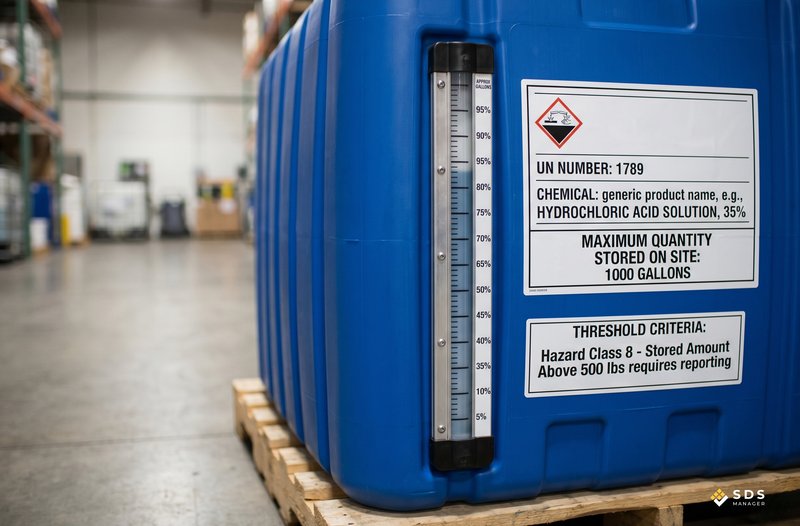
An Extremely Hazardous Substance can pull a facility into reporting well below the general limit, since its trigger sits far under 10,000 pounds. EPA lists several hundred of these substances, each with its own Threshold Planning Quantity. State agencies receive large volumes of these filings; Texas regulators alone report taking in roughly 80,000 Tier II reports each year.
These categories reach many sectors: manufacturers, warehouses, hospitals, laboratories, and farms. Any of the businesses required to keep safety data sheets should check each stored chemical against these thresholds.
What Information Must a Tier II Report Include?
The form has two parts: facility details and a chemical inventory. Facility details cover the identifiers responders need. These include the site name and address, the primary NAICS code (the federal industry classification number), owner information, emergency contacts, and a 24-hour phone number.
For each reportable chemical, the inventory records:
- Chemical name and CAS number (a unique chemical identifier), plus mixture components where relevant
- Physical and health hazard categories
- Maximum amount on site during the year
- Average daily amount on site
- Number of days the chemical was present
- Storage type, conditions, and location at the facility
Pulling these fields together is simpler when the chemical list stays up to date, and a hazardous chemical inventory worksheet captures the quantity, location, and hazard data the form asks for.
When Is the Tier II Deadline, and Where Do Reports Go?
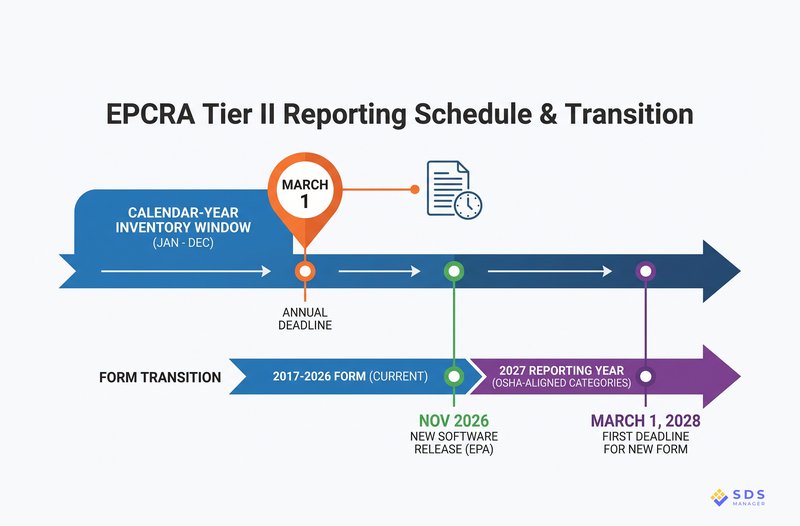
Reports are due March 1 each year, covering the prior calendar year, and they go to three recipients: the State Emergency Response Commission, the Local Emergency Planning Committee, and the local fire department. The deadline is fixed at March 1 and holds every year. Filing follows a clear sequence:
- Compile the prior-year inventory, recording the maximum amount of each chemical on site.
- Compare each chemical against the thresholds, and flag those that meet or exceed them.
- Build the report in the system the state accepts, such as EPA's Tier2 Submit reporting software, E-Plan, or a state portal.
- Submit to all three recipients by the deadline.
- Pay any state or local fees, then save the confirmation as proof of filing.
The filing tools are changing. Under EPA's 2026 hazard-category rule, the 2027 reporting year uses categories matched to OSHA's Hazard Communication Standard. Those forms are due March 1, 2028. EPA plans 2027 versions of its Tier2 Submit and CAMEO Data Manager software for November 2026.
How Do State Tier II Rules Differ From the Federal Baseline?
States run their own Tier II programs on top of the federal rules. Many set lower thresholds, add chemicals, or require their own forms and portals. Tier II reporting requirements therefore vary widely from one state to the next.
Fees differ too. Some states bill per chemical, others per employee, and others a flat fee per facility. Several require site plans showing where chemicals sit relative to exits and water sources. Late submissions can draw a state late fee on top of federal exposure.
A 2018 amendment, the America's Water Infrastructure Act, also gave community water systems access to this inventory data. Because the details shift by location, facilities confirm each state's Tier II reporting procedures before they file.
What Are the Penalties for Missing Tier II Reporting?
The civil penalty. Under 42 U.S.C. 11045(c)(1), a Section 312 violation carries a civil penalty of up to $71,545 per violation, and each additional day counts as a separate violation. That amount is the inflation-adjusted maximum for penalties assessed on or after January 8, 2025, raised from a $25,000 statutory base. EPA revises it for inflation, so the current figure sits in the penalty table at 40 CFR 19.4.
How the totals grow. Because the count runs per chemical as well as per day, a handful of missed chemicals across a reporting period can reach six figures quickly.
Costs beyond fines. A missing report leaves responders without accurate data during an incident. It also exposes the facility to legal and reputational harm.
Conclusion
Accurate Tier II reporting depends on an inventory that stays current all year. Facilities that record new chemicals and quantities as they arrive have the data ready when the filing window opens.
The routine is simple: keep the chemical list up to date, match a safety data sheet to each chemical, and track the largest amount of each one on site. Chemical tracking that supports Tier II inventory reporting keeps those quantities and hazards current across sites, so the report becomes a quick export of data the facility already holds.
Frequently Asked Questions
Is Tier II reporting a federal or state requirement?
It's a federal requirement under EPCRA Section 312, but states administer it. Each state can set its own forms, portals, thresholds, and fees.
What is the difference between a Tier I and a Tier II form?
The Tier I form gives aggregate data by hazard type, while the Tier II form lists each chemical. Most states require the Tier II form.
Do small businesses have to file a Tier II report?
Yes, if they store a hazardous chemical at or above its threshold. The requirement applies regardless of facility size.
What happens if a facility files after March 1?
The deadline is fixed, so a late filing can draw federal penalties and any state late fee. Filing promptly limits the exposure.
Does filing a Tier II report also satisfy Section 311?
In most states, the Section 312 filing covers the related Section 311 chemical list for those chemicals. Local rules should be confirmed.

Arysha Alif Khan

Arysha Alif Khan is an EHS and chemical safety specialist with a background in biochemistry, biotechnology, and public health. She works closely with the product and regulatory teams to turn complex chemical regulations, SDS requirements, and workplace safety standards into clear, practical guidance for people.