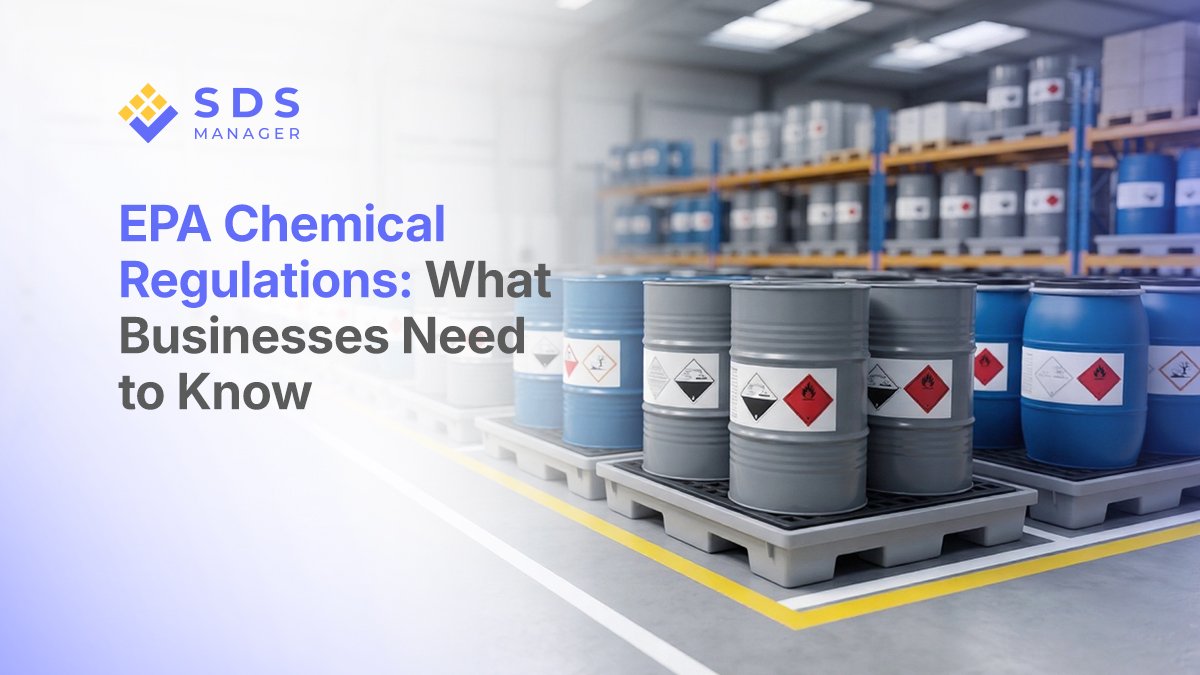
EPA chemical regulations are seven federal laws that control chemicals at different stages of their life: TSCA, RCRA, EPCRA, the Clean Air Act, FIFRA, CERCLA, and the Clean Water Act. A single business often falls under three or more at once, since one law covers manufacturing, another waste, and another emergency reporting. Each statute that applies carries its own reporting duties and deadlines, and missing even one can bring civil penalties.
For most industrial businesses, EPA chemical regulations come down to three core duties: tracking the chemical inventory, reporting it, and disposing of waste correctly. This guide maps the seven laws, shows which businesses each one captures, and covers what TSCA, RCRA, and EPCRA require.
Key Takeaways
- EPA regulates chemicals through seven federal laws: TSCA, RCRA, EPCRA, the Clean Air Act, FIFRA, CERCLA, and the Clean Water Act.
- Under TSCA Section 5, a company files a premanufacture notice with EPA before making or importing a new chemical.
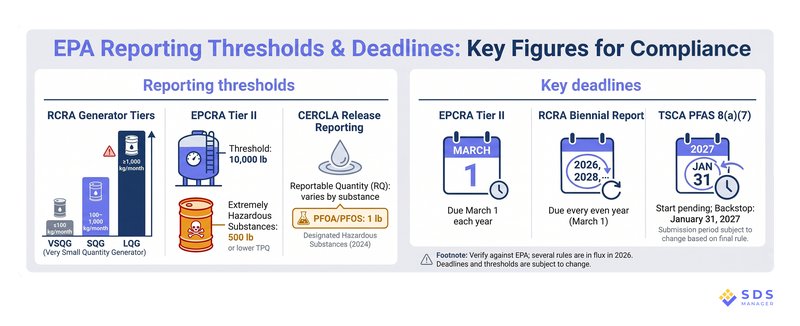
- RCRA classifies hazardous waste generators by monthly weight: VSQG up to 100 kg, SQG 100 to 1,000 kg, and LQG 1,000 kg or more.
- EPCRA Tier II reports are due March 1 each year, triggered at 10,000 pounds stored, or 500 pounds for extremely hazardous substances.
- TSCA's PFAS reporting under Section 8(a)(7) starts no later than January 31, 2027, after EPA postponed the window in April 2026.
EPA Chemical Regulations Span Seven Federal Laws
EPA administers seven statutes that reach chemicals at different points. Each targets a separate activity, from market entry to disposal to emergency planning.
- TSCA (Toxic Substances Control Act): controls the manufacture, import, and use of industrial chemicals.
- RCRA (Resource Conservation and Recovery Act): governs hazardous waste from the point it's generated to final disposal.
- EPCRA (Emergency Planning and Community Right-to-Know Act): requires reporting of stored hazardous chemicals to local responders.
- CAA (Clean Air Act): limits hazardous air emissions and, through the Risk Management Program, regulates accidental release risk.
- FIFRA (Federal Insecticide, Fungicide, and Rodenticide Act): registers and controls pesticides.
- CERCLA (Superfund): sets cleanup liability and release reporting for hazardous substances.
- CWA (Clean Water Act): controls chemical discharges into surface water.
The statutes overlap in practice. One chemical can pass through TSCA at import, EPCRA in storage, and RCRA at disposal, all in a single facility.
Which EPA Laws Apply to a Business?
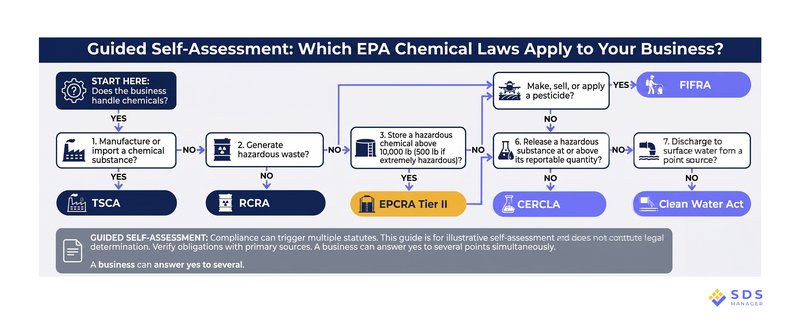
The fastest way to see what applies is to match each activity to the law that governs it. The table maps the seven statutes to the businesses they cover and what triggers each one.
Table: EPA chemical laws by activity and trigger
| Law | What it covers | Who it applies to | Key trigger |
|---|---|---|---|
| TSCA | Industrial chemical manufacture and import | Manufacturers, importers, processors | Making or importing a chemical substance |
| RCRA | Hazardous waste handling and disposal | Any business that generates hazardous waste | Generating listed or characteristic waste |
| EPCRA | Hazardous chemical storage reporting | Facilities storing chemicals above thresholds | 10,000 lb (500 lb for extremely hazardous substances) |
| CAA / RMP | Air emissions and accidental release | Facilities with regulated substances over limits | Holding a listed substance above its threshold |
| FIFRA | Pesticide registration and use | Pesticide makers, distributors, applicators | Producing, selling, or applying a pesticide |
| CERCLA | Release reporting and cleanup liability | Facilities that release hazardous substances | A release at or above a reportable quantity |
| CWA | Chemical discharge to water | Facilities discharging to surface water | Discharging a pollutant from a point source |
Most industrial businesses fall under the first three. A plant that stores solvents, generates spent-solvent waste, and imports a raw chemical triggers EPCRA, RCRA, and TSCA at once.
What Does TSCA Require of Manufacturers and Importers?
TSCA gives EPA authority over industrial chemicals across their commercial life. It sits behind the EPA's TSCA Inventory, the official list of chemicals cleared for U.S. commerce, which records more than 83,000 substances.
Before making or importing a new chemical, a company files a premanufacture notice (a pre-market submission to EPA) under Section 5. EPA reviews it before commercial production can start.
Section 8 then adds ongoing reporting and recordkeeping for manufacturers, importers, and processors. Under Section 8(e), a company that finds its chemical may pose a substantial risk must tell EPA promptly.
Importers carry their own duty. Under Section 13, an importer certifies that each shipment either complies with TSCA or falls outside it. TSCA treats an importer as a manufacturer, so testing and notice rules can apply.
PFAS reporting is the fast-moving piece. PFAS, short for per- and polyfluoroalkyl substances, are persistent “forever chemicals” used across many industries. Section 8(a)(7) requires PFAS manufacturers and importers to report uses dating back to 2011. EPA postponed the reporting window in its April 2026 final rule. The submission period now starts on a backstop date of January 31, 2027 (the latest it can start), though it could open earlier, 60 days after a forthcoming revised rule.
The risk-evaluation framework is shifting too. In September 2025, EPA proposed a return to use-by-use risk determinations, reversing the 2024 “whole chemical” approach. A final rule is expected in 2026, and the 2024 rule applies until then.
How Does RCRA Classify Hazardous Waste Generators?
RCRA follows hazardous waste from the point it's generated to final disposal. A business's duties depend on how much hazardous waste it produces each month. EPA sets three generator categories.
- Very Small Quantity Generator (VSQG): up to 100 kilograms a month, or up to 1 kilogram of acutely hazardous waste (the most dangerous wastes EPA lists). Lightest federal duties.
- Small Quantity Generator (SQG): more than 100 but less than 1,000 kilograms a month. Needs an EPA ID number and hazardous waste manifests (shipping records that track waste to disposal).
- Large Quantity Generator (LQG): 1,000 kilograms or more a month, or over 1 kilogram of acutely hazardous waste. Full storage, training, and reporting duties.
EPA's generator categories depend on monthly weight, not industry, so a facility's status can change from one month to the next. Crossing 1,000 kilograms in a single month makes it a Large Quantity Generator with the fullest storage, training, and manifest duties, even if it usually generates far less. A single large cleanout is enough to trigger that jump for the month it occurs.
The first question is always whether a waste stream is regulated at all. That turns on whether it meets the definition of a listed or characteristic hazardous waste, meaning a waste EPA names specifically or one that is ignitable, corrosive, reactive, or toxic. That single determination decides every requirement that follows.
What Is EPCRA Tier II Reporting, and Where Do SDSs Fit?
EPCRA is where chemical storage meets community safety. Section 312 requires facilities to report hazardous chemicals held above set thresholds to state and local responders. That annual filing is the Tier II report.
The trigger ties directly to safety data sheets. EPCRA uses OSHA's definition: a hazardous chemical is one that needs an SDS under the Hazard Communication Standard. So the chemicals that require an SDS are the ones counted toward Tier II thresholds.
Under Section 312, a facility files its Tier II inventory report by March 1 each year. It covers any hazardous chemical stored above the threshold during the previous calendar year. For most SDS-listed chemicals, that threshold is 10,000 pounds, according to the EPA's federal Tier II form instructions. Extremely hazardous substances carry a far lower trigger: 500 pounds or the threshold planning quantity (a substance-specific limit EPA publishes), whichever is less.
The report goes to the State Emergency Response Commission, the Local Emergency Planning Committee, and the local fire department. The threshold applies to the maximum amount on site at any point in the year. A chemical held briefly in bulk can be reportable even after it's gone.
Section 311 adds a related duty. A facility must give those same authorities either the safety data sheets for its hazardous chemicals or a list of those chemicals. Because Tier II covers the same chemicals that require an SDS, knowing which businesses must keep safety data sheets is the practical starting point for EPCRA reporting.
The Clean Air Act and Risk Management Program for Chemical Facilities
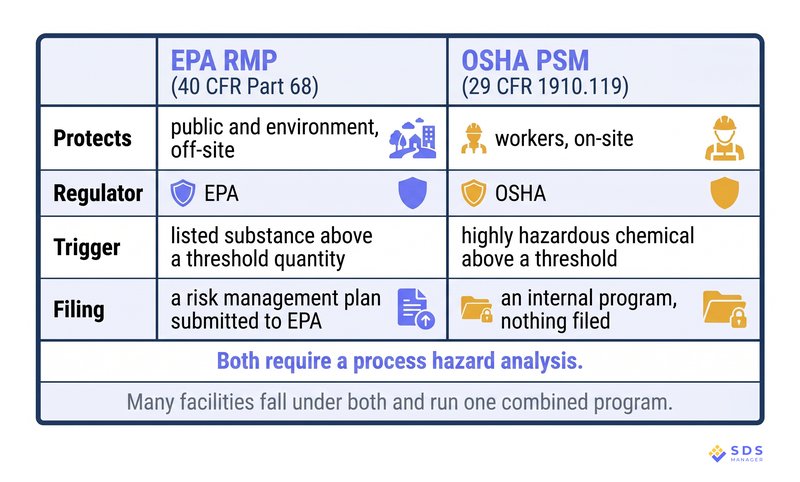
The Clean Air Act limits hazardous air pollutants, but the part most relevant to chemical handlers is the Risk Management Program. RMP, set out in 40 CFR Part 68, applies to facilities that hold listed hazardous substances above threshold quantities. It targets the risk of a catastrophic accidental release.
Two points cause regular confusion:
- RMP versus OSHA PSM: RMP is an EPA rule that protects the public and environment off-site. Process Safety Management is an OSHA rule that protects workers on-site. Both require a process hazard analysis of covered processes, and many facilities fall under both and run one combined program.
- Rule status: The 2024 RMP amendments are in effect, with most compliance dates in 2027 and 2028. EPA proposed rolling back much of that update in February 2026, with a final rule expected late 2026. Until then, the 2024 requirements stand.
What Do FIFRA, Superfund, and the Clean Water Act Require?
Three more EPA statutes apply to narrower sets of businesses. FIFRA governs pesticides, so any company that makes, distributes, or applies one must use EPA-registered products and follow label rules.
CERCLA, known as Superfund, sets cleanup liability and requires reporting a hazardous-substance release at or above its reportable quantity (the amount that triggers a report). The Clean Water Act controls chemical discharges to surface water through permits for point sources (discrete outlets such as a pipe or outfall).
PFAS run across several of these rules. EPA designated PFOA and PFOS as CERCLA hazardous substances in 2024, with a one-pound reportable quantity for releases. In September 2025, EPA said it would keep that designation in place. A separate 2024 proposal to list nine PFAS as RCRA hazardous constituents remains pending.
How Can a Business Stay Compliant With EPA Chemical Regulations?
Staying on top of epa chemical compliance is an ongoing, repeatable routine. Five steps cover most obligations.
- Build a complete chemical inventory. List every chemical on site with quantities and locations. This single record feeds TSCA, RCRA, and EPCRA decisions at once.
- Map each chemical to the laws that apply. Use the activity-and-trigger table above to flag the statutes each substance falls under.
- Calendar the fixed deadlines. EPCRA Tier II is due March 1. RCRA biennial reports (filed every two years) and TSCA windows run on their own dates.
- Keep records that match each rule. Most EPA statutes require retained documentation, and inspections turn on what a facility can produce.
- Track rule changes. Several 2024 chemical rules face rollback proposals through 2026, so a quarterly check against EPA sources pays off.
A current inventory tied to live SDS data does most of this work. Teams that centralize their chemical inventory and SDS management can pull Tier II data and disposal records from one system.
Conclusion
EPA chemical regulations look sprawling because the authority is split across seven laws. The practical entry point is narrow. Most businesses are captured by TSCA, RCRA, and EPCRA, and all three read from the same chemical inventory.
Get that inventory accurate and current, then map it to the statutes that apply. The rules keep shifting, especially the 2024 updates now under review. The safest position is a live record and a habit of checking EPA before each fili
Frequently Asked Questions
What are the main EPA chemical regulations?
The core statutes are TSCA, RCRA, EPCRA, the Clean Air Act's Risk Management Program, FIFRA, CERCLA, and the Clean Water Act. Each governs a different stage of chemical use.
Which EPA regulations apply to a small business?
It depends on activity and volume. A small firm that stores chemicals may face EPCRA. One that generates little waste may be a Very Small Quantity Generator under RCRA, with minimal duties.
When is the EPCRA Tier II report due?
Tier II reports are due March 1 each year. They cover hazardous chemicals stored above thresholds during the prior calendar year.
Does TSCA apply to importers?
Yes. TSCA treats importers as manufacturers. Under Section 13, an importer must certify that each shipment complies with TSCA or is exempt.
What is the difference between EPA RMP and OSHA PSM?
RMP is an EPA rule protecting the public and environment from off-site releases. PSM is an OSHA rule protecting workers on-site. Facilities often run both together.

Arysha Alif Khan

Arysha Alif Khan is an EHS and chemical safety specialist with a background in biochemistry, biotechnology, and public health. She works closely with the product and regulatory teams to turn complex chemical regulations, SDS requirements, and workplace safety standards into clear, practical guidance for people.