OSHA CONSTRUCTION SITE SAFETY CHECKLIST 0101 A construction site safety checklist is a structured document used to identify hazards and help a jobsite meet federal safety standards. It acts as a guide for supervisors to walk through a project area and verify that equipment, environments, and work practices are safe. It helps prevent injuries and fatalities by catching risks like falls, electrical faults, or chemical exposure before they lead to accidents. It also serves as documentation that your company is taking active steps to protect its workers. The following checklist complies with the rules and regulations of the Occupational Safety and Health Act (OSHA). 01 OSHA CONSTRUCTION SITE SAFETY CHECKLIST An OSHA Construction Site Safety Checklist helps with: Preventing Injuries: Helps spot the "Fatal Four" hazards (falls, struck-by, caught-in/between, and electrocution). Legal Compliance: Ensures a site aligns with OSHA 1926 standards to avoid heavy fines and legal issues. Efficiency: Reduces downtime caused by accidents or equipment failure. Culture of Safety: Shows employees that their health and safety are a top priority for the company. Organized Records: Provides a clear paper trail for safety audits and insurance requirements. This checklist is ideal for: General Contractors: To oversee the safety of the entire project and multiple subcontractors. Site Supervisors: For daily or weekly walk-throughs to maintain site order. Safety Officers: To conduct formal internal audits and training sessions. Small Business Owners: In the construction trade who need a simple way to manage OSHA requirements without a full safety department. Administrative Prerequisites: OSHA 300 records every work-related injury or illness. OSHA 300A shows total incident counts for public display. This document must be finalized before February 1st, for each fiscal year and posted within April 30th. OSHA 301 records the details and people involved in each accident. In addition to this checklist, OSHA recommends recording all occupational injuries and illnesses via forms 300, 300A, and 301 as a prerequisite for administrative purposes. Note: The templates/guides in our Content Library were created by the SDS Manager Team to help you manage site operations effectively. They are provided as reference tools and should be tailored to match your specific project needs, ompany policies, and industry standards. SDS Manager does not guarantee that these templates meet legal, regulatory, or contractual requirements. Users are responsible for reviewing and adapting each template to ensure compliance with their operational and legal obligations. 01 02 OSHA CONSTRUCTION SITE SAFETY CHECKLIST Site Location: Inspectorʼs Name: Inspection Date: 1. ADMINISTRATIVE REQUIREMENTS Verifying that all records, reports, and postings are up to date. Status Compliance Check Notes / Corrective Action Is the OSHA "Safety and Health Protection on the Job" poster displayed where everyone can see it? Yes No Are all work-related deaths, injuries, and illnesses recorded on the OSHA Form 300? Yes No Is the annual summary (OSHA Form 300A) posted from February 1 through April 30? Yes No Is OSHA notified within 8 hours of any fatality or accident that hospitalizes 3 or more workers? Yes No Is a supplementary record (OSHA Form 301) filled out within 7 days of any injury? Yes No 2. GENERAL SAFETY, HEALTH & ENVIRONMENTAL CONTROLS Managing sanitation, first aid, and environmental hazards. Status Compliance Check Notes / Corrective Action Is a medical facility nearby (within 3 minutes), or is there someone trained in First Aid on site? Yes No Are emergency numbers for doctors, hospitals, and ambulances clearly posted? Yes No Is there clean drinking water and a toilet available at the job site? Yes No Is there enough lighting in all work areas and walkways? Yes No Is there a written Hazard Communication Program for chemicals used on site? Yes No Is a Safety Data Sheet (SDS) available for every chemical, and are workers trained to read them? Yes No If lead is present, has air sampling been done to check exposure levels? Yes No 03
100%
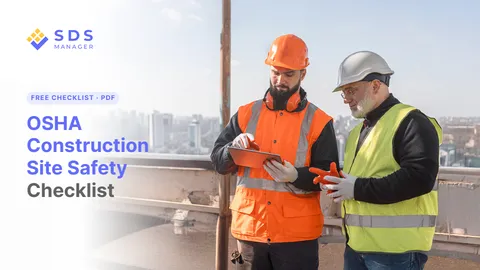
OSHA Construction Site Safety Checklist — cover

That’s the end of the preview

Download the PDF to read the full report.

Checklist · Free PDF

OSHA Construction Site Safety Checklist

16 pages · PDF

Free OSHA construction site safety checklist (PDF) based on 29 CFR 1926. Check recordkeeping, first aid, hazard communication, fall protection and the Fatal Four hazards on your jobsite.

What's inside

  • Administrative requirements: the OSHA poster, Forms 300, 300A and 301, and incident reporting
  • General safety, health and environmental controls: first aid, drinking water, toilets and lighting
  • Hazard communication: a written program and safety data sheets for every chemical
  • Checks for the Fatal Four: falls, struck-by, caught-in/between and electrocution
  • Items aligned with OSHA's construction standards, 29 CFR 1926
  • A categorized layout for jobsite walk-throughs

Who it's for

  • General contractors
  • Site supervisors and foremen
  • Safety officers
  • Small business owners in the construction trades

Why construction needs its own checklist

Construction work is covered by OSHA's construction standards, 29 CFR 1926, not the general industry standards most workplaces follow. The site changes every day, crews from several employers work side by side, and the most serious hazards change as the job moves from excavation to framing to finishing.

OSHA's "Fatal Four" (falls, struck-by, caught-in/between and electrocution) account for more than half of construction worker deaths, according to OSHA. A checklist keeps those hazards in front of the people running the site every day.

What to check on an OSHA construction site

Recordkeeping and reporting

  • OSHA "It's the Law" poster displayed
  • Form 300 log kept up to date, and the Form 300A summary posted from February 1 to April 30
  • A fatality reported to OSHA within 8 hours; an in-patient hospitalization, amputation or eye loss within 24 hours

First aid and site welfare

  • A trained first aider on site if medical care isn't nearby, plus a stocked first aid kit (1926.50)
  • Drinking water, toilets and adequate lighting

Hazard communication

  • A written hazard communication program for the site
  • A safety data sheet for every chemical, including those brought by subcontractors
  • Labeled containers, including small containers filled on site

Falls

  • Fall protection at 6 feet or more above a lower level (1926.501(b)(1))
  • Guardrails on scaffolds more than 10 feet high (1926.451(g))
  • Ladders extending at least 3 feet above the landing (1926.1053(b)(1))
  • Floor holes and openings covered and marked

Struck-by and caught-in/between

  • High-visibility clothing near vehicle traffic
  • Backup alarms or spotters for equipment
  • Protective systems in excavations 5 feet deep or more (1926.652), inspected daily by a competent person

Electrocution

  • GFCIs or an assured equipment grounding program for temporary power (1926.404(b)(1))
  • Safe distances from overhead power lines
  • Damaged cords removed from service

The role of the competent person

Many 1926 standards require a "competent person": someone who can identify hazards and has the authority to correct them. Scaffolds, excavations and fall protection all depend on this role. Make sure your checklist names who that person is for each area.

Subcontractors and multi-employer sites

On a shared site, more than one employer can be cited for the same hazard. Under OSHA's multi-employer citation policy, that can include the employer who created the hazard, the employer whose workers were exposed, the employer responsible for fixing it, and the controlling employer, often the general contractor. Check subcontractors' areas as well as your own.

Using the checklist on site

Run a short daily walk-through focused on the Fatal Four, and a full checklist inspection weekly. Inspect again after storms and at each new phase of work. Record findings with photos and give each one an owner and a deadline.

OSHA construction site safety plan

The checklist works best alongside a written site safety plan that sets out responsibilities, emergency procedures and how subcontractors will coordinate. The checklist then shows whether the plan is being followed.

Download the free OSHA construction site safety checklist for your next jobsite inspection. To train crews, use it with the Construction Safety Training Guide.