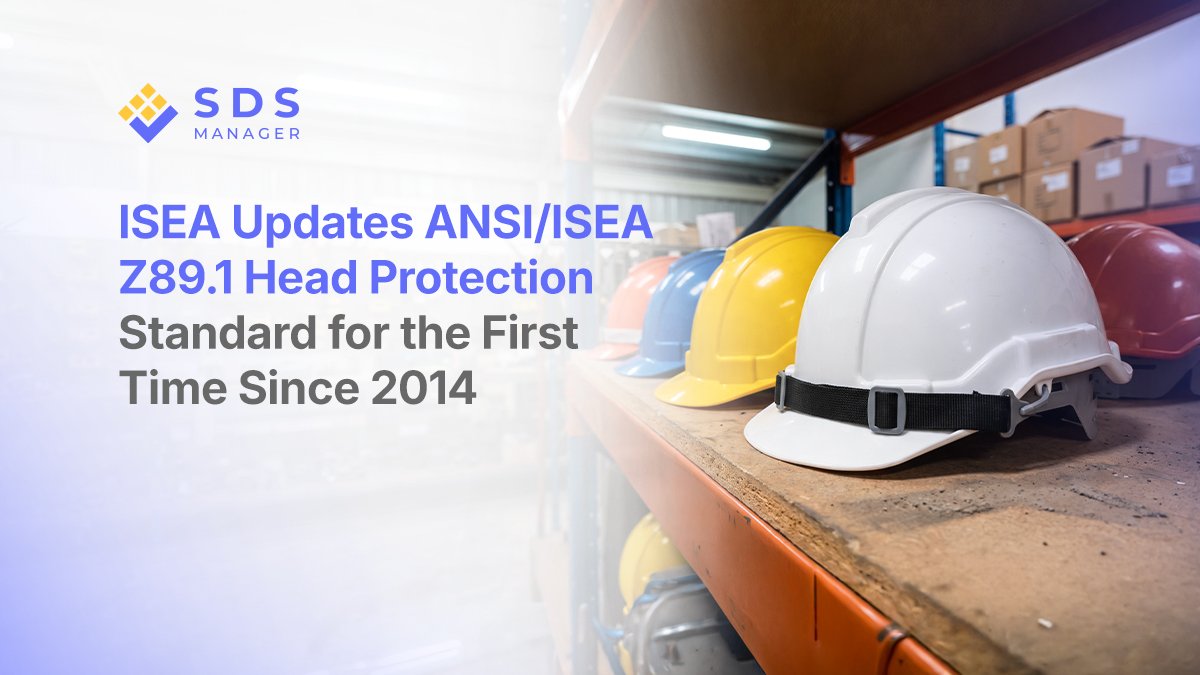
The International Safety Equipment Association (ISEA) released the ANSI/ISEA Z89.1-2026 industrial head protection standard on September 11, 2026, following approval from the American National Standards Institute (ANSI).
It marks the first substantive update to the consensus hard hat standard since 2014. Rather than replacing the existing Type and Class system, the revision builds an optional tier on top of it.
What Prompted the 2026 Revision
ANSI/ISEA Z89.1 sets the performance and testing rules manufacturers rely on to sell hard hats as compliant. It is also the benchmark OSHA cites when mandating head protection under 29 CFR 1910.135 and 29 CFR 1926.100.
Traditional hard hats often fail during common jobsite accidents. Without a fastened chin strap, a standard shell easily falls off when a worker slips, trips, or falls. Conventional Type I hard hats are also designed only to absorb top impacts to the crown, leaving workers unprotected against lateral blows.
While the 2014 edition tested chin straps and lateral impact for Type II helmets, it provided no consensus test for chin straps on Type I helmets and did not test helmet retention during slips or falls.
The update formalizes these protective features as more contractors require enhanced protection on the job. In announcing the revision, ISEA President and CEO Cam Mackey noted that head injuries accounted for nearly 700 worker fatalities in the last year.
What Changed: Type I+ and Type II+ Designations
The revision keeps the existing Type I (top-impact) and Type II (top-and-side impact) categories and Class E, G, and C electrical ratings intact. Alongside them, it introduces an optional "+" designation for helmets tested beyond baseline requirements:
- Type I+: Adds a chin strap, enhanced retention testing, and multi-directional impact protection covering the front, rear, and sides of the helmet, rather than the top alone.
- Type II+: Adds a chin strap and enhanced retention testing to Type II's existing top-and-side impact protection.
New optional tests tied to the "+" rating cover chin strap retention during impacts and falls, shell retention during slips and trips, and reverse-wearing stability.
The standard also renames "High Visibility (HV)" to "Enhanced Visibility (EV)." The committee made this change because head protection falls outside the scope of ANSI/ISEA 107, the high-visibility apparel standard from which the old label originated. The HT (high-temperature) and LT (low-temperature) markings remain unchanged.
Why ISEA Built an Optional Tier Instead of a Mandatory Rule
Instead of raising baseline requirements across every industrial hard hat, ISEA structured the update as a voluntary tier that manufacturers and employers can adopt as needed.
ISEA President and CEO Cam Mackey called the update "the roadmap for an industry transformation."
Tim Gallant, who chairs the association's Head Protection Product Group, noted that the "+" system provides a common language. It helps manufacturers, safety teams, and workers clearly understand what specific protection a given helmet provides.
What This Means for OSHA Compliance and Job Site Safety
Adopting the new "+" designations is entirely voluntary. ANSI and ISEA have not set a compliance deadline, and federal OSHA standards have not caught up to the revision.
Current general industry regulations (29 CFR 1910.135) and construction rules (29 CFR 1926.100(b)(1)) incorporate only the 1997, 2003, and 2009 editions of Z89.1. OSHA last updated that consensus list in a June 22, 2012, Federal Register rulemaking. The agency has not formally incorporated the 2014 edition into the text, let alone the 2026 revision.
While 29 CFR 1910.135(b)(2) and 29 CFR 1926.100(b)(3) require employers to demonstrate that newer gear is "at least as effective," in practice employers rely on OSHA's de minimis enforcement policy (29 CFR 1903.14).
Under that policy, inspectors do not issue citations for using newer consensus editions that meet or exceed outdated standards. That is why the 2014 edition is widely used on job sites today, and the 2026 "+" ratings will operate under the same logic.
Safety teams do not need to wait for OSHA rulemaking to use the 2026 standard in purchasing decisions. Evaluating specific jobsite risks, such as lateral impacts, work at height, or slip-and-trip hazards, allows employers to match Type I+ or Type II+ head protection directly to specific roles.
Documenting PPE hazard assessments and maintaining clear gear issuance logs gives safety managers a defensible record if an inspector asks how protective equipment was selected.
References:
- ISEA, "ISEA Releases Updated Head Protection Standard to Support Modern Jobsite Safety Programs" (PR Newswire)
- ANSI Webstore, ANSI/ISEA Z89.1-2014 (R2019)
- BLS, Census of Fatal Occupational Injuries Summary, 2024

Arysha Alif Khan

Arysha Alif Khan is an EHS and chemical safety specialist with a background in biochemistry, biotechnology, and public health. She works closely with the product and regulatory teams to turn complex chemical regulations, SDS requirements, and workplace safety standards into clear, practical guidance for people.