REACH is the EU's main law for controlling chemicals. It applies to almost every business that makes, imports, or sells products containing these chemicals. Any company placing chemical substances on the EU market must follow the rules to sell legally. Non-compliance can mean shipments held at the border and fines set by each member state.
So what is REACH compliance in practical terms? It means meeting the duties in Regulation (EC) No 1907/2006. In short, three things: register substances with ECHA, manage their risks, and share safety information downstream.
This guide explains what REACH covers, who is responsible for the duties, and the exact steps to achieve and maintain compliance. It also translates the jargon, so the rules make sense even to a first-time reader.
Key Takeaways
- REACH compliance means meeting EU Regulation (EC) No 1907/2006, which requires registering chemicals, managing their risks, and sharing safety data.
- REACH stands for Registration, Evaluation, Authorisation and Restriction: the four duties governing how chemicals are sold and used.
- REACH duties fall on manufacturers, importers, downstream users, distributors, and only representatives, based on what each does with a substance.
- Companies must register a substance with ECHA once they make or import it at one tonne a year or more.
- Once a substance joins ECHA's SVHC Candidate List, articles (finished products) containing it above 0.1% trigger notification duties.
- A planned REACH overhaul was shelved in 2026, so EU rules stay mandatory; Great Britain runs separate UK REACH rules.
What is REACH compliance?
REACH compliance means meeting the duties of the EU's main chemicals law, Regulation (EC) No 1907/2006. Companies that manufacture, import, or use chemicals must register them with ECHA, control the associated risks, and share safety information down the supply chain.
The name stands for the Registration, Evaluation, Authorisation and Restriction of Chemicals. In force since 2007, it shifts the burden of proof onto industry. The duty is on the user to prove safe use, not on regulators to prove harm.
EU REACH compliance rests on a simple principle: no data, no market. A substance with no registration cannot be placed on the EU market at all. That single rule shapes most of the work that follows.
The law protects human health and the environment by catching chemical hazards early. It then controls them through registration duties, restrictions, and bans on the worst substances. REACH also covers substances on their own, in mixtures, and in many finished articles, not only drums of raw chemicals.
What do the key REACH terms mean?
REACH carries a lot of shorthand, and official guidance rarely stops to explain it. The terms below appear throughout the rest of this guide, so a quick decode helps before the details start.
Table 1: Key REACH terms, decoded
| Term | What it actually means |
|---|---|
| Substance | A single chemical, like acetone or lead |
| Mixture | Two or more substances blended together, like paint or glue |
| Article | A finished object whose shape drives its function, like a phone or a chair |
| Dossier | The technical file sent to ECHA that proves a substance's safe use |
| Tonnage band | The yearly weight bracket that decides how much data is required |
| Downstream user | A company that uses a chemical rather than making or importing it |
| Only representative | An EU-based stand-in that handles a non-EU maker's duties |
| SVHC | Substance of very high concern, the EU's most hazardous category |
| Candidate List | The running watch list of SVHCs, updated about twice a year |
| Annex XIV vs XVII | Authorisation List (needs permission) versus Restriction List (limits or bans) |
| SCIP | ECHA's database of substances of concern in articles |
| Exposure scenario | Instructions describing the conditions for using a substance safely |
These distinctions matter in practice. Confusing an article with a mixture, for instance, leads a company to the wrong set of duties.
Who needs to comply with REACH?
REACH duties depend on what a company does with a substance, not on its job title. Most firms fall into one of these roles, and many hold more than one at once.
- Manufacturers make substances in the EU and carry the heaviest duties, starting with registration.
- Importers bring substances or products into the EU and often inherit the duties a non-EU maker would otherwise hold.
- Downstream users, like formulators and end users, work chemicals into their own products under set safe-use conditions.
- Distributors store and supply chemicals without changing them, so their main job is to keep safety information accurate.
- Only representatives are EU-based parties appointed by a non-EU company to take on its importer-style duties.
A business that only sells finished articles, like tools or electronics, can still face duties, mainly around SVHCs within those articles.
The four core duties under REACH
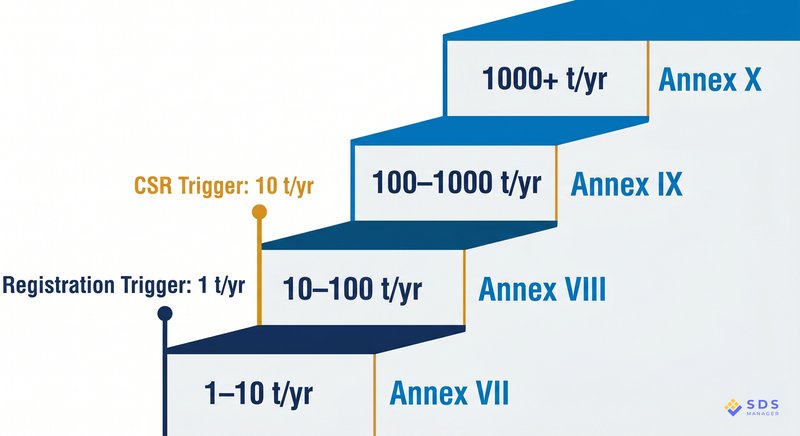
The acronym REACH maps almost directly onto four duties. Registration is where most companies spend their time. The European Commission sets the registration trigger at 1 tonne a year per company. Beyond registration, three more duties decide which substances stay usable.
ECHA publishes the binding lists, including the Annex XVII restrictions that ban or cap specific uses. The table below sets out what each duty demands and what triggers it.
Table 2: The four REACH duties at a glance
| REACH duty | What it means | What triggers it |
|---|---|---|
| Registration | File a dossier with ECHA on the substance's properties and safe use | Making or importing a substance at 1 tonne or more per year |
| Evaluation | ECHA and member states review dossiers and may demand more data | Selected dossiers and substances of concern |
| Authorisation | Win specific permission to keep using a listed high-concern substance | Substance placed on the Authorisation List (Annex XIV) |
| Restriction | Obey EU-wide limits or outright bans on certain uses | Substance or use listed in Annex XVII |
Authorisation and restriction sound alike but work in opposite directions.
Authorisation means a substance is banned by default, and a company must win permission for a named use.
Restriction means a substance stays legal, except for the specific uses the EU has limited or banned. None of these duties is a one-time check. A substance can move onto a watch list at any review, so monitoring matters as much as the first registration.
How do companies achieve REACH compliance?
Compliance follows a clear sequence. The table gives the whole route at a glance, and the eight steps below add the detail.
Table 3: REACH compliance at a glance
| Step | Action | Done when |
|---|---|---|
| 1 | Confirm the company's role | Every activity is mapped to a REACH role |
| 2 | Inventory substances and volumes | Each substance has a tonnage and a source |
| 3 | Register substances at 1 t/year or more | ECHA registration numbers are in hand |
| 4 | Screen against the SVHC and Authorisation lists | No unmanaged SVHC; authorisation sought where needed |
| 5 | Check Annex XVII restrictions | No banned or capped use slips through |
| 6 | Communicate down the supply chain | Customers and ECHA hold current information |
| 7 | Keep records and monitor the lists | A re-screen is scheduled, not ad hoc |
| 8 | Appoint a only representative (non-EU firms) | A non-EU maker's EU duties are covered |
Step 1: Confirm the company's role
The role a company plays decides every REACH duty that follows. A manufacturer makes substances inside the EU and carries the full registration duty. An importer brings substances, mixtures, or products in from outside the EU.
A downstream user works chemicals into its own processes or products under safe-use conditions. A distributor resells without changing the chemical, so its task is to keep safety data accurate. Many firms hold several roles at once, importing one substance while making another.
Step 2: Inventory every substance and volume
Compliance starts from a complete inventory. The inventory records each substance on its own and inside every mixture, because both carry duties. It notes the yearly tonnage per substance, since that figure sets the obligations. Anything sourced from outside the EU is flagged, since import duties may apply. The list stays live because new products and suppliers keep changing it.
Step 3: Register substances at 1 tonne a year or more
Registration is the core REACH duty. A company files a dossier with ECHA for every substance at 1 tonne a year or more. The dossier records the substance's identity, hazards, uses, and safe-handling advice. A dossier is simply the technical file that proves a substance can be used safely.
Data requirements rise with the tonnage band, and a Chemical Safety Report (CSR) is needed from 10 tonnes a year. Registrants of the same substance usually submit together to share data and costs. The registration number is the licence to sell, so no number means no legal sale.
Step 4: Screen against the high-concern lists
A clean registration doesn't settle whether a substance can keep being used. Every substance gets checked against the SVHC Candidate List, the EU's watch list of the most hazardous chemicals. Where a substance reaches the Authorisation List (Annex XIV), a company must apply to ECHA to keep using it. The screen runs again on each list update, because new substances are added through the year.
Step 5: Check Annex XVII restrictions
Restrictions are EU-wide limits or outright bans on specific uses. The check compares each use, not just each substance name, against the restriction entries. Where a use is capped or banned, a company reformulates, switches supplier, or drops that use. A restricted-substance comparison across the whole library catches matches faster than manual checks.
Step 6: Communicate down the supply chain
REACH depends on safety information moving down the supply chain. Suppliers provide a safety data sheet under Article 31 for hazardous substances and mixtures. The SDS goes out in the official language of each market where the product is sold. Customers get notified of any SVHC present above 0.1% under Article 33. Articles that contain such a substance also need a SCIP entry submitted to ECHA.
Step 7: Keep records and monitor the lists
Compliance is ongoing, since the lists change throughout the year. Records of registrations, SDS versions, and notifications are kept accessible for audit. A re-screen is scheduled against each Candidate List update. Another check follows whenever a formulation, supplier, or volume changes.
Step 8: Non-EU companies appoint an only representative
A company outside the EU cannot register directly. Instead, it appoints an EU-based only representative to hold the registration duties, relieving its importers of that burden.
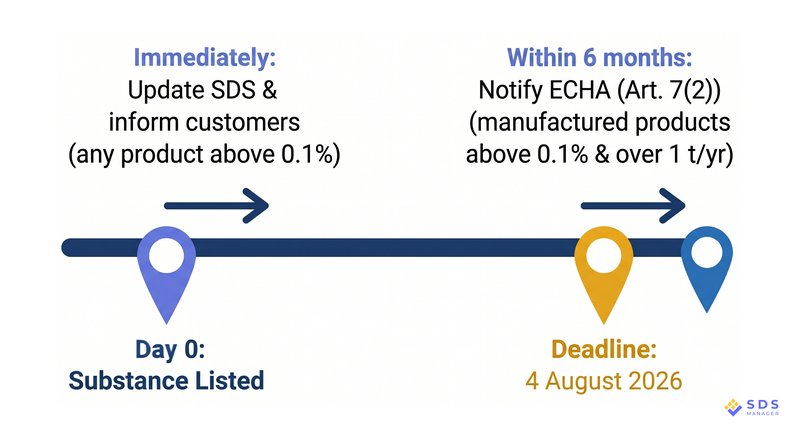
The most common failure is skipping the screening steps. When a substance joins the Candidate List after a clean registration, the duties apply immediately.
The Candidate List is the EU's running tally of substances of very high concern. As of the February 2026 update, it held 253 entries, according to ECHA. ECHA's rules then require suppliers to pass safety information to customers, and articles holding that substance above 0.1% trigger a notification within six months. For the two substances added in February 2026, the notification deadline falls on 4 August 2026.
Many firms register a substance correctly, then miss its later addition to the Candidate List. Re-screening the inventory against each list update catches these changes in time.
What does non-compliance cost?
The first cost is market access. Products with unregistered or restricted substances can be stopped at EU borders or pulled from sale. For many companies, losing the right to ship into the EU outweighs any fine.
Financial penalties sit on top of that. REACH itself doesn't set one EU-wide fine. Under the Regulation, each member state defines its own penalties. The figure varies widely by country and by how serious the breach is.
A slower cost follows too. A supplier that cannot prove compliance loses trust with customers, who increasingly ask for proof before buying. Liability can also arise if an unregistered hazardous substance later causes harm. In each case, the advantage goes to companies that can produce their documentation on demand.
How REACH connects to SDS and CLP duties
Day to day, most teams encounter REACH through safety data sheets. The link runs through Article 31, and it sits beside the EU's classification rules. A few definitions make the connection clear.
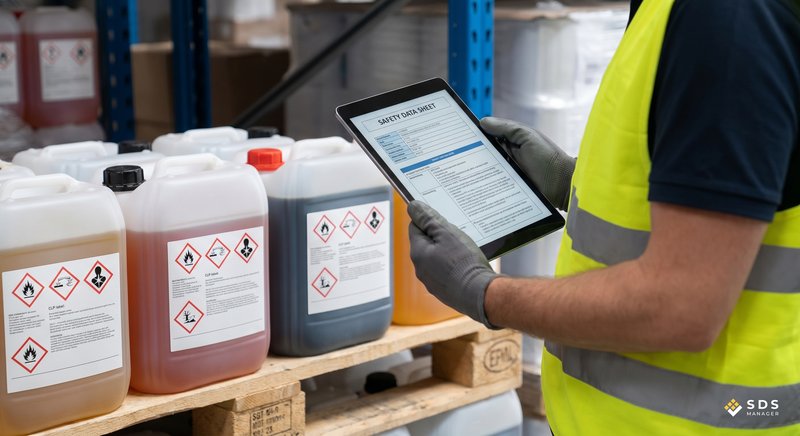
Safety data sheet (Article 31): Suppliers must give recipients an SDS for hazardous substances and mixtures. It has to be in the market's official language.
Extended safety data sheet: Substances registered above 10 tonnes a year may need a chemical safety report. Its exposure scenarios are then attached to the SDS. Getting exposure scenarios right when creating extended safety data sheets is a common challenge, and handling it well sets a supplier apart.
SCIP notification: Articles holding an SVHC above 0.1% need a SCIP entry in ECHA's database. This sits on top of the Article 33 message to customers.
CLP link: REACH and CLP, Regulation (EC) No 1272/2008, work together. CLP sets how a chemical is classified and labelled, and the SDS reflects that.
A current SDS carries most of the communication duties on its own. If it falls out of date, a single audit can expose gaps across every site.
Is REACH about to change?
For years, a major overhaul, often called REACH 2.0, was expected to land. The picture in 2026 settled the question. Two updates matter now:
- EU REACH: On 27 April 2026, the Commission confirmed it won't reopen REACH for a full revision. The rules stay in force, with focus shifting to enforcement and PFAS restrictions. A PFAS decision stage is expected by the end of 2026.
- UK REACH: Since Brexit, Great Britain runs its own regime under the HSE. Northern Ireland still follows EU REACH under current arrangements. It has also pushed its main registration deadlines back to 2029, 2030, and 2031. Companies selling into both markets may face two parallel sets of duties.
Conclusion
REACH rewards companies that treat it as an ongoing process, not a one-off project. The core habits are simple: know the role, register what crosses the threshold, watch the lists, and keep safety information current and shared. Because substances and lists change throughout the year, the work is never quite finished.
Teams that run their SDS and substance data through dedicated chemical compliance software spend less time chasing list updates. The goal is easy to state and harder to keep. At any moment, a company should be able to prove that what it sells is registered, safe, and properly communicated to remain REACH compliant.
Frequently Asked Questions
Is REACH compliance mandatory?
Yes. Any company that makes, imports, or uses chemicals in the EU above the thresholds must comply. It is a condition of market access.
Who is responsible for REACH compliance?
Duties fall on manufacturers, importers, downstream users, and distributors. Non-EU firms act through an EU-based only representative.
What is the difference between REACH and CLP?
REACH manages registration and risk control. CLP, Regulation (EC) No 1272/2008, sets how chemicals are classified and labelled.
Does REACH apply to companies outside the EU?
Not directly. Their EU importers, or an appointed only representative, carry the REACH duties instead.
What is a REACH certificate of compliance?
It is a supplier statement that a product meets REACH, often backed by testing. REACH issues no formal certificate of its own.
Does REACH still apply in the UK?
EU REACH no longer covers Great Britain, which runs a separate UK REACH regime. Northern Ireland follows EU rules under current arrangements.

Arysha Alif Khan

Arysha Alif Khan is an EHS and chemical safety specialist with a background in biochemistry, biotechnology, and public health. She works closely with the product and regulatory teams to turn complex chemical regulations, SDS requirements, and workplace safety standards into clear, practical guidance for people.