RoHS and REACH both regulate hazardous substances in goods sold across the EU, but they operate in different ways. RoHS restricts a short list of substances in electrical and electronic equipment, whereas REACH governs chemicals in almost every kind of product. A failure on either can stop goods at the EU border or trigger penalties set by each member state.
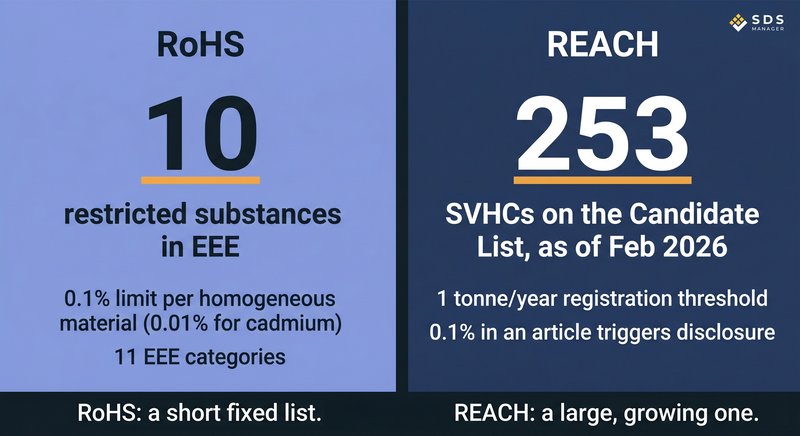
The two frameworks differ in scope and method. RoHS caps 10 named substances in electronics. REACH manages a far larger, growing list of chemicals through registration, authorisation, restriction, and disclosure duties.
This article sets out what each regulation restricts and where they overlap. It ends with a practical way to manage both at once.
Key Takeaways
- RoHS restricts 10 substances in electrical and electronic equipment; REACH applies to chemicals in nearly all products on the EU market.
- RoHS sets fixed concentration limits per homogeneous material; REACH controls substances through registration, authorisation, restriction, and supply-chain disclosure.
- Several substances sit under both rules, including lead, cadmium, and the four phthalates added to RoHS in 2019.
- A substance on REACH's SVHC Candidate List triggers disclosure duties at 0.1% in an article, separate from any RoHS limit.
- Most electronics makers must meet both, where supplier data and re-screening against list updates carry the bulk of the work.
What's the difference between REACH and RoHS compliance?
Both rules sit under EU chemical law, but they answer different questions: one sets what may go into electronics, the other how chemicals are controlled across the whole market.
RoHS is the Restriction of Hazardous Substances Directive, 2011/65/EU. It limits named hazardous substances in electrical and electronic equipment (EEE) and ties that limit to CE marking.
REACH is Regulation (EC) No 1907/2006, in force since 2007. It places the burden of proof on the industry to show chemicals are used safely across substances, mixtures, and finished articles.
RoHS is narrow and prescriptive; REACH is broad and process-driven.
RoHS vs REACH: a side-by-side comparison
For a reach vs rohs compliance comparison at a glance, the table below maps the two frameworks against legal form, scope, and the duties each places on a business.
Table 1: RoHS and REACH compared
| Attribute | RoHS | REACH |
|---|---|---|
| Legal form | Directive (2011/65/EU), enacted by each member state | Regulation (EC) No 1907/2006, directly binding EU-wide |
| Scope | Electrical and electronic equipment (EEE) | Substances, mixtures, and articles across nearly all products |
| What it controls | 10 named substances | A large, growing list of chemicals (SVHCs, Annex XIV, Annex XVII) |
| Limit basis | Fixed % by weight per homogeneous material | 0.1% w/w in an article triggers disclosure; restriction limits vary |
| Main duty | Meet limits, hold a technical file, CE mark | Register, screen, restrict, and disclose down the chain |
| Who is bound | EEE makers, importers, distributors | Manufacturers, importers, downstream users, distributors, only representatives |
| Proof of compliance | EU Declaration of Conformity plus technical file | Registration dossier, SDS, SCIP notification |
What does the RoHS Directive restrict?
RoHS applies to 11 categories of EEE, from large household appliances to medical devices and monitoring equipment. The European Commission's review of the directive confirms that 10 substances and substance groups are currently restricted. The original six date from 2006, and four phthalates were added by Directive (EU) 2015/863, which took effect on 22 July 2019.
The 10 restricted substances are:
- Lead (Pb)
- Mercury (Hg)
- Cadmium (Cd)
- Hexavalent chromium (Cr VI)
- Polybrominated biphenyls (PBB)
- Polybrominated diphenyl ethers (PBDE)
- Bis(2-ethylhexyl) phthalate (DEHP)
- Butyl benzyl phthalate (BBP)
- Dibutyl phthalate (DBP)
- Diisobutyl phthalate (DIBP)
The cap is 0.1% by weight in each homogeneous material, except cadmium at 0.01%. A homogeneous material is the smallest part that can't be separated further, so the limit applies below the level of the finished product. Compliance is shown through a technical file and an EU Declaration of Conformity, backed by the CE mark.
How does REACH compliance work?
REACH runs on a single principle: no data, no market. A substance with no registration can't be sold in the EU. Four duties flow from that rule.
- Registration. Companies file a dossier with ECHA for any substance made or imported at one tonne a year or more.
- Evaluation. ECHA and member states review dossiers and can ask for more data.
- Authorisation. Substances on the Authorisation List (Annex XIV) need specific permission for continued use.
- Restriction. Annex XVII sets EU-wide limits or bans on certain substances and uses.
Beyond those four duties, ECHA maintains the SVHC Candidate List, its watch list of the most hazardous chemicals. As of the February 2026 update, it held 253 entries. A listed substance triggers disclosure duties once it exceeds 0.1% in an article, whether or not it's restricted elsewhere.
Registration and the re-screening it demands are the ongoing core of REACH compliance, which this comparison doesn't work through in full.
Where do RoHS and REACH overlap?
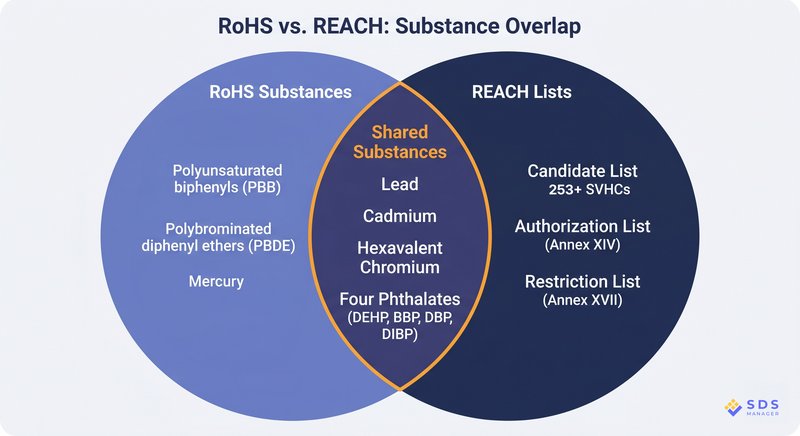
The two rules meet at the substances they share. Lead, cadmium, hexavalent chromium, and the four phthalates appear under RoHS and also feature in REACH's restriction and candidate lists. The same chemical can therefore face a RoHS concentration cap and a REACH disclosure duty at the same time.
Overlap doesn't mean the two rules duplicate each other. They control substances at different stages. RoHS Annex II sets a fixed limit per homogeneous material in electronics. REACH works through three separate lists. These are the SVHC Candidate List, the Authorisation List (Annex XIV), and the Restriction List (Annex XVII).
A substance can sit on one list without the other, because the Candidate List flags chemicals that may face further control rather than ones already restricted. RoHS, REACH, and the POPs Regulation share one aim: protecting health and the environment. Ireland's Environmental Protection Agency notes that each applies a different mechanism to reach it. When a RoHS-controlled substance joins the REACH Candidate List, authorities coordinate the two frameworks so the requirements stay consistent.
One practical example shows the split. RoHS phthalate limits don't extend to toys, which fall under REACH instead. The Annex XVII restrictions carry their own limits, sometimes as a percentage by weight, sometimes as a migration limit. A product team has to check each framework on its own terms, since meeting one doesn't prove the other.
When do both RoHS and REACH apply?
Whether both rules apply comes down to what the product is and what it contains. Electronics almost always fall under both. A non-electronic article usually faces REACH alone.
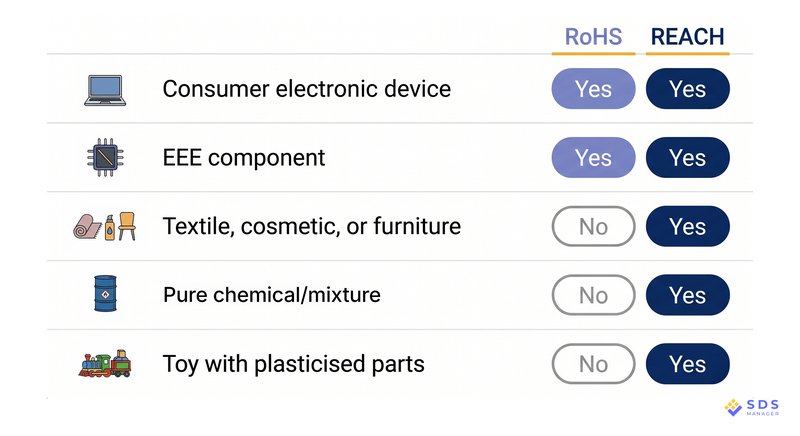
The table below maps common product types to the rules they trigger and the first check to run for each.
Table 2: Which rules apply, by product type
| Product type | RoHS applies? | REACH applies? | First check to run |
|---|---|---|---|
| Consumer electronic device (EEE) | Yes | Yes | Screen for the 10 RoHS substances and any SVHC above 0.1% |
| Component or sub-assembly for EEE | Yes | Yes | Collect supplier declarations covering both frameworks |
| Textile, cosmetic, or furniture item | No | Yes | Check SVHC disclosure and Annex XVII restrictions |
| Pure chemical or mixture, no EEE use | No | Yes | Apply registration and SDS duties, not RoHS |
| Toy with plasticised parts | No | Yes | Phthalates fall under REACH, not RoHS |
Building one RoHS and REACH compliance program
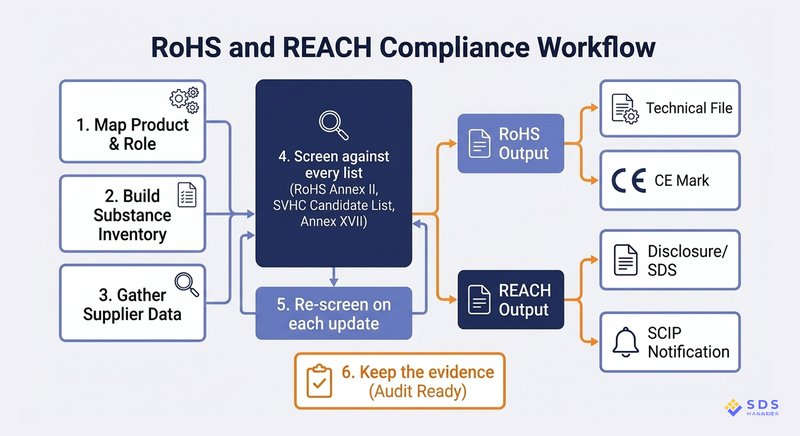
Most electronics makers run both checks through a single substance-control process rather than running two separate ones. The steps below combine them without doubling the work.
- Map the product and its role. Confirm whether each item is EEE, an article, or a chemical, and what the company does with it.
- Build one substance inventory. Record materials at the homogeneous level for RoHS and at the article level for REACH.
- Gather supplier data once. Request full material declarations that cover both the RoHS 10 and REACH SVHCs.
- Screen against every list. Compare each material to RoHS Annex II, the SVHC Candidate List, and Annex XVII.
- Re-screen on each update. Repeat the screen whenever ECHA updates the Candidate List or a formulation changes.
- Keep the evidence. Hold technical files, declarations, and SDS versions ready for audit.
Across a large catalogue, comparing every material against three restricted-substance lists by hand is slow and error-prone. A single screening process that feeds both frameworks removes most of the duplication.
Conclusion
Both frameworks change on different schedules. ECHA updates the SVHC Candidate List about twice a year, and RoHS exemptions expire on fixed dates of their own. A programme that screens once and then stops will fall out of compliance as the lists grow.
On the REACH side, a full overhaul once expected as REACH 2.0 was set aside in April 2026. EU focus has moved to enforcement, with a PFAS restriction decision due by the end of 2026. The RoHS list has stayed at 10 substances since 2019. The EU withdrew its proposal to add TBBP-A and medium-chain chlorinated paraffins in December 2024, so no expansion is in progress for now.
Teams that keep their SDS and substance data in a chemical compliance software can re-screen against each list update automatically, instead of rebuilding the check by hand each time. The goal is the same under both rules: at any point, a company should be able to prove that its products stay within the limits and are properly declared.
Frequently Asked Questions
Is RoHS part of REACH?
No. RoHS and REACH are separate EU rules. RoHS is a directive for electronics; REACH is a regulation for chemicals across most products.
Which substances fall under both RoHS and REACH?
Lead, cadmium, hexavalent chromium, and the four phthalates (DEHP, BBP, DBP, DIBP) appear under both, controlled in different ways.
Does a CE mark prove REACH compliance?
No. The CE mark on electronics signals RoHS conformity, among other directives. REACH duties, such as SVHC disclosure, sit outside it.
Do electronics need both RoHS and REACH checks?
Usually yes. Electronics are EEE under RoHS and articles under REACH, so both the 10 RoHS substances and any SVHCs need screening.
Is testing required, or is documentation enough?
Often documentation and supplier declarations are enough. Targeted lab testing helps when supplier data is missing, outdated, or unreliable.

Arysha Alif Khan

Arysha Alif Khan is an EHS and chemical safety specialist with a background in biochemistry, biotechnology, and public health. She works closely with the product and regulatory teams to turn complex chemical regulations, SDS requirements, and workplace safety standards into clear, practical guidance for people.