Dangerous chemicals move by road across EU member states every day. Getting classification, packaging, or paperwork wrong can stop a shipment at the loading bay and trigger significant fines.
ADR compliance is the regulatory framework governing the transport of dangerous goods by road. It controls how hazardous substances are classified, packaged, labelled, and documented before they leave the shipper's site. That responsibility sits with the consignor (the company handing goods to a carrier), not the driver.
This article covers what ADR requires from the consignor and how to check your product scope. It also covers what changed in ADR 2025 and when a Dangerous Goods Safety Adviser (DGSA) is required.
Key Takeaways
- ADR is a UNECE treaty given legal force across all EU member states by Directive 2008/68/EC. It applies to domestic shipments, not just cross-border movements
- The consignor is legally responsible for classification, packaging, marking, and transport documents before the truck leaves the site
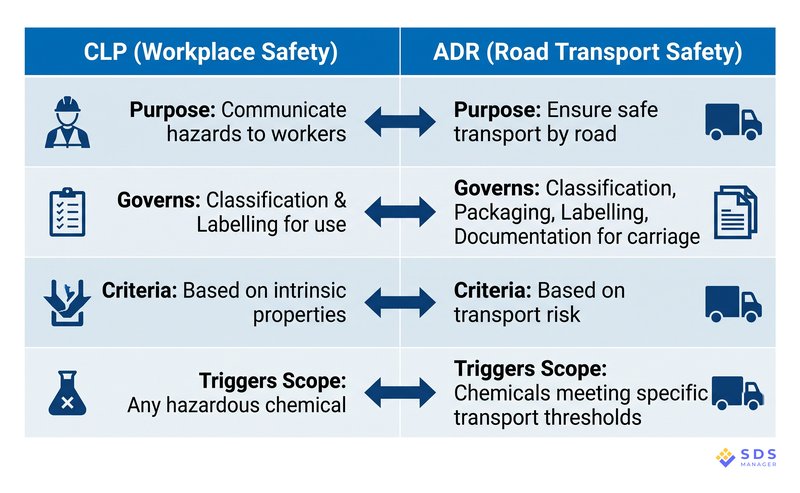
- A product classed as hazardous under CLP (the EU regulation for chemical classification and labelling) is not automatically regulated for road transport under ADR
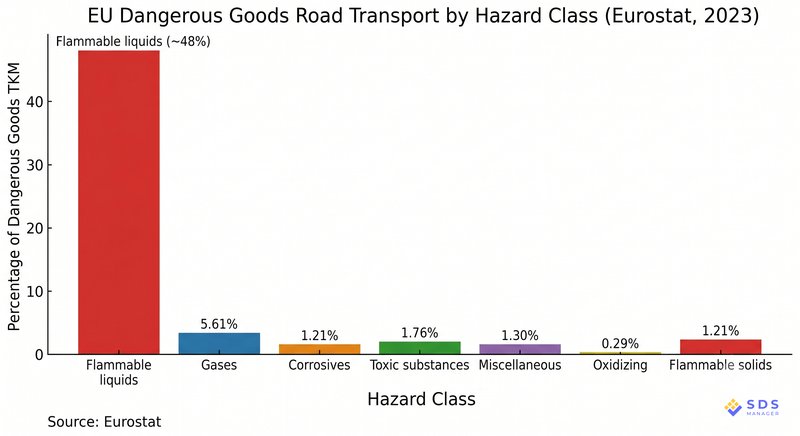
- Flammable liquids make up around 48% of EU dangerous-goods road transport, by tonne-kilometre (weight carried multiplied by distance)
- ADR 2025 became mandatory on 1 July 2025 and introduced new UN numbers for sodium-ion batteries and electric vehicles
- Most chemical manufacturers and distributors must appoint a DGSA; the exemptions are narrower than many assume
What is ADR compliance?
ADR compliance means meeting the requirements of the Agreement concerning the International Carriage of Dangerous Goods by Road. This UNECE treaty governs how hazardous substances are classified, packaged, labelled, and transported by road across 55 contracting parties.
The current edition is ADR 2025, published as ECE/TRANS/352. It entered into force on 1 January 2025 and became mandatory on 1 July 2025. ADR 2023 remained accepted through a six-month transitional period. The agreement is revised every two years, and ADR 2027 is already in development.
The agreement was concluded in Geneva in 1957. Its contracting parties now span Central Asia, North Africa, and the Caucasus, well beyond its original European scope.
Directive 2008/68/EC wrote ADR into EU law and extended those requirements to domestic transport within all EU member states. A local van carrying solvents faces the same classification and packaging rules as an international tanker crossing three borders.
ADR works through two annexes.
Annex A covers requirements for goods: classification, packaging, marking, labelling, and documentation.
Annex B covers vehicle requirements: construction, equipment, driver training, and emergency procedures. Both apply to every consignment.
According to Eurostat, dangerous goods accounted for approximately 3.4% of EU road-freight tonne-kilometres in 2023. Flammable liquids made up around 48% of that dangerous-goods share. Across 55 contracting states, ADR is the single compliance framework within which every one of those shipments must operate.
Why ADR compliance matters for chemical transport
For EU chemical shippers, non-compliance carries consequences in four areas:
- Safety. ADR's packaging performance standards, hazard labelling, and emergency documentation reduce incident severity when accidents happen. Dangerous goods are a small share of EU road freight, but their risk profile far exceeds their tonnage share.
- Legal and financial exposure. National enforcement authorities across all contracting states can issue fines per infraction or per consignment. The consignor and the carrier can both be held liable for the same non-compliance.
- Shipment refusal. Under ADR 1.4.2.2, a carrier has the legal right to refuse goods that don't meet requirements. Wrong classification, missing documentation, or non-compliant packaging means the goods don't leave.
- Supply chain disruption. A refused load or a border-crossing stop means delayed deliveries, renegotiated contracts, and supplier relationships under strain.
Most non-compliance problems don't start with the vehicle. They start at the point where products are classified and paperwork is prepared. That is the consignor's territory.
ADR compliance also connects directly to your SDS obligations: Section 14 under REACH Annex II must reflect your actual transport classification. If that data is out of date, your transport compliance sits on a weak foundation.
Who is responsible under ADR? The consignor's legal duties
ADR chapter 1.4 distributes obligations across three roles. All three may be present in a single shipment.
Consignor: The consignor is the company that prepares goods and hands them to a carrier, also called the shipper. Under ADR 1.4.2.1, it must verify classification, packaging to ADR standards, marking, and labelling before dispatch. The consignor prepares transport documents and provides the carrier with all information needed to move the goods safely. If it acts on behalf of a third party, that third party must supply classification details in writing. Responsibility cannot be verbally delegated to the driver.
Carrier (the road transport company): Must confirm the documentation is present and the goods authorised for carriage, then inspect the load and select the right vehicle for the hazard class.
Consignee (the receiving site or company): Must not unreasonably delay acceptance. After unloading, the consignee checks compliance with any ADR provisions applicable to that operation.
Chemical manufacturers and distributors are consignors. Directive 2008/68/EC makes these obligations apply to domestic EU shipments, not only cross-border movements. Classification errors don't start with the carrier. They start at the point where goods are prepared for loading.
The nine ADR hazard classes and how goods are classified
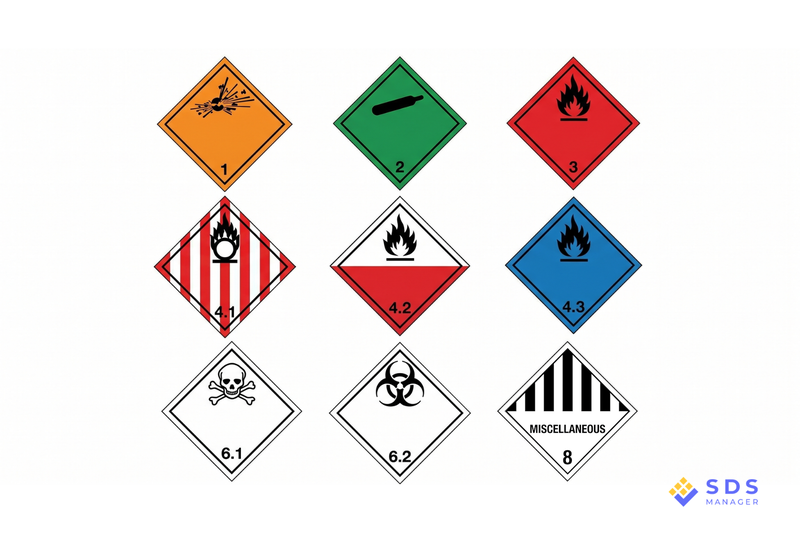
Every ADR-regulated substance is assigned to one of nine hazard classes and a UN number, a four-digit identification code assigned under the UN Model Regulations. Most substances also carry a packing group (I, II, or III), indicating the danger level within the class.
ADR hazard classes: quick reference
| Class | Category | Common chemical examples |
|---|---|---|
| 1 | Explosives | Ammunition, fireworks, airbag inflators |
| 2 | Gases (compressed, liquefied, or dissolved) | LPG, chlorine, carbon dioxide |
| 3 | Flammable liquids | Ethanol, acetone, paints, petroleum products |
| 4.1 | Flammable solids, self-reactive substances | Metal powders, some adhesive formulations |
| 4.2 | Substances liable to spontaneous combustion | White phosphorus, some activated carbons |
| 4.3 | Substances that emit flammable gas in contact with water | Sodium metal, calcium carbide |
| 5.1 | Oxidising substances | Hydrogen peroxide above 8%, ammonium nitrate |
| 5.2 | Organic peroxides | Benzoyl peroxide, methyl ethyl ketone peroxide |
| 6.1 | Toxic substances | Methanol, many pesticides |
| 6.2 | Infectious substances | Applicable to medical and veterinary waste only |
| 7 | Radioactive material | Governed by additional specialised requirements |
| 8 | Corrosive substances | Sulphuric acid, sodium hydroxide |
| 9 | Miscellaneous dangerous substances and articles | Lithium batteries, sodium-ion batteries, dry ice |
Not every product that carries a GHS hazard label is a dangerous good under ADR. Classification under CLP and classification under ADR follow separate criteria. A product hazardous under CLP may fall outside ADR's transport thresholds, and vice versa.
ECHA maintains the ADR dangerous goods list under Directive 2008/68/EC. It covers UN numbers, packing groups, and packaging instructions for every classified substance.
How do you know if your chemical is regulated for transport?
The fastest check is SDS Section 14 (Transport Information), which suppliers are required to complete under REACH Annex II.
- Check Section 14.1 for a UN number. These four-digit codes identify substances across all transport modes and determine dangerous goods classification requirements under ADR. If a UN number appears, the product is in scope and full ADR requirements apply to its road shipment.
- Note the ADR-specific fields. Section 14 should also state the proper shipping name, the hazard class, and the packing group. The proper shipping name is the official ADR product description, not the commercial trade name. A blank or missing Section 14 is not a pass; it may indicate an incomplete SDS.
- Check whether an exemption applies. Some shipments qualify for reduced requirements under limited-quantity or excepted-quantity provisions, or fall below the ADR 1.1.3.6 small-load threshold. These exemptions still require correct packaging and marking. They don't create an ADR-free zone.
- Re-evaluate after any reformulation. If a product's composition or flash point changes, the Section 14 data may no longer be current. Re-assessment of the transport classification is a consignor responsibility, not something to wait for a supplier to initiate. For teams managing large portfolios, an SDS management system can surface those supplier updates before the next consignment goes out.
What if Section 14 says "not subject to transport regulations"?
This means the supplier has assessed the product and determined it does not meet ADR classification criteria. A GHS-hazardous product can legitimately fall outside ADR scope if its properties don't reach the transport classification thresholds.
That said, "not subject to transport regulations" should be explicitly stated in the SDS, not simply absent. An SDS with an empty Section 14 warrants a direct check against the ADR dangerous goods list before shipping.
What changed in ADR 2025?
ADR 2025 is the edition currently in force, mandatory across all contracting parties from 1 July 2025. The key changes relevant to chemical shippers include:
- New UN numbers for sodium-ion batteries. ADR 2025 introduced UN 3551 (sodium-ion batteries, organic electrolyte) and UN 3552 (sodium-ion batteries in equipment). These parallel the framework already established for lithium batteries.
- New entries for battery-powered vehicles. UN 3556, 3557, and 3558 now cover vehicles powered by lithium-ion, lithium-metal, and sodium-ion batteries. Lithium-powered vehicles previously classified under UN 3171 moved to these new entries from March 2025.
- Extended training requirements. ADR 2025 expanded training mandates for limited-quantity transport, affecting personnel who previously fell outside formal dangerous goods awareness requirements.
- Packaging updates. Several packing instructions were revised, with new performance requirements for certain package types. Transitional provisions for tanks and tank containers built before July 2025 were also extended.
Ireland's Health and Safety Authority has published an ADR 2025 amendments summary covering each change by chapter and annex.
The two-year update cycle means ADR 2027 amendments are already being drafted by the UNECE working party. If your portfolio includes battery products or battery-powered equipment, the 2025 changes affect your classification and packaging obligations.
Do you need a Dangerous Goods Safety Adviser?
ADR 1.8.3 requires any undertaking (business) that consigns, fills, loads, or carries dangerous goods to appoint a DGSA. The DGSA must hold a vocational training certificate obtained through an approved examination, valid for five years. One DGSA can serve multiple undertakings and can be an external consultant rather than a permanent employee.
Core duties: monitoring ADR compliance, advising on procedures, investigating incidents, and preparing the annual report under ADR 1.8.3.3. The report isn't submitted to a regulator automatically, but authorities can request it at any time. An absent report is itself evidence of non-compliance.
The requirement was extended to consignors specifically in ADR 2019. Before that, some consignor-only operations fell outside the DGSA obligation. Since ADR 2019, any undertaking that regularly consigns dangerous goods must appoint one.
Exemptions exist under ADR 1.8.3.2, but they're narrow. An undertaking qualifies only if its dangerous goods activities fall below the ADR 1.1.3.6 thresholds. Transport of dangerous goods must also be neither the main activity nor a supporting one for the business. Most chemical manufacturers and distributors don't meet both conditions.
Worth keeping in mind: the exemption must be actively assessed and documented. Assuming exemption without checking is not a safe position.
Building an ADR compliance process that holds up
A practical ADR compliance structure for chemical shippers covers seven areas.
- Classify your product portfolio. Work through ADR Table A and assign a UN number, hazard class, and packing group to each substance. Where Section 14 is blank or incomplete, consult the product supplier or your DGSA.
- Select compliant packaging. ADR packaging must meet tested performance standards for its packing group. Use only packaging that carries the correct UN mark for the substance and packing group. Packing Group I requires the highest performance standard; Group III the lowest.
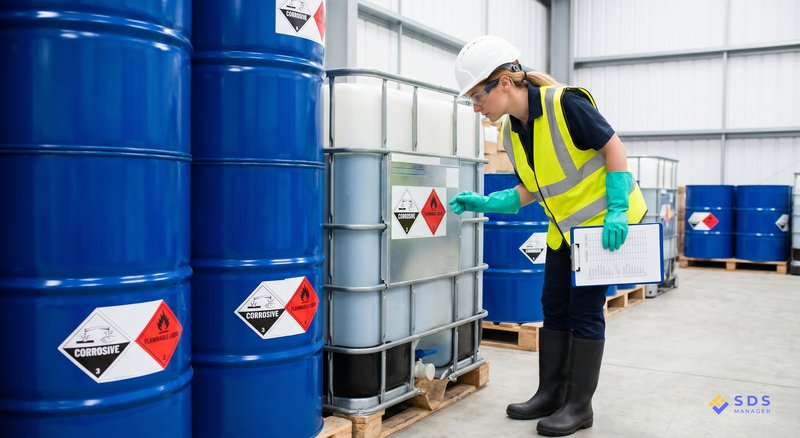
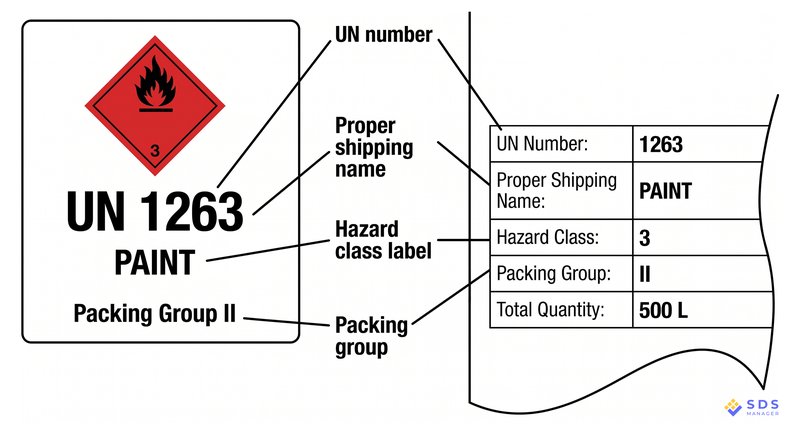
- Apply marks and labels. Each package must carry the UN number, proper shipping name, and hazard class label. Where a substance has more than one hazard class, additional danger labels apply alongside the primary one.
- Prepare accurate transport documents. The transport document must state the UN number, proper shipping name, hazard class, and packing group. Quantity and any applicable tunnel restriction codes must also appear. Errors in transport documents are among the most common ADR enforcement findings.
- Train your consignment staff. All personnel involved in consigning dangerous goods need ADR 1.3 general awareness training. This applies to order processors, warehouse staff, and anyone completing transport documents, not only drivers.
- Appoint a DGSA and set up the annual report cycle. Review the ADR 1.8.3.2 exemption conditions. If your operation doesn't meet both criteria, appoint a DGSA before the next consignment.
- Keep SDS data current. Your transport labels and transport documents are only as accurate as the SDS data behind them. When a product is reformulated or a supplier updates the SDS, review Section 14 data for every affected product.
Conclusion
ADR compliance doesn't start with the vehicle. It starts with classification, and classification is the consignor's job.
The checkpoints are predictable: accurate Section 14 data for every product, packaging matched to the correct packing group, and transport documents that reflect the actual contents. A DGSA on file and an annual activity report round out the structure.
ADR 2027 is already in development. Building a compliance review into your annual cycle now is the lower-risk path.
Frequently Asked Questions
What does ADR compliance mean for chemical shippers?
ADR compliance means meeting the classification, packaging, labelling, documentation, and training requirements for road transport of dangerous goods. For chemical shippers, the primary obligations fall on the consignor: the company preparing goods for road transport.
Does ADR apply to transport within a single EU country?
Yes. Directive 2008/68/EC extended ADR requirements to domestic road transport within all EU member states. The same rules apply whether a shipment crosses an international border or stays within one country.
What is the difference between CLP and ADR classification?
CLP governs chemical hazard communication for the workplace; ADR governs dangerous goods classification for road transport. The two systems use different criteria, so a CLP-hazardous product may not be a dangerous good under ADR.
Who must appoint a Dangerous Goods Safety Adviser (DGSA)?
Any undertaking that consigns, fills, loads, or carries dangerous goods must appoint a DGSA under ADR 1.8.3. Since ADR 2019, this includes consignor-only operations, not only carriers and freight handlers.
When did ADR 2025 become mandatory?
ADR 2025 entered into force on 1 January 2025. The transitional period ended 30 June 2025, making ADR 2025 the mandatory standard from 1 July 2025.

Arysha Alif Khan

Arysha Alif Khan is an EHS and chemical safety specialist with a background in biochemistry, biotechnology, and public health. She works closely with the product and regulatory teams to turn complex chemical regulations, SDS requirements, and workplace safety standards into clear, practical guidance for people.