
SDS validation is the process of systematically checking every Safety Data Sheet in your library against current regulatory requirements, confirming all 16 sections are present, accurate, and up to date. Having an SDS on file is a starting point. Validation is the proof that it actually meets the standard.
That proof matters. OSHA cited 2,888 Hazard Communication violations in FY2024, the second most-cited standard across all of general industry.
A recent study by SDS Manager analyzed the most commonly used 100,000 Safety Data Sheets across a library of 17 million+ documents from 800 companies and found that 4.3% of documents are missing Section 15 entirely, with a further 44% returning incomplete Section 1 and 2 data across the dataset.
Most EHS managers know their SDSs should be compliant. Validation is how you confirm they are.
Key Takeaways
- SDS validation checks all 16 mandatory sections for accuracy, completeness, and currency, going well beyond confirming a document exists
- OSHA's HazCom 2025 update (GHS Rev 7 alignment) required substance SDS updates by May 19, 2026. That deadline has now passed.
- 41% of companies still manage SDSs with spreadsheets or paper, making systematic validation structurally impossible.
- AI validation in SDS Manager checks every document simultaneously against OSHA, GHS, and REACH, delivering results in minutes
What Is SDS Validation, and Why Is Having an SDS Not Enough?
SDS validation is the systematic process of checking whether a Safety Data Sheet actually meets the regulatory requirements it's supposed to satisfy. A document can sit in your library, be accessible to workers, and still be out of compliance.
Inspectors check three distinct layers. Most organizations address only one:
- Structural completeness: All 16 sections present, in the correct order, with required subheadings populated
- Regulatory accuracy: Classifications, hazard statements, and disclosures aligned with current standards (GHS Rev 7, OSHA HazCom 2025, REACH Annex II)
- Document currency: Revision dates tracked against OSHA's 3-month update obligation when significant new hazard information becomes available
Layers two and three are where audit failures actually happen.
Why Manual SDS Validation Breaks Down at Scale
Manual validation works for 30 SDSs. It becomes structurally unworkable at 300. Four failure patterns appear consistently.
The Regulation Lag Problem
GHS revisions, REACH ATPs, and OSHA updates require manual intervention on every affected SDS. That chain breaks frequently across busy EHS teams managing multiple sites.
The Volume Trap
A 500-SDS library reviewed quarterly produces a compliance snapshot that's already aging by the time it closes. Continuous monitoring is absent. Teams rely on periodic spot-checks, with compliance gaps accumulating in between.
The Section 9 Blind Spot
OSHA enforcement data consistently identifies Sections 8, 9, and 11 as the most frequently incomplete sections in non-compliant SDSs. Section 9 alone now requires 19 physical and chemical property fields under HazCom 2025, an increase from the previous version. It's the highest-risk section for any organization that hasn't revalidated recently.
The Version Confusion Problem
When a supplier sends an updated SDS, does your team flag the old version for removal? Without automation, version control across a large library is a full-time job on its own.
How AI Validation in SDS Manager Works Differently
The defining advantage AI brings to SDS validation is coverage at scale. Here's what SDS Manager's AI engine does that manual review cannot replicate.
Field-level reading across all 16 sections.
AI validation reads every required field within each section, checking whether content is populated and coherent. A Section 8 with a heading but no occupational exposure limits gets flagged. A Section 2 that lists a hazard classification without the corresponding precautionary statements gets flagged.
Multi-regulation cross-reference in a single pass.
A single SDS may need to satisfy OSHA HazCom 2025, EU REACH Annex II, and GHS Rev 7 simultaneously. SDS Manager cross-references all applicable standards against the same document in one operation, which is essential for teams with international reach.
Automatic SDS age tracking.
OSHA requires SDSs to be updated within three months of receiving significant new hazard information. SDS Manager monitors revision dates across your entire library and surfaces overdue updates before an inspector encounters them.
Structured, actionable status output.
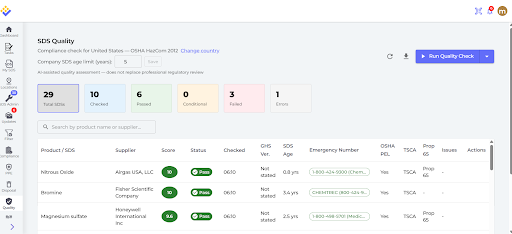
Every SDS in your library receives one of three statuses:
| Status | What It Means | |
|---|---|---|
| Pass | All 16 sections complete, classifications consistent, revision date current | |
| Conditional | Core structure intact but specific flagged issues need attention before the next audit | |
| Fail | Critical gaps including missing sections, inconsistent GHS classifications, absent emergency contact, or misaligned transport data |
The three-tier system turns abstract compliance risk into a prioritized action list. A Fail list tells you where to start. A Conditional list tells you what's next.
How to Run AI SDS Validation in SDS Manager (6 Steps)
Getting from an unvalidated library to a full compliance picture takes six steps.
- Create your account at sdsmanager.com.
- Build your SDS library by uploading existing files or searching the SDS Manager database by product name or supplier.
- Go to Validation and start the automated run. The AI engine checks every SDS simultaneously across GHS, OSHA HazCom 2025, and REACH/CLP, covering all 16 sections.
- Review your results. Each SDS shows a Pass/Conditional/Fail status with specific findings: which section failed, which field is missing, what the gap is.
- Cross-check flagged SDSs. Work through Conditional and Fail results with targeted, precise findings for each flagged document.
- Update non-compliant SDSs and enable auto-update to keep your library current automatically as regulations change.
Is Your SDS Library Actually Compliant?
SDS Manager runs AI-powered validation across your entire SDS library, checking all 16 sections, every applicable regulation, with a clear Pass/Conditional/Fail status for every document. Results arrive in minutes.
Start your free trial at SDS Manager and see exactly which documents pass, which need attention, and which carry active compliance risk.
Frequently Asked Questions
What is SDS validation?
SDS validation is the systematic process of checking a Safety Data Sheet against applicable regulatory requirements, confirming all 16 mandatory sections are present, substantively complete, and aligned with current standards like OSHA HazCom 2025, GHS Revision 7, and REACH Annex II. Document possession alone provides no compliance assurance.
How often should SDSs be validated?
OSHA requires SDSs to be updated within three months of receiving significant new hazard information. EHS best practice is continuous monitoring. AI-powered validation in SDS Manager provides exactly that, where quarterly manual reviews leave periodic blind spots where regulatory changes go undetected.
Can an SDS fail validation even if the supplier provided it?
Yes. Supplier-provided SDSs carry no automatic compliance guarantee. Suppliers may use outdated templates, miss HazCom 2025 updates, or provide SDSs compliant in one jurisdiction but not yours. Under OSHA's HCS, the receiving employer is responsible for ensuring SDSs are compliant, regardless of source.
What sections are most commonly incomplete?
OSHA enforcement data consistently identifies Sections 8 (exposure controls), 9 (physical and chemical properties), and 11 (toxicological information) as the most frequently incomplete. Section 9 is the highest-risk section under HazCom 2025, now requiring 19 property fields.

Mehreen Iqbal

Started with a Bachelors in Microbiology, then a Masters in Public Health; Currently a Workplace Safety Expert.