What is industrial safety training?
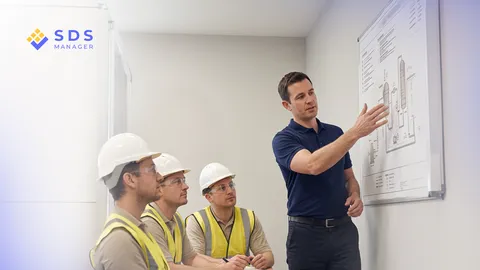
Industrial safety training is job-specific instruction that teaches workers in factories, plants and warehouses to recognize hazards, follow safe operating procedures and respond to emergencies. It's the part of an industrial safety program that turns written procedures into how people actually work.
Generic awareness courses have their place. But a forklift operator, a maintenance technician and a packing line worker face different hazards, and they need training on the hazards of their own job.
What OSHA requires from employers
The OSH Act requires employers to provide a workplace free from recognized serious hazards. For general industry, the detailed rules are in 29 CFR 1910, and many of them include training requirements. Some examples:
- Hazard communication: Train workers on the chemicals in their work area, including labels and safety data sheets (1910.1200(h)).
- Lockout/tagout: Train authorized and affected employees on energy control procedures (1910.147(c)(7)).
- Powered industrial trucks: Train and evaluate forklift operators, with a performance evaluation at least every three years (1910.178(l)).
- Permit-required confined spaces: Train entrants, attendants and entry supervisors before they're assigned to the work (1910.146(g)).
- PPE: Train workers on when PPE is needed, what to wear, and how to use and care for it (1910.132(f)).
OSHA also expects training in a language and vocabulary that workers understand.
Core areas of industrial safety training
Hazard recognition
Teach workers to spot the main hazards in industrial settings: moving machinery, stored energy, chemicals, noise, heat, vehicle traffic and work at height.
Safe operating procedures
Walk through the written procedure for each machine or task, then have workers demonstrate it. Explain why each step matters, so workers keep following it when they're under time pressure.
PPE
Show what PPE each task needs, how to inspect it and when to replace it. Remind workers that PPE is the last line of defense, after engineering and administrative controls.
Emergency response
Cover alarms, exit routes, assembly points, spill response and first aid. Run drills, because people respond the way they've practiced.
Building a factory safety training program
- Map roles to hazards. List each job and the training it needs. A training matrix makes gaps easy to see.
- Train before exposure. New workers and transfers should complete hazard training before they start the task.
- Use the actual equipment. Hands-on practice on your own machines works better than slides alone.
- Check competence. A short practical test or supervised task shows whether the training worked.
- Record everything. Log the date, topic, trainer and attendees. If an OSHA inspector asks, you need to show who was trained and when.
- Refresh on a schedule. Retrain after incidents, near misses, process changes and at the intervals the standards require.
Industrial safety management and training
Training on its own won't prevent injuries if equipment is unguarded or procedures are out of date. Treat it as one part of industrial safety management, along with hazard assessments, inspections, incident investigation and corrective action.
Download the free Industrial Safety Training Guide to plan your next round of training. To track who has completed each course, use it with the EHS Training Matrix Tracker.