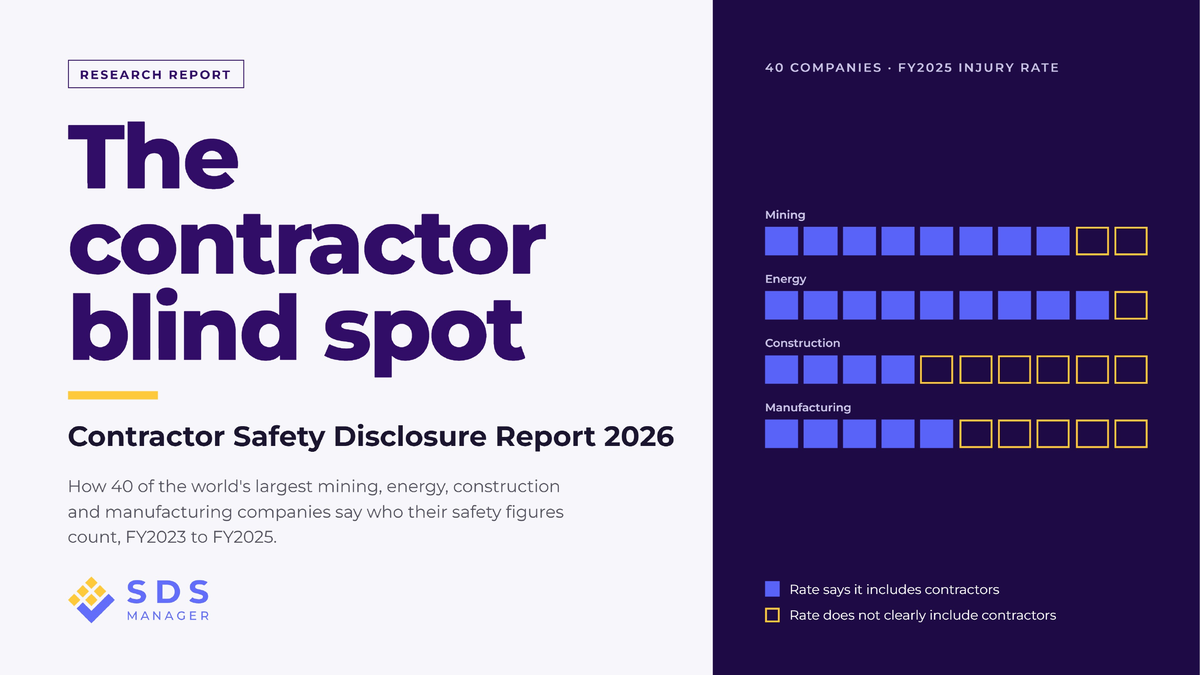
Contractors often do the most hazardous work at mines, plants and construction sites. When a company's injury rate leaves them out, the company can look safer than the work on its sites really is.
SDS Manager's Contractor Safety Disclosure Report 2026 reviewed 600 safety figures from 40 large listed companies. In FY2025, only 26 of those companies said an injury rate includes contractors. Seven published the contractor hours needed to check a contractor injury rate.
Key takeaways
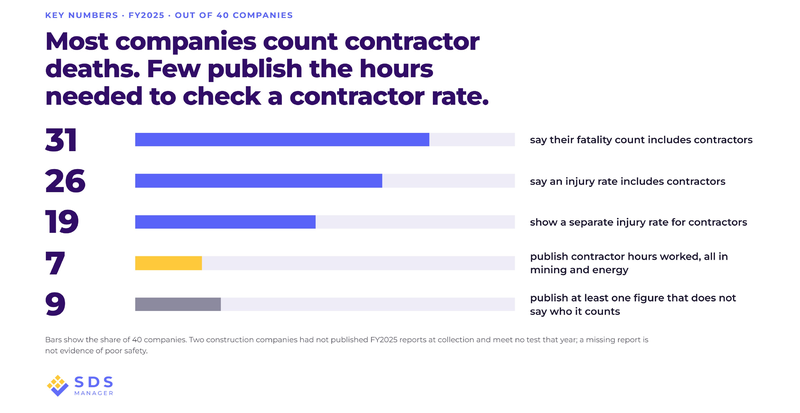
- In FY2025, 31 of 40 large mining, energy, construction and manufacturing companies said their fatality count includes contractors.
- Fewer said the same of an injury rate: 26 of the 40 in FY2025.
- Only 7 of the 40 companies published contractor hours worked in FY2025, all in mining and energy.
- None of the 20 construction and manufacturing companies in the study published contractor hours in FY2025.
- Of 400 FY2024 and FY2025 safety figures, 108 can't be compared directly with the year before.
- The study measures how clearly companies label their safety figures, not how safe any company is.
What did the Contractor Blind Spot study find?
Most large industrial companies label contractor deaths clearly, but fewer say who their injury rates count. In FY2025, 19 of the 40 showed a separate injury rate for contractors, against 31 that named contractors in their fatality count.
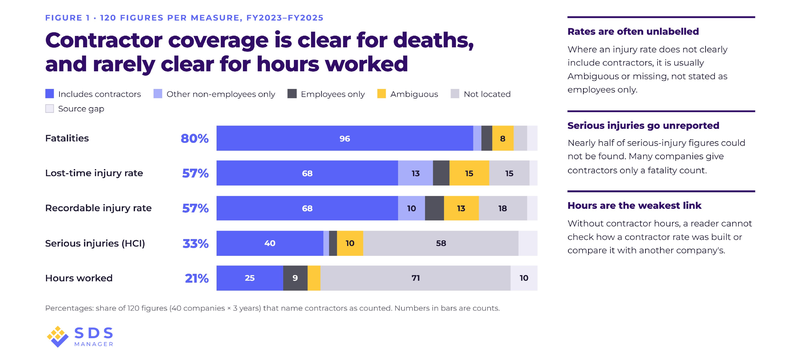
The three-year data shows how far apart the measures are. Of 120 fatality figures from FY2023 to FY2025, 80% named contractors as counted. For hours worked, the share was 21%.
Hours matter because an injury rate is calculated per hours worked. Without contractor hours, a reader can't check how a contractor rate was calculated or compare it with another company's.
Serious injuries were also hard to find. The study could not locate 58 of 120 serious-injury figures. Many companies gave contractors only a fatality count.
Why do unclear labels on injury rates matter?
An injury rate that doesn't name the workers it counts can't be compared fairly across companies or years. In FY2025, 14 of the 40 companies had injury rates that didn't clearly include contractors. The most common reason was silence, not exclusion. Of those 14:
- Five published a rate with nothing beside it saying who it counts.
- Four named employees and temporary workers, but not contractors.
- Two stated that their rate covers employees only.
- Three had no FY2025 report or no rate to check.
Of 325 figures that named non-employees, 28 covered temporary or agency workers but not contractors. A phrase like "employees and other workers" doesn't confirm that contractors are in the count.
"Contractors often do the most hazardous work on a site, yet many companies don't say whether their injury rates count them. Most already report contractor deaths clearly. Closing the gap on rates often takes just one sentence beside who the numbers covers."
-Arysha Alif Khan, Product Compliance Manager, SDS Manager
Which sectors disclose the least about contractor safety?
Construction trails mining and energy on every disclosure test, and manufacturing trails them on injury rates, separate contractor rates and hours. No construction or manufacturing company published contractor hours in FY2025. Construction met each test least often, with 4 of 10 companies saying an injury rate includes contractors.
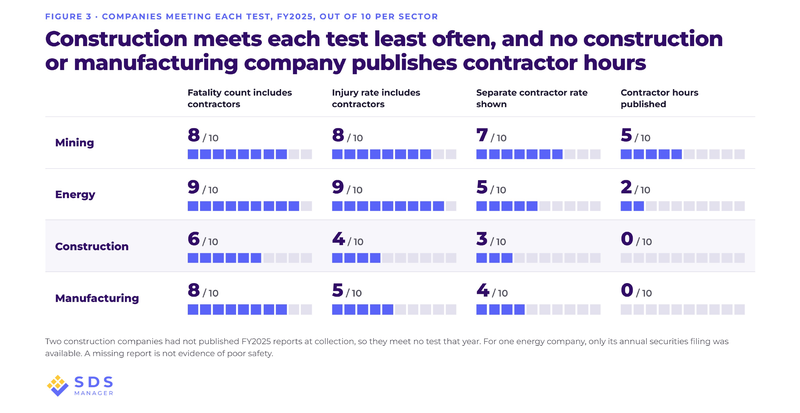
Mining had the strongest record overall. Eight of 10 mining companies said an injury rate includes contractors, and 5 published contractor hours. Energy labeled its figures most clearly, with 9 of 10 companies meeting both the fatality and injury-rate tests.
How did contractor safety reporting change from FY2023 to FY2025?
Headline totals barely moved over three years, but 16 of the 40 companies changed on a key test at least once. Some labels became clearer. Others went backward: one manufacturer moved from naming contractors, to employees only, to no statement.
Companies meeting each disclosure test, out of 40
| Test | FY2023 | FY2024 | FY2025 |
|---|---|---|---|
| Fatality count includes contractors | 31 | 34 | 31 |
| Injury rate includes contractors | 29 | 28 | 26 |
| Separate contractor rate shown | 21 | 21 | 19 |
| Contractor hours published | 5 | 6 | 7 |
| At least one figure doesn't say who it counts | 10 | 11 | 9 |
The small FY2025 dip mostly reflects missing reports. Two construction companies hadn't published FY2025 reports, and one energy company had only its annual securities filing available.
Reporting boundaries shifted too. Of the 600 figures, 167 covered operated sites only and 91 were affected by acquisitions or disposals. Between label and boundary changes, 108 of the 400 FY2024 and FY2025 figures don't line up directly with the year before.
Five practices for clearer contractor safety reporting
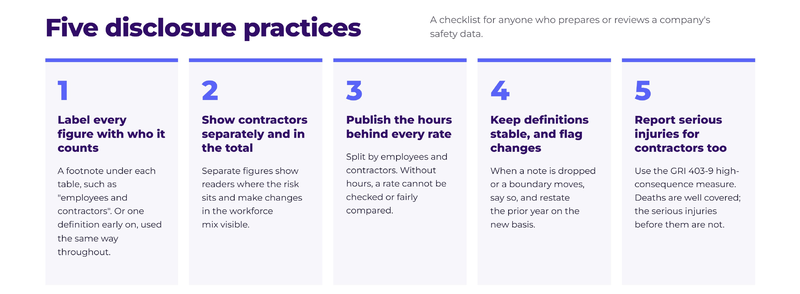
The clearest reports in the study point to five practices. None of them requires new data, only clearer labels on data companies already hold.
- Label every figure with who it counts, such as "employees and contractors" in a footnote under each table.
- Show contractors separately and in the total, so readers can see where the risk sits.
- Publish the hours behind every rate, split by employees and contractors.
- Keep definitions stable, and restate the prior year on the new basis when a boundary moves.
- Report serious injuries for contractors too, using the GRI 403-9 high-consequence injury measure.
Contractor hours were the least-reported of the five measures in the study.
How was the study conducted?
The study reviewed public reports from 40 large listed companies, chosen by market value before any report was read. Each of the 600 figures was coded twice and linked to its source page.
- Sample: 10 companies each in mining, energy, construction and manufacturing, with names withheld.
- Sources: 135 sustainability reports, ESG data books and annual reports published as of early October 2026.
- Measures: fatalities, serious injuries, recordable and lost-time injury rates, and hours worked, from FY2023 to FY2025.
- Coding: two blind AI coding passes agreed on 82.8% of figures (497 of 600), with disagreements settled against the source.
- Checks: a reviewer verified randomly drawn figures against source pages, in a pilot and after the full run.
- Limits: a missing figure isn't a zero, and an unclear label isn't evidence of poor safety.
Clear labels make contractor safety figures comparable
Most large industrial companies in the study already say their fatality counts include contractors. The gaps are in injury rates, serious injuries and the hours behind them.
A footnote naming who each figure covers, plus contractor hours, would let readers compare companies on the same basis.
Track contractor safety in EHS Solutions by SDS Manager alongside your own team, and the contractor figures are ready when the safety report is due.
References
- SDS Manager, The Contractor Blind Spot: Contractor Safety Disclosure Report 2026 (2026).
- Global Reporting Initiative, GRI 403: Occupational Health and Safety 2018. globalreporting.org/standards

Zarif Ahmed

An engineer and safety writer by profession, focusing on chemical management, regulatory development, and the patterns that shape workplace practice over time.