
RIDDOR sets four separate deadlines, and mixing them up is one of the most common compliance failures among UK employers.
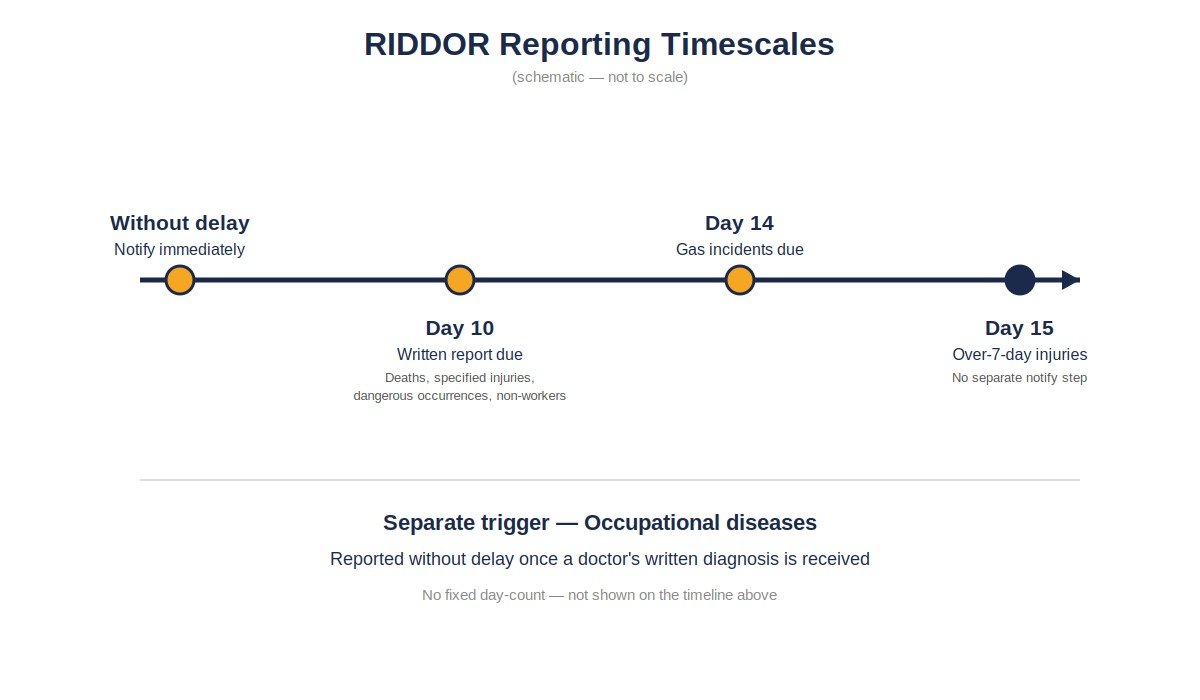
Deaths, specified injuries, and dangerous occurrences must be reported without delay, followed by a written report within 10 days. Over-7-day injuries get 15 days instead.
Occupational diseases follow a different clock entirely, starting only once the responsible person receives the written diagnosis
RIDDOR reporting timescales matter because missing a deadline is a criminal offence in its own right, separate from whatever caused the incident.
This article sets out every category, its exact deadline, and the process that keeps a business inside all of them.
Key Takeaways
- RIDDOR sets four timescales, not seven. The category determines the timescale, not severity. An over-7-day injury gets the longest window despite being less serious than a specified injury.
- Deaths, specified injuries, dangerous occurrences, and non-worker hospitalisations all require notification without delay, followed by a written report within 10 days. Gas incidents also require notification without delay, but their written report deadline is 14 days, not 10.
- Over-7-day injuries must be reported within 15 days, a timescale set separately from the 10-day rule.
- Occupational diseases must be reported without delay once the responsible person receives the written diagnosis, not from the date the doctor writes it or the date symptoms began.
- Failing to report on time is a criminal offence under Section 33 of the Health and Safety at Work etc. Act 1974, independent of any prosecution for the underlying incident.
- RIDDOR records must be kept for at least 3 years from the date the record was made, not the date of the incident itself.
What Are the RIDDOR Reporting Categories and Their Deadlines?
Every RIDDOR category falls into one of four timescales. The category determines the timescale. Severity correlates but doesn't decide it. That’s because an over-7-day injury gets the longest window despite being less serious than a specified injury.
| Category | Timescale | Reporting method |
|---|---|---|
| Death of any person | Without delay, then a written report within 10 days | Online form, or phone for faster initial notification |
| Specified injuries to workers | Without delay, then a written report within 10 days | Online form, or phone for faster initial notification |
| Over-7-day injuries to workers | Within 15 days, no separate notification step | Online form |
| Injuries to non-workers taken directly to hospital for treatment | Without delay, then a written report within 10 days | Online form |
| Occupational diseases (Regulations 8 and 9) | Without delay, once the responsible person receives the written diagnosis | Online form |
| Dangerous occurrences (Schedule 2) | Without delay, then a written report within 10 days | Online form |
| Gas incidents | Without delay, then a written report within 14 days | Dedicated gas incident and gas fitting forms |
The Seven Reportable Categories
These seven cover the categories that apply to workplaces generally. Mines, quarries, relevant transport systems and offshore installations have additional reportable events and, in some cases, separate reporting routes.
Death of any person
This includes a death that happens later in hospital, not just at the scene, as long as it results from the accident and occurs within one year of the incident date.
Suicides are excluded from this category. There is also no requirement to report the death of a self-employed person if it occurs on premises they solely own or occupy.
Specified injuries to workers (fractures, amputations, serious burns, etc.)
Regulation 4's list of eight runs from fractures and amputations through to permanent sight loss, crush injuries to the head or torso, serious burns, scalping, loss of consciousness from a head injury or asphyxia, and injury from working in an enclosed space that requires resuscitation or hospital admission for more than 24 hours.
Over-7-day injuries to workers
The count starts the day after the accident, uses calendar days rather than working days, and still includes weekends and rest days even though the accident day itself doesn't count.
The trigger is incapacity, not absence: a worker who attends work but can't perform their normal duties still counts toward the 7 days, even if they never actually stay home.
Injuries to non-workers taken directly for hospital treatment
This category has three conditions that all need to be met: the injury happened during a work activity, the person was taken directly from the scene to hospital, and they received actual treatment once there.
An X-ray or examination with no treatment given doesn't count, and neither does a visit the person makes on their own sometime after the accident.
If the accident happens on hospital premises, the rule inverts. The hospital only reports if the injury is specified. The ordinary "taken to hospital for treatment" test can't apply when the person is already there. A visitor who slips and needs a dressing isn't reportable; one who fractures a wrist is.
Occupational diseases (Regulations 8 and 9)
This covers eight categories of reportable illness, including carpal tunnel syndrome, occupational dermatitis, and hand-arm vibration syndrome.
The clock starts when the responsible person actually receives the written diagnosis, not when the doctor writes it.
Dangerous occurrences (Schedule 2)
Twenty-seven categories apply to general workplaces, such as lifting equipment collapse or an uncontrolled release of a hazardous substance, reportable regardless of whether anyone was actually hurt. Further categories apply specifically to mines, quarries, transport systems, and offshore workplaces.
Gas incidents
Gas distributors and suppliers report death, unconsciousness, or hospitalisation linked to their gas, while Gas Safe engineers report dangerous gas fittings they find.
Both routes carry the same 14-day deadline for the written report, following notification without delay. Engineers must report a dangerous fitting even in a domestic property, and even if they repair it on the spot.
Who Must Meet RIDDOR Reporting Timescales?
- The responsible person carries the legal duty. This is usually the employer, but it extends to the self-employed and anyone in control of work premises.
- Employers report deaths, specified injuries, over-7-day injuries, and occupational diseases affecting their own employees, wherever those employees are working at the time.
- Premises controllers report incidents involving members of the public, self-employed people working on their site, and dangerous occurrences that happen there, since the duty follows the location, not the employment relationship.
- Self-employed people report their own reportable accidents only if they happen on premises they control themselves. If the accident happens on someone else's premises, the duty shifts to whoever controls that site. A work-related diagnosis is different: if a doctor tells you that you have a reportable disease, you report it yourself regardless of whose premises you work on.
- Agency workers create a shared responsibility. If the agency is the legal employer, it reports as any employer would. Where the worker is effectively self-employed or under the host's day-to-day control, the duty falls to the host business instead, and the agency is expected to make clear in advance which side is responsible.
- Directors, managers, and similar officers can be prosecuted personally under Section 37 of the 1974 Act, where a company's failure to report happened with their consent, connivance, or neglect.
- There is no minimum business size. Even a sole trader carries the same reporting duty as a large employer.
How Do You Report, and to Whom?
RIDDOR compliance depends on getting both halves right: submitting the report correctly, and sending it to the authority that actually has jurisdiction. Getting the method right but the destination wrong still leaves an incident unreported to the body responsible for it.
How Do You Report?
Every category is reported through HSE's online RIDDOR reporting system, which uses a different form depending on what's being reported, such as F2508 for injuries and dangerous occurrences or a separate form for diseases. Software that tracks RIDDOR F2508 filings automatically, with phone and written notification logs built in, keeps a record of exactly when each clock started.
The form asks for details including what happened, when, where, who was involved, and what immediate action was taken. Fatal accidents and specified injuries to workers can also be phoned in first, with the online form still required afterward to complete the written report.
To Whom Do You Report?
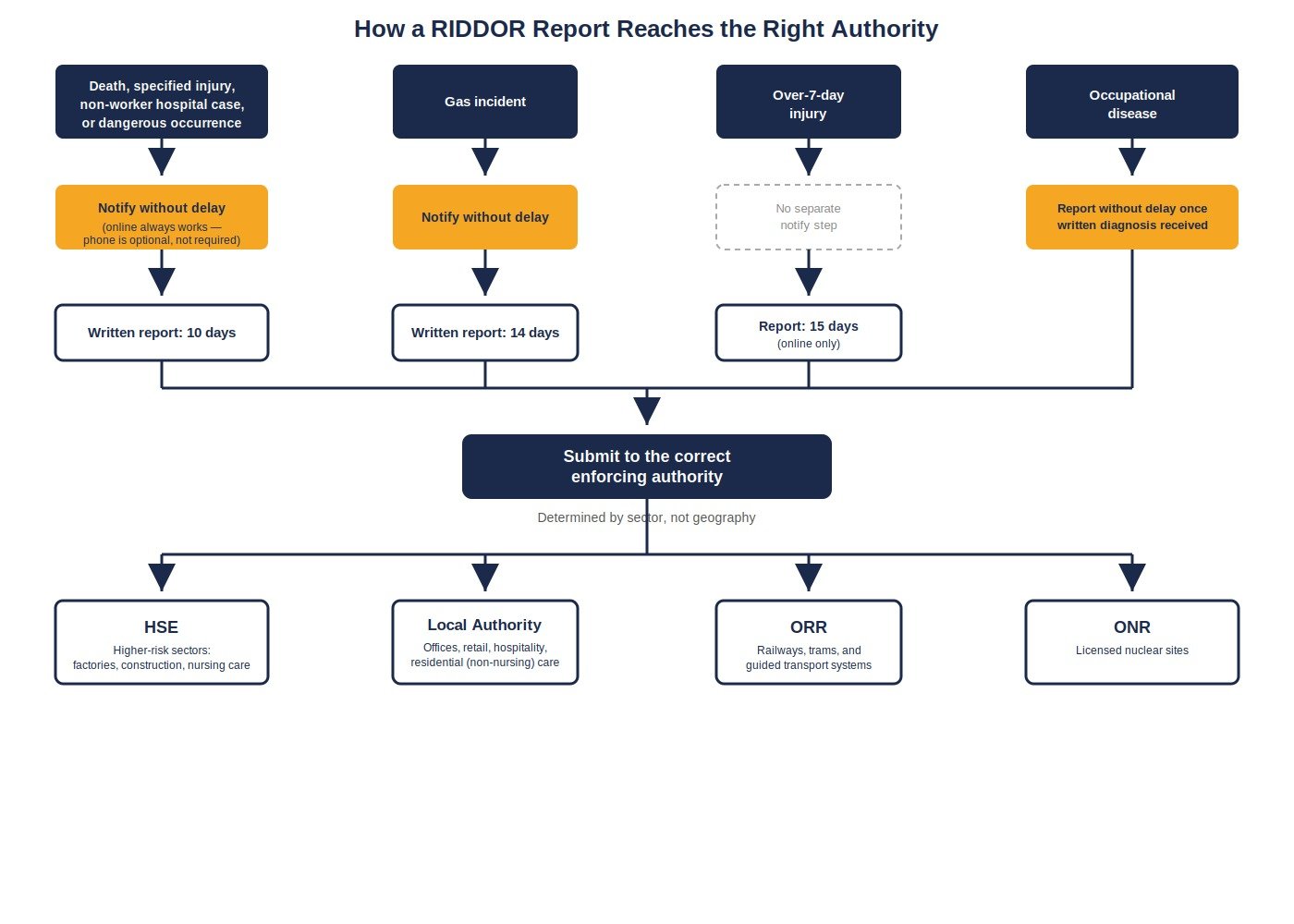
The report must go directly to whichever authority has jurisdiction over those premises, not to HSE by default. HSE and local authorities split enforcement by sector, not geography, so identifying the right recipient depends on the type of business, not where it's located.
- HSE enforces higher-risk sectors such as factories, construction sites, warehouses used for more than storage, and nursing homes that provide nursing care.
- Local authorities enforce lower-risk, public-facing sectors such as offices, retail, hospitality, leisure, hairdressing and beauty, places of worship, and residential care homes that don't provide nursing care.
- Care homes split on this exact distinction. A home providing nursing care falls to HSE; a home providing residential care without nursing falls to the local authority. Where both are provided, HSE is the enforcing authority unless the nursing element is minimal.
- Two further destinations exist outside the HSE/local authority split. The Office of Rail and Road (ORR) enforces railways, trams, and other guided transport systems. The Office for Nuclear Regulation (ONR) enforces at licensed nuclear sites.
How Do You Build a Process That Meets Every RIDDOR Deadline?
- Train line managers to recognise which of RIDDOR's four reporting timescales applies (10-day, 14-day, 15-day, or disease-triggered), and to separately track the over-3-day recording-only duty, which sits outside RIDDOR's reporting deadlines entirely.
- Assign one nominated reporter per site who submits the external report, not just someone who logs the incident internally. Name a second, out-of-hours contact too, since a specified injury or fatality doesn't wait for office hours and the without-delay clock starts regardless of when the office reopens.
- Route occupational disease diagnoses to the same nominated reporter. This path has no fixed day-count, so the reporter needs a way to know the moment a written diagnosis arrives, not just when someone remembers to mention it.
- Record every over-3-day injury in the accident book, even though it isn't RIDDOR-reportable on its own. Regular audits catch these before they're missed entirely, and the record often surfaces a missed over-7-day report before HSE would otherwise catch it.
- Build an escalation trigger for any injured worker still off or on modified duties approaching day 7, since the 15-day clock starts from the accident date, not from when HR notices the absence.
- Build a reopening trigger for closed cases: if a worker with a previously reported injury dies within a year, that death is reportable as a fatality in its own right.
- Keep a dated record of every submission, including the confirmation reference, for at least 3 years.
Timescale vs. Practice: Where RIDDOR Compliance Falls Short
Failing to report is a criminal offence under Section 33 of the Health and Safety at Work etc. Act 1974, carrying an unlimited fine and up to two years' imprisonment on indictment. It is prosecuted independently of whatever caused the incident.
A 2021 case shows how badly this can go wrong. A builder was sentenced to 24 weeks in prison after failing to report a worker's leg amputation on his site.
The HSE only learned of the incident roughly 8 months later, after the injured worker complained directly. By that point, HSE noted, the construction job was nearly finished, and little meaningful investigation was possible.
Under-reporting is not a fringe problem. HSE estimates that only around half of RIDDOR-reportable non-fatal injuries to employees are actually reported. When a failure does come to light, it's often through an insurance claim, an employee complaint, or hospital records; months after the "without delay" window closed.
Reporting late is still better than not reporting, but it doesn't undo the offence. The deadline exists precisely so an investigation can happen while evidence is still fresh.
Why Do RIDDOR Timescales Exist? From Accident to Accountability
RIDDOR 1985 (in force 1986). Established the baseline reporting duty, replacing the earlier Notification of Accidents and Dangerous Occurrences Regulations from 1980.
RIDDOR 1995 (in force 1996). Refined the categories and set the injury threshold at 3 days off work, with a 10-day reporting deadline.
The 2012 amendment (in force April 2012). Raised the injury threshold from 3 days to 7 days and extended the reporting deadline from 10 days to 15 days, giving employers time to confirm whether an absence actually crossed the new, higher threshold.
RIDDOR 2013 (current law). Grew out of Professor Löfstedt's 2011 independent review of health and safety law, which recommended clarifying and simplifying reporting requirements after businesses had flagged widespread ambiguity, particularly around injuries to non-workers. RIDDOR 2013 replaced the 1995 Regulations, consolidated the 2012 threshold changes, and simplified the old "major injuries" list into the current specified-injury categories.
The timescales exist to serve two different needs, not one. The without-delay notification duty exists so an investigation can start while evidence and witness memory are still fresh, which is why it applies immediately to deaths, specified injuries, dangerous occurrences, and gas incidents regardless of how long the paperwork takes afterward.
The written-report deadlines exist for a separate, more practical reason: giving the responsible person enough time to gather accurate details. That's most visible in the 15-day window for over-7-day injuries, which has to be long enough to actually observe whether the 7-day threshold is met before a report is even due.
Meeting RIDDOR Timescales Comes Down to One Thing
Meeting every RIDDOR deadline comes down to knowing which of the four clocks has started, not memorising all seven categories individually.
Once a business identifies whether an incident falls into the without-delay bucket, the 15-day bucket, or the disease-notification bucket, the rest is a matter of process rather than judgement.
Incident management software that timestamps a report the moment it's logged makes it easier to prove exactly when each clock started, which is often the detail that decides whether a late report becomes a prosecution.
Frequently Asked Questions
Is RIDDOR 10 Days or 15 Days?
RIDDOR is both, plus a third figure for one category. Deaths, specified injuries, dangerous occurrences, and non-worker hospitalisations need a written report within 10 days, following notification without delay. Gas incidents get their own 14-day deadline. Over-7-day injuries get 15 days instead.
Does the Reporting Clock Start on the Day of the Incident?
Yes, the reporting deadline runs from the accident date itself, not the day after. Over-7-day injuries must be reported within 15 days of the accident, and the 10-day categories within 10 days of the incident. This is separate from the 7-day incapacitation count, which does exclude the day of the accident when working out whether the threshold was crossed.
How Long Must RIDDOR Records Be Kept?
RIDDOR records must be kept for at least 3 years from the date the record was made, not the date of the incident itself. Records can be kept electronically or on paper, as long as they stay accessible.
What Does "Without Delay" Mean in Practice?
"Without delay" means reporting by the fastest practicable method, and HSE's guidance presents the online form as the primary route for every category. Phone is offered as an alternative, but only for fatal accidents and specified injuries to workers, not as the expected first step.
Do Near Misses Need to Be Reported Under RIDDOR?
No, only specific near misses are reportable. For general workplaces, RIDDOR lists 27 defined "dangerous occurrences" under Schedule 2, with further categories applying to mines, quarries, transport systems, and offshore workplaces. Only events matching the relevant list qualify, regardless of how serious a general near miss looks.

Mehreen Iqbal

Started with a Bachelors in Microbiology, then a Masters in Public Health; Currently a Workplace Safety Expert.