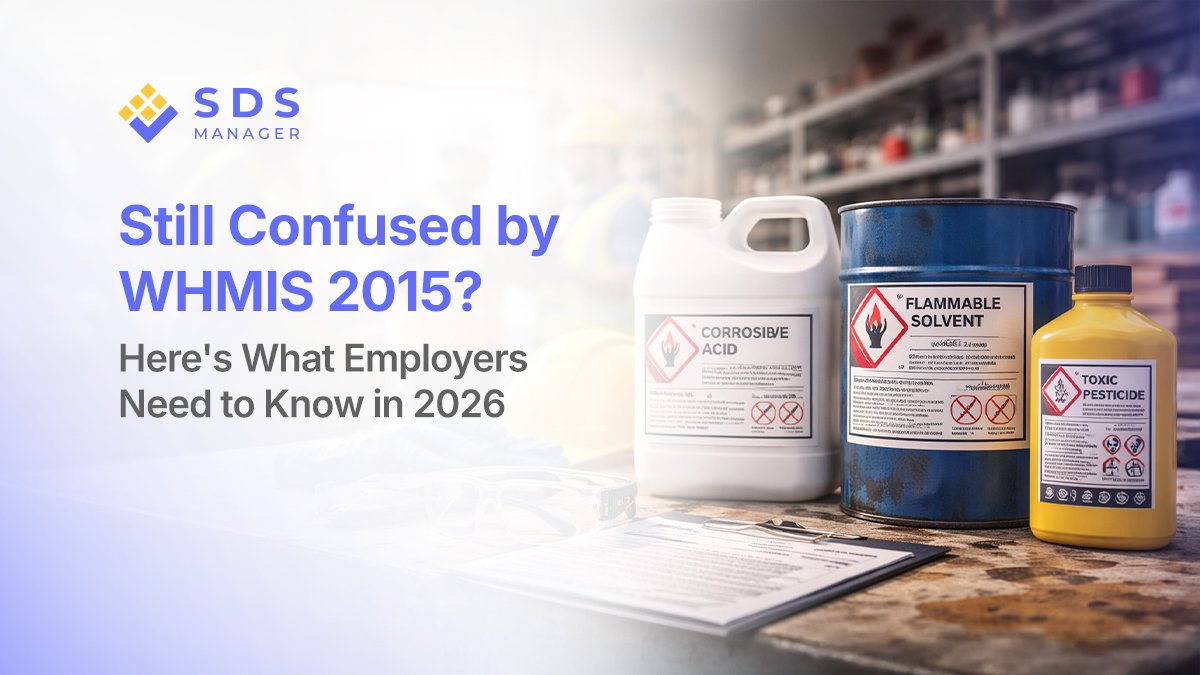
WHMIS 2015 is Canada's national standard for hazard communication in the workplace, updated in 2015 to align with the UN Globally Harmonized System of Classification and Labelling of Chemicals (GHS).
The "2015" label can be misleading though. It doesn't mean the standard is a decade old and due for replacement. It refers to when Canada's system was last overhauled, and the framework is very much active in 2026. In fact, further amendments came into force in December 2022, with full supplier compliance required as of December 15, 2025, making right now one of the most important moments to ensure your program is up to date.
This guide covers every core employer obligation under WHMIS 2015, what inspectors look for, and what it costs to get it wrong.
What Is WHMIS 2015?
WHMIS stands for Workplace Hazardous Materials Information System. It's Canada's national standard for communicating health and safety information about hazardous products in the workplace.
The 2015 update aligned Canada's system with the UN Globally Harmonized System of Classification and Labelling of Chemicals (GHS), replacing WHMIS 1988 and its outdated Material Safety Data Sheet format. Before 2015, Canada's system used its own classification rules that differed from the rest of the world, creating friction for businesses operating across borders and confusion for workers handling products from international suppliers.
The key changes were a new classification system with 31 hazard classes, standardized diamond-shaped pictograms, and the 16-section Safety Data Sheet format replacing the older nine-section MSDS (CCOHS, 2025).
These changes made Canada's hazard communication consistent with over 70 countries worldwide. In December 2022, Health Canada amended the Hazardous Products Regulations further to align with GHS Revisions 7 and 8, adding new hazard classes and expanding SDS content requirements, with full compliance required as of December 15, 2025.
What Are Employers Required to Do?
Employers have four core obligations under WHMIS 2015, enforced through both federal legislation and provincial or territorial occupational health and safety laws. Failing any one of them is enough to trigger an enforcement action.
Maintain A Hazardous Product Inventory
Keep a complete, current list of all hazardous products used, stored, or handled in your workplace. This includes everything from cleaning products and lubricants to solvents and adhesives. It's the foundation everything else builds on, and an incomplete inventory is one of the most common findings during inspections.
Ensure Sds Access At All Times
Every hazardous product must have a current 16-section SDS accessible to workers at any time, including during emergencies. SDSs must be no more than three years old, and digital systems must work even during power or internet outages. If a supplier hasn't provided an updated document within that window, it's the employer's responsibility to follow up (CCOHS, 2025).
Label All Containers Correctly
Every container, including decanted or transferred products, needs a compliant WHMIS label with the product identifier, hazard pictograms, signal word, hazard statements, and supplier contact information. Small containers and spray bottles are not exempt. In 2023, an Ontario manufacturer was fined $35,000 after a worker suffered chemical burns from a mislabeled container where the SDS hadn't been updated in over five years (Training Source, 2026).
Deliver And Document Site-Specific Training
Generic online courses don't meet the legal standard. Training must cover the specific products workers handle in their role, be reviewed at least annually, and be fully documented. A warehouse worker handling flammable solvents needs different training than an office cleaner, and both need more than a certificate from a generic e-learning module. If it isn't written down, it didn't happen.
What Are the Penalties for Non-Compliance?
Violations of the Hazardous Products Act can result in fines up to $1,000,000 per violation, product seizures, corrective orders, and up to two years' imprisonment for willful negligence. Health Canada administers the federal side, while provincial and territorial occupational health and safety regulators handle workplace enforcement. Provincially, inspectors can issue stop-work orders on the spot.
A 2024 Alberta contractor received one for failing to train temporary workers on epoxy resins, costing nearly $50,000 in lost productivity before coming back into compliance (Training Source, 2026). Beyond regulatory penalties, a single chemical exposure incident can cost CAD $40,000 to $100,000 or more in WSIB claims, medical costs, and retraining (WSIB Ontario).
For employers managing large workforces or multiple sites, that exposure multiplies quickly. It's also worth noting that inspections can happen at any time and without prior notice. The cost of a well-run WHMIS program is a fraction of what a single serious incident or unannounced inspection failure costs.
Managing SDS Compliance at Scale
For workplaces with dozens or hundreds of hazardous products, keeping SDSs current is the hardest part of staying compliant. Documents need to be under three years old, bilingual where required, version-controlled, and accessible across every site.
This becomes even more complex when suppliers update their SDSs following regulatory changes, as they were required to do by December 2025. Manual systems, binders, and shared drives don't scale, and they're the first thing an inspector will flag.
SDS Manager centralizes your entire SDS library, automates supplier update tracking, and gives every site instant access, so your team isn't chasing documents before an inspection. For multi-site operations in particular, having a single source of truth for every SDS across every location is what separates a program that holds up under scrutiny from one that doesn't.
With the December 2025 amendments now in full effect, there's no better time to get your SDS library in order.
Frequently Asked Questions
What must a WHMIS 2015 label include?
The product identifier, hazard pictograms, signal word, hazard and precautionary statements, and supplier contact information (CCOHS, 2025).
How often does WHMIS training need to be renewed?
At least annually, and whenever new hazardous products are introduced or hazard information changes.
Do temporary workers need WHMIS training?
Yes. Any worker who works with or near hazardous products must be trained, regardless of employment status.
What happens if an SDS is more than three years old?
It's considered out of date. Contact the supplier for a current version immediately, as using outdated documents creates both a compliance gap and a safety risk.

Mehreen Iqbal

Started with a Bachelors in Microbiology, then a Masters in Public Health; Currently a Workplace Safety Expert.