If you manufacture or import chemicals in Canada, two lists determine your regulatory obligations before a substance enters the market: the Domestic Substances List (DSL) and the Non-Domestic Substances List (NDSL).
Which list your substance appears on, or whether it appears at all, determines whether you need to notify Environment and Climate Change Canada before manufacture or import, and how much data you need to provide. Getting this wrong carries serious financial and legal consequences under the Canadian Environmental Protection Act, 1999 (CEPA).
This guide explains what the DSL and NDSL are, how they differ, and what each one means for your compliance obligations.
What Is the Domestic Substances List?
The Domestic Substances List is the official inventory of substances that were manufactured in or imported into Canada on a commercial scale. It was first published in the Canada Gazette on May 4, 1994, and captured approximately 23,000 substances that were in Canadian commerce between January 1984 and December 1986 (Environment and Climate Change Canada, 2026). The list now contains more than 28,000 substances and is amended on average 12 times per year to add, update, or remove entries.
The DSL is maintained by Environment and Climate Change Canada (ECCC) under subsection 66(1) of CEPA. Its purpose is straightforward: if a substance is on the DSL, it is considered an existing substance in Canada and generally does not require a New Substances Notification (NSN) before it is manufactured or imported.
A company can import or manufacture a DSL substance in any quantity without the notification requirement, unless the substance is subject to a Significant New Activity (SNAc) notice, which imposes additional assessment obligations for new uses or conditions of use that differ meaningfully from those originally assessed (Chemscape, 2025).
The DSL is divided into eight parts based on substance type, including chemicals, polymers, inanimate products of biotechnology, and living organisms, as well as whether the substance identity is confidential. Confidential substances are identified by masked names and a unique confidential substance identity number assigned by ECCC.
What Is the Non-Domestic Substances List?
The Non-Domestic Substances List is Canada's second chemical inventory, covering substances that are commercially available internationally but were not in commercial use in Canada during the 1984 to 1986 reference period. The NDSL currently lists over 58,000 substances and is updated on average 10 times per year (Canada.ca, 2025).
The NDSL is updated annually to incorporate substances that have been on the United States Environmental Protection Agency's Toxic Substances Control Act (TSCA) Chemical Substances Inventory for at least one year, making it closely tied to the US regulatory framework.
However, certain substances are excluded from NDSL eligibility regardless of their TSCA status, including substances subject to risk management in Canada or the US, substances covered by the Stockholm Convention on Persistent Organic Pollutants, and all per- and polyfluoroalkyl substances (PFAS) as defined in the State of PFAS Report (Canada.ca, 2025).
Unlike DSL substances, NDSL substances are still considered new to Canada. This means they are subject to the New Substances Notification Regulations (Chemicals and Polymers), but with significantly reduced information requirements compared to substances that appear on neither list.
What Is the Difference Between the DSL and NDSL?
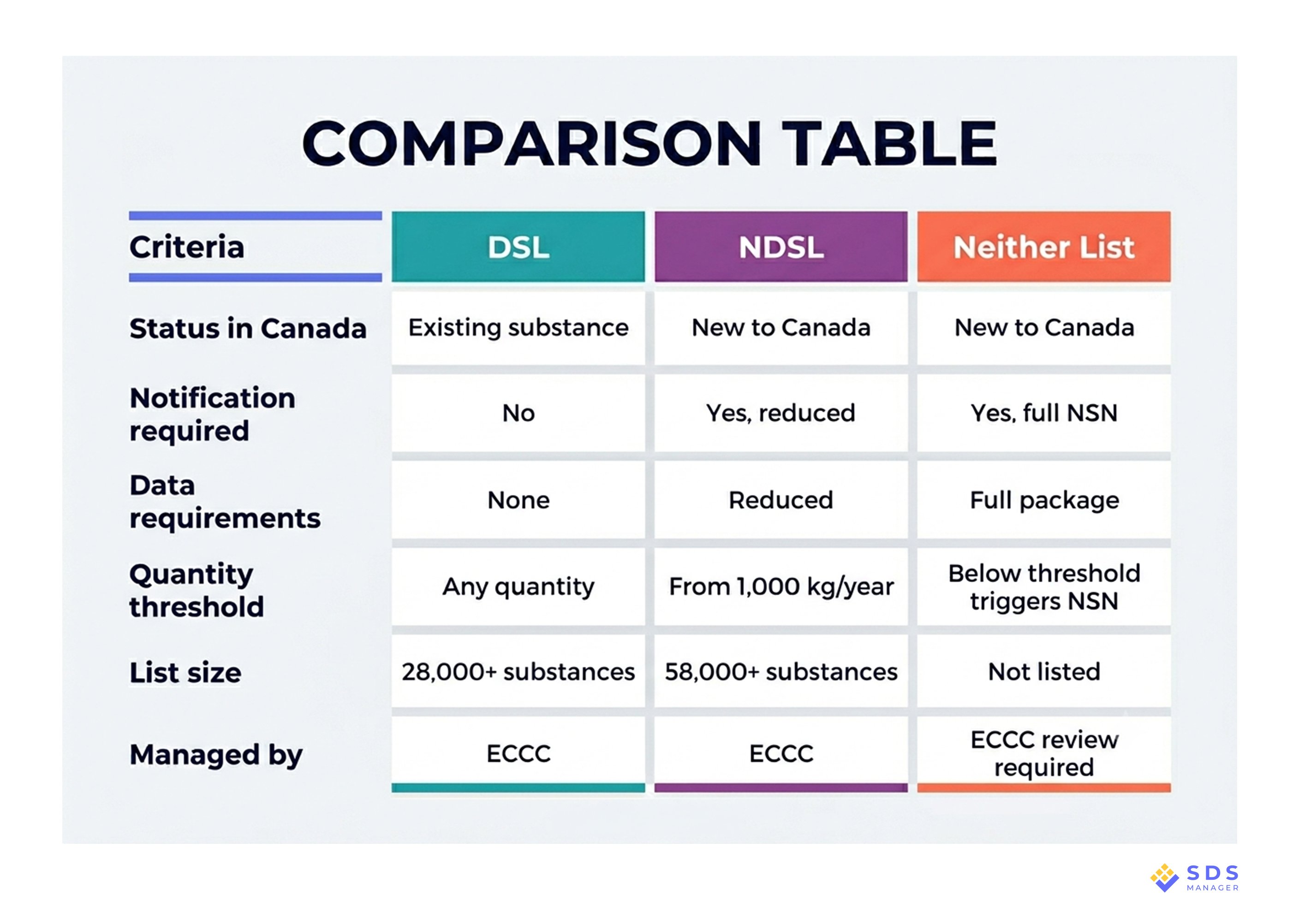
The core difference comes down to status and notification burden. A substance on the DSL is considered existing in Canada and can generally be used without prior notification. A substance on the NDSL is considered new to Canada but benefits from a lighter notification pathway. A substance on neither list faces the full New Substances Notification requirements before it can be manufactured or imported above threshold quantities.
In practice, the NDSL functions as a middle tier. It signals that a substance has a track record in international commerce, specifically in the US market, and allows Canadian businesses to notify ECCC with less data than would otherwise be required. The notification thresholds for NDSL substances are triggered at 1,000 kg per year for the first submission level and 10,000 kg per year for the second, with additional requirements if quantities exceed 50,000 kg per year and the public may be significantly exposed (New Substances Notification Regulations, 2026).
It is important to note that a substance cannot appear on both lists simultaneously. Once a substance is added to the DSL, it is removed from the NDSL. When that happens, the notification requirement for that substance falls away entirely, representing a meaningful reduction in ongoing regulatory burden for businesses using it (GoCompliance, 2026).
What Happens If a Substance Is on Neither List?
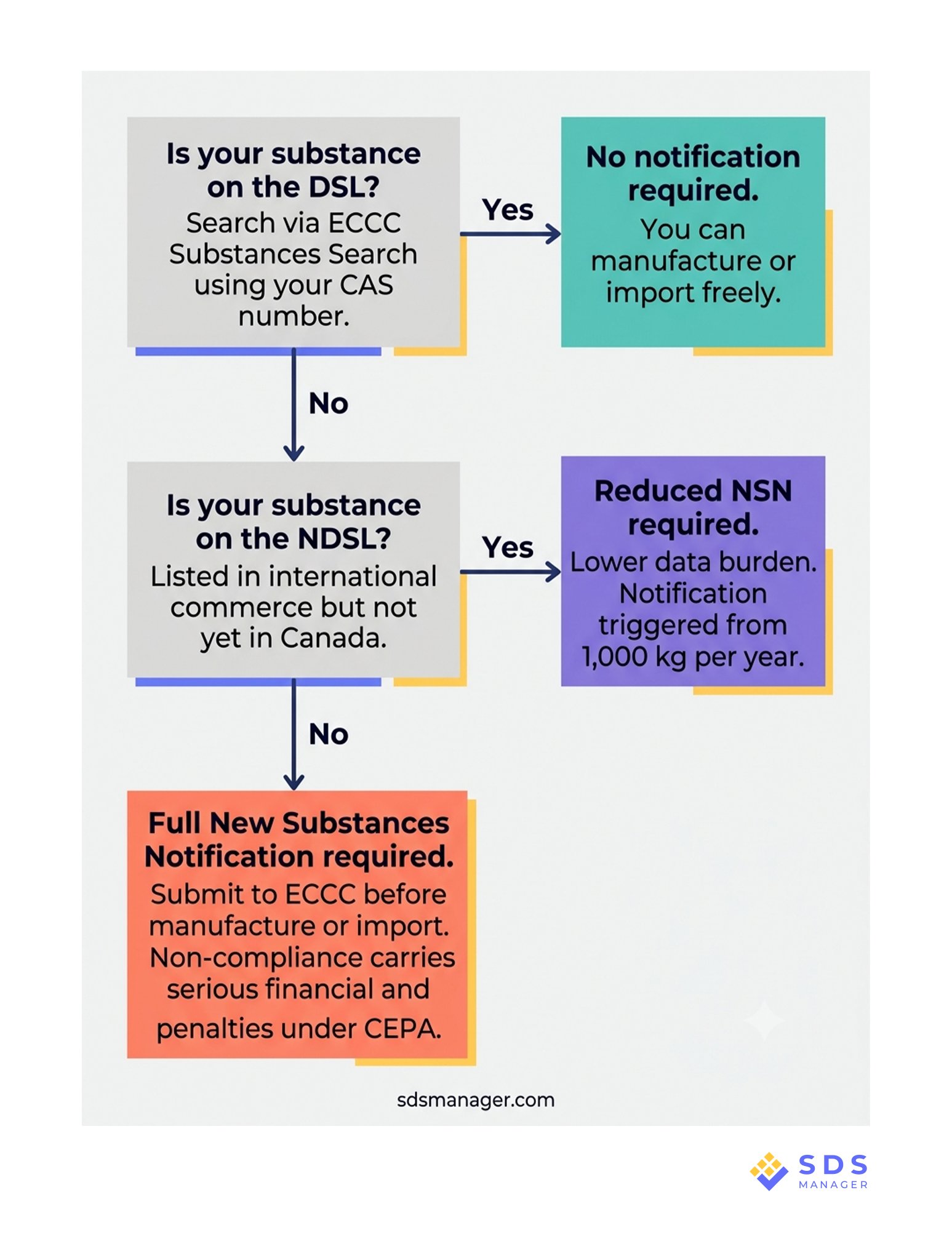
If a substance does not appear on the DSL or the NDSL, it is classified as new to Canada and subject to the full New Substances Notification process under CEPA before it can be manufactured or imported above threshold quantities. The notification must be submitted to ECCC with all information prescribed in the New Substances Notification Regulations, and the government must assess the substance to determine whether it is toxic or capable of becoming toxic under section 64 of CEPA.
Missing this requirement carries serious consequences. CEPA provides for significant financial penalties and potential criminal liability for violations, and there is no retrospective exemption once a substance has been manufactured or imported without the required notification (Chemscape, 2025).
How To Check Whether a Substance Is on the DSL or NDSL
ECCC provides a public search tool called Substances Search, accessible through the Government of Canada website. A CAS number search returns the list status of any substance, including whether it carries any administrative flags such as the N flag, which indicates the substance was assessed as a new substance before being added to the DSL, or the T flag, which covers substances added during the transitional period between January 1987 and July 1994 (Canada.ca, 2026).
For businesses managing large chemical inventories, checking CAS numbers one at a time is not a practical compliance strategy. Keeping your SDS library current and organised is the foundation of knowing what substances you are working with.
Final Thoughts
The DSL is a living document. In April 2026, the Government of Canada published Order 2026-112-03-01, amending the DSL to add four living organisms including a recombinant viral vector and unmodified human hematopoietic stem cells, alongside four additional chemicals and polymers. Once a substance is added to the DSL, it is no longer subject to the New Substances Notification Regulations, removing the notification burden for any business manufacturing or importing it (GoCompliance, 2026).
For businesses monitoring substances currently on the NDSL, watching for DSL additions is worth building into your compliance calendar. A substance moving from the NDSL to the DSL removes notification requirements entirely.
Frequently Asked Questions
What does DSL stand for in Canada?
DSL stands for Domestic Substances List. It is an inventory of substances manufactured in or imported into Canada on a commercial scale, maintained by Environment and Climate Change Canada under CEPA.
What is the difference between the DSL and NDSL?
The DSL lists substances considered existing in Canada, which generally do not require notification before manufacture or import. The NDSL lists substances considered new to Canada but in international commerce, which require notification with reduced information requirements. A substance on neither list requires full New Substances Notification before it can be manufactured or imported above threshold quantities.
How often is the DSL updated?
The DSL is amended on average 12 times per year to add, update, or remove substances. Amendments are published in the Canada Gazette.
What happens if my substance is not on the DSL or NDSL?
It is classified as new to Canada and requires a full New Substances Notification to ECCC before it can be manufactured or imported above threshold quantities. CEPA violations carry significant financial and legal penalties.
Can a substance be on both the DSL and NDSL?
No. A substance cannot appear on both lists simultaneously. When a substance is added to the DSL it is removed from the NDSL.

Mehreen Iqbal

Started with a Bachelors in Microbiology, then a Masters in Public Health; Currently a Workplace Safety Expert.