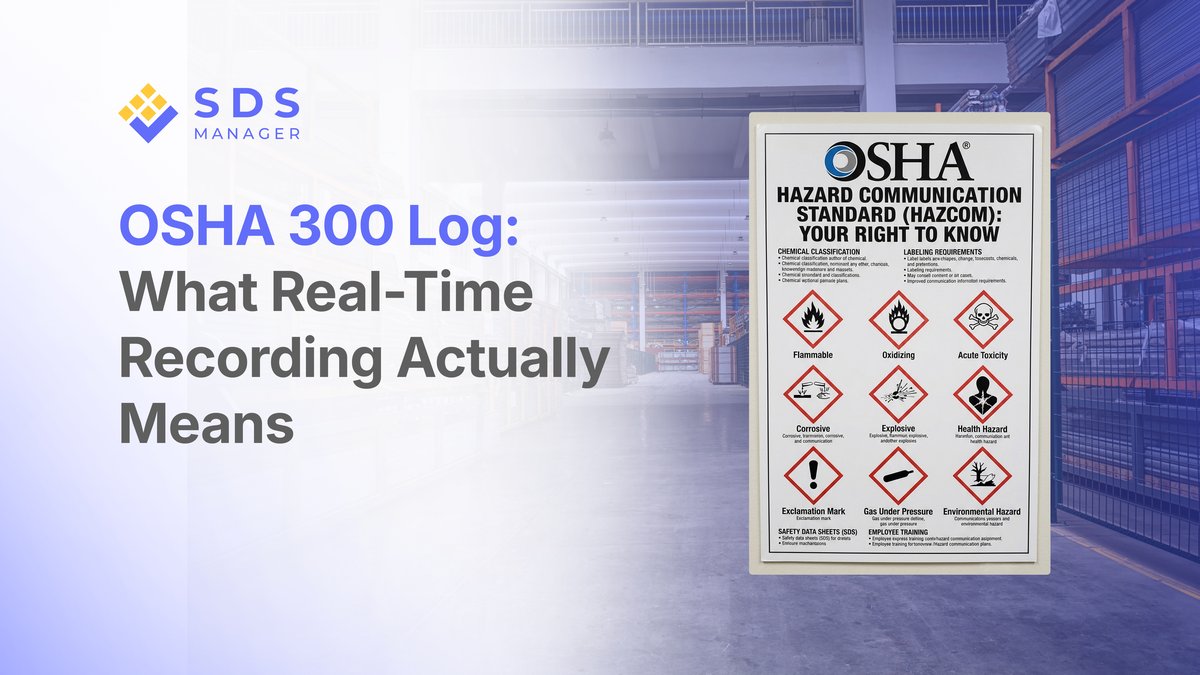
The OSHA 300 Log is a federally required record that US employers use to document all work-related injuries and illnesses that occur in their workplace each year.
It is not an end-of-year task. It is a live document, and failing to treat it that way is one of the most common recordkeeping mistakes OSHA cites.
The document requires each recordable injury to be entered within seven calendar days of receiving information about the injury or illness. That window applies year-round, not at summary time. Many organisations complete their logs in January when the 300A posting deadline comes around, which means they are already months behind on entries that should have been recorded in real time.
A worker reports a recordable injury on a Tuesday in September. The seven-day clock starts that day. By the following Tuesday, the entry must be in the 300 Log and the 301 Incident Report must be complete. Many organisations miss that window entirely, catching up only in January when the 300A posting deadline forces a review. At that point, entries that should have been recorded in real time are months overdue.
That seven-day requirement applies year-round, not just at summary time.
What The Seven-Day Rule Actually Requires
OSHA requires three primary forms to document work-related injuries and illnesses.
- Form 300 serves as the ongoing log of recordable incidents.
- Form 300A summarises the annual totals.
- Form 301 provides detailed information about each recordable case, including how and where the incident occurred.
All three are connected. The OSHA 301 Incident Report must also be completed within seven calendar days of learning about a recordable work-related injury or illness, not just the 300 Log entry. The seven-day clock starts when the employer learns of the incident, not when it is formally reported internally.
Separately, all employers are required to notify OSHA within eight hours after a work-related death, and within 24 hours when an employee suffers a work-related in-patient hospitalisation, amputation, or loss of an eye. These reporting timelines sit on top of the recordkeeping requirement and apply to organisations of all sizes.
Where Organisations Are Falling Short
One of the most common recordkeeping mistakes is failing to record incidents promptly. Waiting until year-end invites errors. But the problem goes beyond timing.
Recordkeeping issues that frequently result in citations include improperly completed OSHA 300 forms, no coordination between workers compensation recordkeeping and OSHA recordkeeping, and employers failing to perform audits or make corrections to their documents.
Employers with multiple establishments or job sites are especially vulnerable to recordkeeping violations because these situations present special compliance challenges and more exposure to violations. For multi-site organisations managing incidents across locations, keeping the 300 Log accurate and current in real time is an operational challenge as much as a compliance one.
The enforcement risk is also shifting. OSHA has more frequently issued willful and repeat citations in recent years, and also gives out more incident-by-incident citations rather than grouping incidents into one. When OSHA issues incident-by-incident penalties it can get very expensive very fast, particularly for recordkeeping violations where multiple missed or late entries each represent a separate infraction.
What The Electronic Submission Requirements Add
Since January 2024, the stakes around accurate real-time recordkeeping have increased. Establishments with 100 or more employees in designated high-hazard industries must now submit detailed 300 log and 301 incident report data electronically, not just the 300A summary. If the underlying log is incomplete or inaccurate because entries were not recorded in real time, the submitted data reflects those gaps directly to OSHA.
The electronic submission deadline is March 2 each year, covering the previous calendar year's data. What gets submitted is a direct reflection of how well the 300 Log was maintained throughout the year.
Final Thoughts
Keeping the OSHA 300 Log current across a workforce requires a system that makes incident recording fast and accessible at the point of occurrence. EHS Solution by SDS Manager includes an Incident Management module that captures recordable events as they happen, keeps them organised by establishment, and ensures the right information is documented within the required timeframe.
When March comes around, the log is already complete. That is the difference between real-time recordkeeping and year-end scrambling.

Mehreen Iqbal

Started with a Bachelors in Microbiology, then a Masters in Public Health; Currently a Workplace Safety Expert.