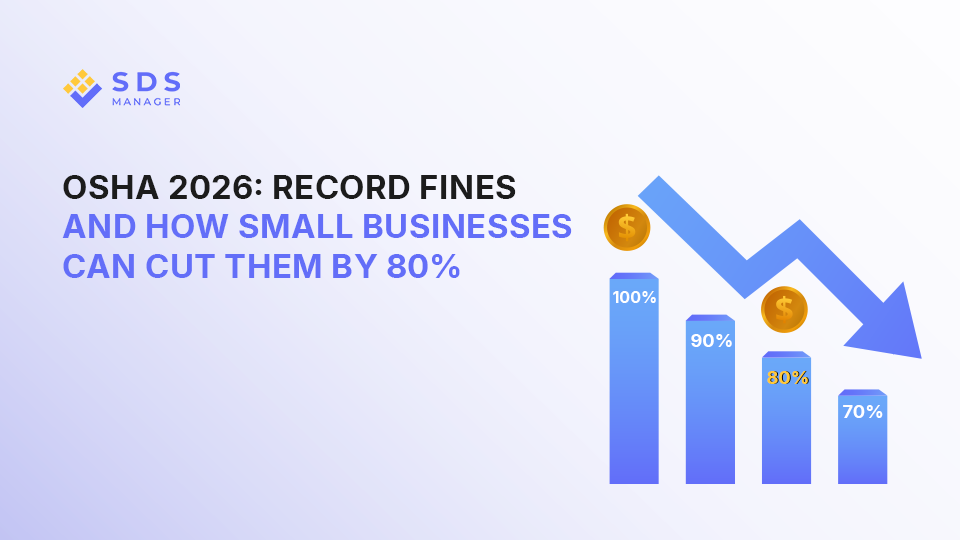
The most expensive OSHA inspection in your company's history could happen this year. Penalty maximums are at all-time highs ($165,514 per willful or repeat violation) and enforcement is active across construction, manufacturing, warehousing, and agriculture.
But a sweeping update to OSHA's penalty calculation rules means qualifying small businesses can now reduce fines by more than 80%. The difference between the maximum fine and what you actually pay comes down almost entirely to documentation and timing.
FINES ARE AT AN ALL-TIME HIGH
Current OSHA penalty ceilings: $16,550 per serious violation, $165,514 per willful or repeat violation. Failure-to-abate citations accrue daily, and multi-item citations in high-risk industries can escalate to six figures fast.
But the number on the citation is not what you necessarily pay.
A small business with a clean record that corrects a hazard immediately could see a willful violation drop from $165,514 to around $49,654, and a serious violation fall from $16,550 to as low as $3,965. The math behind those reductions is now more predictable than ever.
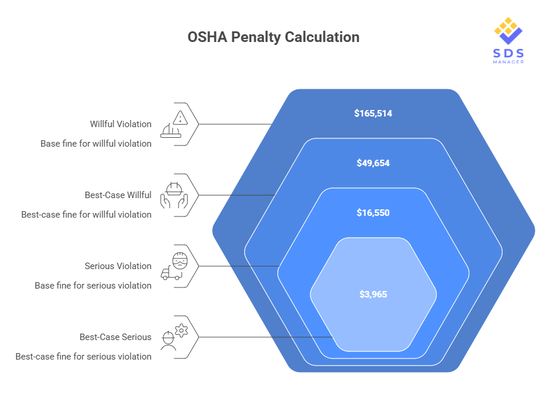
Source: OSHA.gov — Penalty Structure
SMALL BUSINESSES GOT A MAJOR BREAK
OSHA's updated penalty calculation rules delivered one of the most employer-friendly policy shifts in years. Here's how the reductions stack:
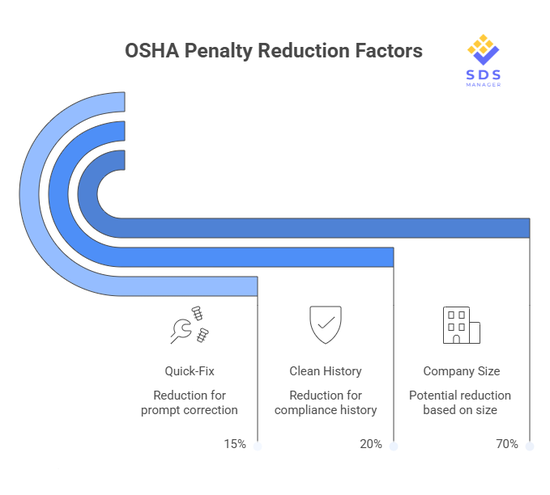
- Size reduction: Businesses with 25 or fewer employees qualify for a 70% penalty reduction
- Quick-Fix reduction: Correct a hazard within 5 days of discovery and claim an additional 15% off
- Good faith/history reduction: No serious violations in the past 5 years, or no prior OSHA inspection at all, adds a further 20% reduction
Combined, qualifying small businesses can see total penalties cut by over 80%.
That means preparation, fast hazard response, and clean recordkeeping are no longer just safety best practices. They're direct financial levers.
WHAT'S CHANGING IN 2026: YOUR DEADLINE CHECKLIST
Hazard Communication (HCS): two deadlines
- May 19, 2026: Manufacturers, importers, and distributors must comply with updated labeling and Safety Data Sheet (SDS) requirements
- November 20, 2026: All employers must update workplace programs and employee training
Heat Illness enforcement: already active The federal heat illness rule is still proposed, but enforcement is running now. Targeted inspections across construction, agriculture, warehousing, and manufacturing are issuing citations under the General Duty Clause. Waiting for a final rule is not a safe strategy.
The Walkaround Rule: now in effect Third-party representatives, including union advocates and outside safety professionals, can now accompany OSHA inspectors during workplace visits. Know who can walk through your facility before an inspection arrives.
California employers: two additional deadlines
- Workplace violence prevention plans must be in place by December 31, 2026
- Revised confined space rules for construction have been in effect since January 1, 2026
WHAT TO DO RIGHT NOW
Under the current penalty structure, your compliance documentation is literally worth money. Three actions that directly reduce fine exposure if an inspection occurs:
- Update your SDS files before May 19. HCS compliance is an active enforcement priority, and documented SDS updates count toward good-faith reductions.
- Log every hazard correction with a date. The Quick-Fix reduction requires proof of correction within 5 days. No documentation, no discount.
- Train staff and keep the records. Training logs are one of the first things an inspector asks for, and one of the fastest ways to demonstrate good faith.
The cost of non-compliance has never been higher. Neither has the financial return on getting ahead of it.
Ready to get your SDS documentation inspection-ready?
SDS Manager helps you update and maintain Safety Data Sheets so your compliance records are always audit-ready, before the inspector walks in.

Mehreen Iqbal

Started with a Bachelors in Microbiology, then a Masters in Public Health; Currently a Workplace Safety Expert.