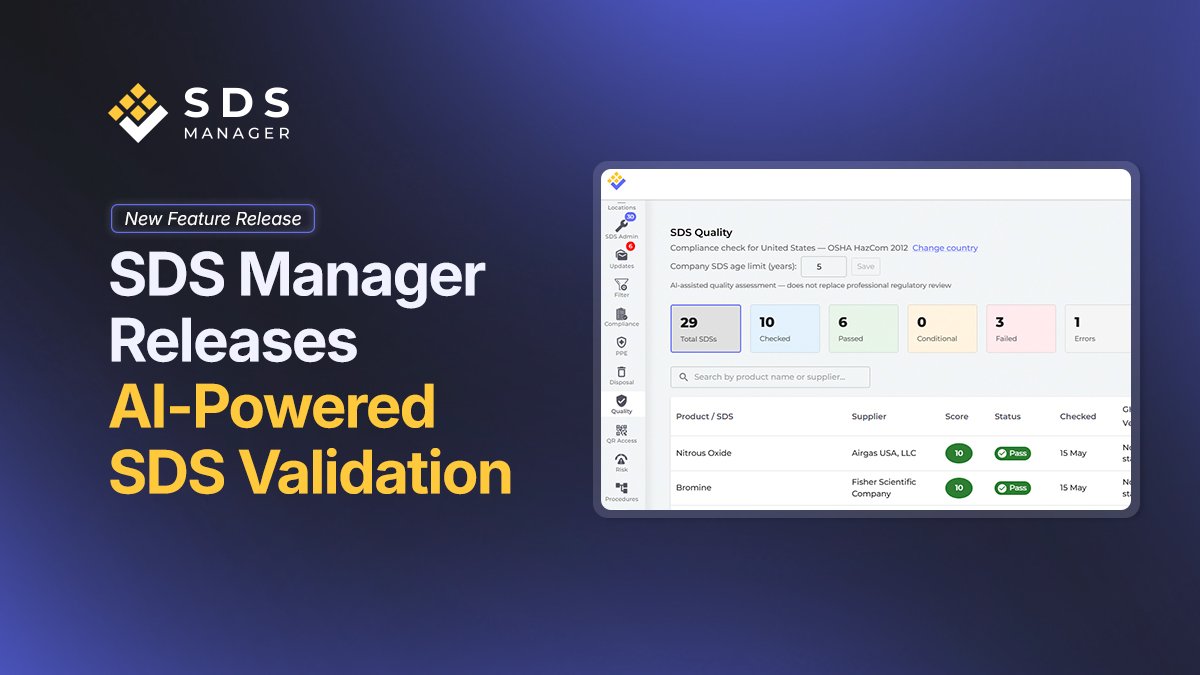
SDS Manager has released AI-powered SDS validation that checks every document in a library against current regulatory requirements and returns a field-level compliance status for each one. The feature addresses what manual review processes cannot do at scale: check content inside every section of every SDS simultaneously against GHS Revision 7, OSHA HazCom 2025, and REACH/CLP requirements.
What AI Validation Checks
The validation engine reads every required field within all 16 SDS sections, not just whether a section heading is present, but whether the content inside it is substantively populated and aligned with current regulatory text.
A Section 8 with a heading but no occupational exposure limits gets flagged. A Section 2 that lists a hazard classification without corresponding precautionary statements gets flagged. Section 9, which now requires 19 distinct physical and chemical property fields under HazCom 2025, is checked against every required field individually.
The engine cross-references each document against all applicable standards in a single pass. For organizations with international operations, a single SDS may need to satisfy OSHA HazCom 2025, GHS Revision 7, and REACH Annex II simultaneously. AI Validation handles all three without running separate checks.
What the Results Look Like
Every SDS in the library receives one of three statuses:
Pass means all 16 sections are complete, classifications are consistent, and the revision date is current.
Conditional means the core structure is intact but specific flagged issues need attention before the next audit.
Fail means critical gaps are present, including missing sections, inconsistent GHS classifications, absent emergency contact information, or misaligned transport data.
Each non-passing SDS comes with specific findings attached: which section failed, which field is missing, and what the gap is. The output is a prioritized remediation list, not a general compliance score, so EHS teams know exactly where to start and what to fix.
Why Coverage at Scale Changes the Compliance Picture
Manual review produces a compliance snapshot that begins aging the moment it closes. An internal SDS Manager analysis of 100,000 commonly used Safety Data Sheets across a library of 17 million+ documents found that 4.3% are missing Section 15 entirely, with a further 44% returning incomplete Section 1 and 2 data. Those gaps exist in libraries that on paper appear maintained.
AI Validation runs across an entire library simultaneously. Whether a library holds 50 or 5,000 SDSs, every document is checked at the same time, returning results in minutes. For EHS teams managing multiple sites, that means a compliance picture that is current, specific, and audit-ready rather than a periodic spot-check with gaps accumulating in between.
Revision dates are monitored automatically across the library. OSHA requires SDSs to be updated within three months of receiving significant new hazard information. AI Validation surfaces overdue updates before an inspector encounters them.
Availability
AI Validation is available now at SDS Manager with full access from the first day of a free trial.
Sources: OSHA FY2024 Enforcement Data; OSHA 29 CFR 1910.1200 HazCom 2025 Final Rule; Trace One Supply Chain Compliance Analysis 2026.

Mehreen Iqbal

Started with a Bachelors in Microbiology, then a Masters in Public Health; Currently a Workplace Safety Expert.