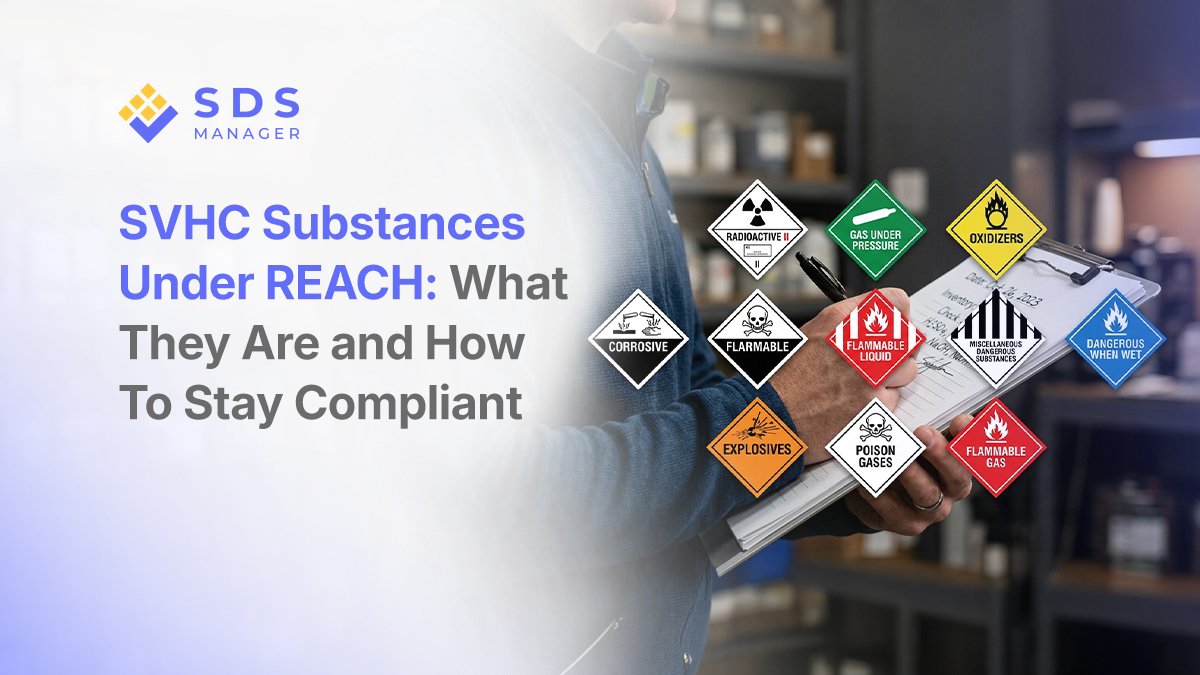
SVHC stands for Substances of Very High Concern, a category of chemicals identified under REACH as posing serious risks to human health or the environment. Once a substance lands on the SVHC Candidate List, it triggers immediate legal obligations for anyone in the supply chain who uses or sells it above a set concentration threshold.
For UK businesses, the SVHC landscape shifted significantly in February 2026 when the government announced a new strategic approach to the UK REACH Candidate List, replacing the post-Brexit interim principles and moving toward closer alignment with the EU.
The UK HSE launched its first public consultation on adding 15 new SVHCs to the UK list in March 2026, with a second batch of 11 substances expected in June 2026 (CIRS Group, 2026). If your compliance programme was built around the original post-Brexit list, it needs reviewing now.
Key Takeaways
- SVHC obligations activate the moment a substance is added to the Candidate List, with no grace period, applying to any article containing it above 0.1 % by weight.
- The 0.1 % threshold is assessed at the individual article level, not the finished product as a whole, meaning a small component can trigger obligations even when the concentration is negligible across the whole assembly.
- The UK REACH Candidate List went five years without a single addition after Brexit. Since February 2026, 26 substances have entered the Registry of Intentions, with a second consultation batch expected in June 2026.
- Candidate List inclusion is not a static compliance checkpoint. Substances can escalate to the Authorisation List, requiring substitution or formal authorisation before use can continue.
What Is an SVHC Substance?
An SVHC is a chemical that meets one or more of the criteria set out in Article 57 of UK REACH. There are three main categories:
Substances classified as carcinogenic, mutagenic, or toxic for reproduction (CMR) at Category 1A or 1B are automatically considered SVHCs. These are substances with established or presumed effects on human health at a fundamental biological level.
Substances that are persistent, bioaccumulative, and toxic (PBT) or very persistent and very bioaccumulative (vPvB) qualify on environmental grounds. These substances accumulate through food chains and remain in ecosystems long after their use ends.
A third category covers substances not fitting neatly into those two groups but for which there is scientific evidence of an equivalent level of concern. Certain endocrine-disrupting chemicals fall here, as do some substances with respiratory sensitising properties (REACH24H, 2025).
Once a substance is formally identified as an SVHC it is added to the Candidate List, which is the starting point for regulatory control under REACH. Inclusion on the Candidate List does not immediately ban a substance, but it does trigger obligations that apply throughout the supply chain.

What Is the REACH SVHC Candidate List?
The Candidate List is the official register of SVHCs that have been formally identified under REACH. In the EU, the list is maintained by ECHA and updated approximately twice a year, currently containing over 250 entries (ECHA, 2026). Under UK REACH, the HSE maintains a separate UK Candidate List.
When the UK left the EU, the UK Candidate List started as a mirror of the EU list at that point in time. Since January 2021, the EU added 42 substances to its list while the UK made no additions, creating a growing gap between the two frameworks (CIRS Group, 2026). The February 2026 policy announcement from DEFRA closes that gap by committing to review and adopt EU additions where appropriate, making the two lists more predictable for businesses operating in both markets.
The Registry of Intentions (ROI) is the UK's early warning mechanism, where substances are proposed before formal Candidate List inclusion. Up until March 2026 the UK ROI had no entries. Since the February announcement, 26 substances have been added, signalling the pace at which the UK list is expected to grow (H2 Compliance, 2026).
What Obligations Does SVHC Status Trigger?
Once a substance appears on the Candidate List above 0.1 % by weight in an article, two obligations activate immediately.
Article 33 communication
Any supplier of an article containing an SVHC above the 0.1 % threshold must proactively inform their business customers, providing at minimum the name of the substance and sufficient information for safe use. Consumers can also request this information and suppliers must respond within 45 days, free of charge (REACH24H, 2025). This obligation applies immediately when a substance is added to the Candidate List, with no grace period.
ECHA notification
If the SVHC exceeds 0.1 % by weight and the total quantity across all articles produced or imported exceeds one tonne per year, the producer or importer must notify ECHA. Notification is required within six months of the substance being added to the Candidate List (ComplyMarket, 2026).
One critical point that catches many manufacturers off guard: the 0.1 % threshold is assessed at the level of each individual article within an assembled product, not at the level of the finished product as a whole. A small component weighing 50 grams that contains 0.15 % of a Candidate List substance triggers the obligation, even if that concentration is negligible across the whole assembly (LegalClarity, 2026).
What Happens If a Substance Moves Beyond the Candidate List?
Candidate List inclusion is the first step in a regulatory process that can escalate. Substances that regulators determine require more stringent control can be moved to the Authorisation List (Annex XIV of REACH), at which point their use becomes prohibited unless a specific authorisation is granted. Some substances face restriction under Annex XVII, which limits or bans specific uses outright.
The practical implication is that SVHC status is not a static compliance checkbox. A substance your supply chain uses today could move to Annex XIV and require substitution or authorisation within a few years. Tracking movement through the regulatory process is part of what SVHC compliance actually involves.

How To Stay Compliant With UK REACH SVHC Requirements
SVHC compliance is a continuous process, not a one-time audit. The Candidate List changes, the UK list is now growing again, and each addition can immediately affect your obligations across your product range.
- Screen your products against the current Candidate List.
Every article you produce, import, or sell needs to be screened against the current UK REACH Candidate List, at the component level. A product-level check is not sufficient. Your SDS documents are a starting point, but component-level material declarations from your supply chain give you the full picture.
- Build supplier communication into your process.
Article 33 obligations flow up and down the supply chain. You need SVHC data from your suppliers to assess your own products, and you need to pass accurate information to your customers. Standardise how you request and receive SVHC declarations, and require suppliers to notify you when the Candidate List changes affect materials they supply to you.
- Keep your SDS library current.
When a substance is added to the Candidate List, its SDS should reflect the updated regulatory status. A centralised SDS library with automated supplier update tracking keeps changes in SVHC status reflected in your documentation, so your team always has accurate hazard information to hand.
- Monitor the UK REACH ROI.
With 26 substances already entered and a second consultation batch expected in June 2026, the UK ROI is now an active regulatory signal. Substances that appear there are candidates for the next Candidate List update. Tracking them gives you lead time to assess your supply chain before obligations formally activate.
Where to Go From Here
SVHC compliance under UK REACH is no longer a static exercise. With the UK Candidate List now actively growing and the second consultation batch expected in June 2026, the obligations that apply to your products today may look different by the end of the year. Screen your products at the component level, keep your supplier communication consistent, and monitor the UK ROI for early signals.
Frequently Asked Questions
What does SVHC stand for?
SVHC stands for Substances of Very High Concern. It is a designation under REACH for chemicals that pose serious risks to human health or the environment due to properties such as carcinogenicity, persistence, or bioaccumulation.
What is the REACH SVHC list?
The REACH SVHC list, formally known as the Candidate List, is the official register of substances identified as SVHCs under REACH. In the UK it is maintained by the HSE under UK REACH. As of 2026 the UK list is being updated to more closely align with the EU Candidate List, which currently contains over 250 entries.
What triggers SVHC compliance obligations?
Obligations activate when an SVHC is present in an article above 0.1 % by weight. At that threshold, Article 33 communication duties apply. If the total quantity also exceeds one tonne per year, ECHA notification is required.
How often is the UK SVHC Candidate List updated?
Following the February 2026 policy change, the UK list is expected to update more frequently and in closer alignment with the EU list, which updates approximately twice per year. The first UK consultation on new additions closed in April 2026, with a second batch expected in June 2026.

Mehreen Iqbal

Started with a Bachelors in Microbiology, then a Masters in Public Health; Currently a Workplace Safety Expert.