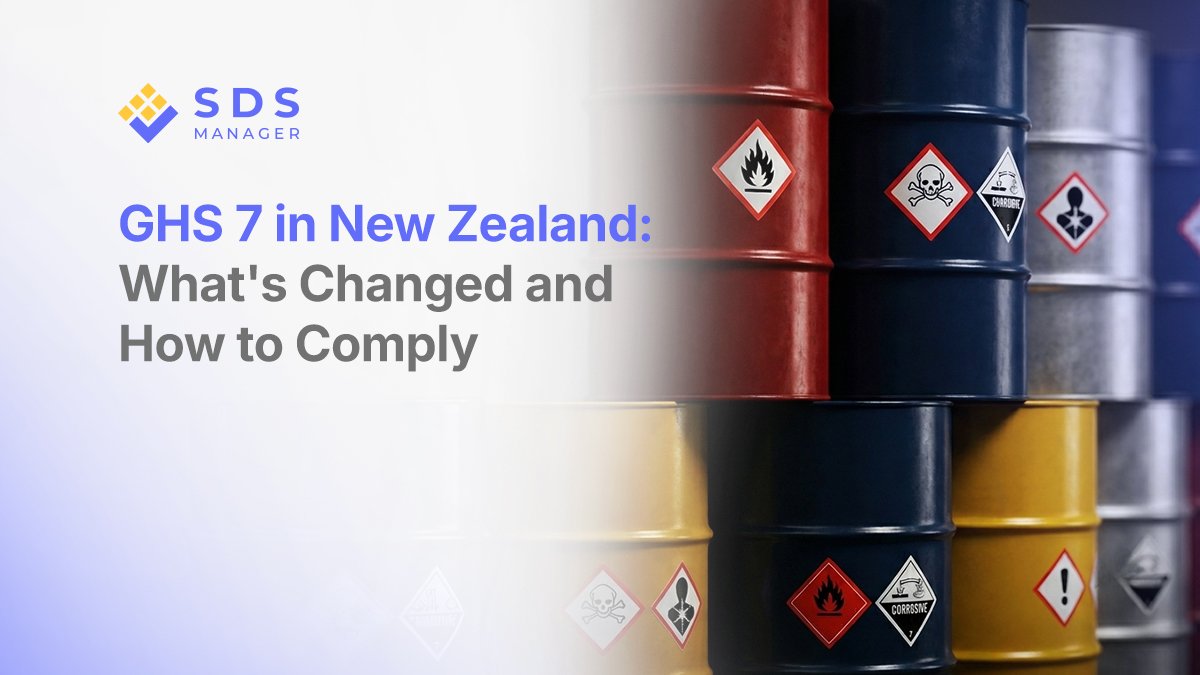
Your SDS might still carry legacy HSNO codes. Your overseas supplier's label almost certainly lacks the NZ 24-hour emergency contact number. Both make you non-compliant.
From 30 April 2025, GHS 7 is the mandatory standard for hazardous substance labels and Safety Data Sheets in New Zealand under the HSNO Act, enforced by the EPA. The gap between knowing the rules changed and confirming your documentation actually reflects them is where compliance risk sits.
This guide breaks down exactly what changed and the six steps required to get your business compliant.
Key Takeaways
- GHS 7 became mandatory in New Zealand on 30 April 2025, replacing the old HSNO alphanumeric classification codes across all labels, Safety Data Sheets (SDS), and packaging.
- Manufacturers, importers, and suppliers are all legally responsible for ensuring their documentation meets the GHS 7 standard under the EPA's consolidated HSNO Notices.
- All NZ product labels must include a 24-hour emergency contact phone number, a requirement not found on most international label formats.
- Workers who handle hazardous substances must be trained on the new hazard categories and SDS format, with records kept as required under NZ health and safety law.
What Is GHS 7 and Why Did New Zealand Switch?
Before GHS 7, New Zealand ran its own chemical classification system using alphanumeric HSNO codes. A code like "6.1A" meant something specific to NZ regulators. To a logistics worker in Germany or a supplier in the United States, it meant nothing. That gap had consequences. Workers handling imported chemicals could not read the labels. Exporters had to produce separate documentation for every market they supplied.
The Globally Harmonised System (GHS), developed by the United Nations, exists to close that gap. New Zealand adopted the 7th revised edition as its legal standard, replacing the old HSNO codes with internationally recognised descriptive hazard categories. "6.1A" becomes "Acute Toxicity, Category 1". The label now speaks the same language as those used in Australia, the EU, the US, and Canada. That is not just a paperwork convenience. It is a safe outcome.
What Specifically Changed Under HSNO Notices
The transition updated three pieces of NZ legislation: the Labelling Notice, the Safety Data Sheets Notice, and the Packaging Notice. All three were consolidated under EPA amendments from April 2021. Four specific changes flow from those updates.
Classification language: Alphanumeric HSNO codes are out. Descriptive GHS 7 hazard category names are in. "3.1B" (flammable liquid) becomes "Flammable Liquid, Category 2". This applies to every document: SDS files, product labels, and self-assignment records.
Terminology expansion: The term "pesticides" on labels has been broadened to "agrichemicals". Any product previously labelled under the narrower term needs a label review.
SDS format alignment: Safety Data Sheets must follow the 16-section GHS format, using standardised H-statements and P-statements. An SDS written to the old HSNO format is no longer compliant, regardless of how recently it was updated.
Emergency contact requirement: Every NZ product label must carry a 24-hour emergency contact phone number. This is a New Zealand-specific obligation that sits on top of the standard GHS elements. It does not appear on most international label formats. A label that fully complies with EU or Australian rules will still fail this requirement.
| Element | Old HSNO System | GHS 7 (Current) |
|---|---|---|
| Classification codes | Alphanumeric (e.g., 3.1B, 6.1A) | Descriptive categories (e.g., Flammable Liquid, Category 2) |
| SDS format | HSNO-specific | 16-section GHS format with H/P statements |
| Label terminology | "Pesticides" | "Agrichemicals" |
| Emergency contact | Not always required | Mandatory 24-hour NZ number on all labels |
| International alignment | NZ-specific | Aligns with the EU, Australia, US, and Canada |
Who Is Legally Responsible Under the New Rules
Compliance responsibility does not sit only with chemical manufacturers. Every business that manufactures, imports, or supplies a hazardous substance in New Zealand is bound by these rules. If you source a product from overseas and place it on the NZ market, even through a distribution agreement, your labelling, SDS documentation, and packaging must meet the GHS 7 standard.
Group standard approvals do not provide cover. The HSNO Notices apply to all substances, including those approved through group standards. An existing approval does not exempt the product from updated labelling or SDS requirements.
Employer obligations extend further still. Workers who handle hazardous substances must receive training sufficient to understand the hazard categories, label symbols, and SDS information relevant to their roles. Handing someone a newly formatted SDS without explanation is not training. It is not compliant either.
How To Comply: A 6-Step Process
The steps below move from documentation audit through to staff training and alternative compliance review. Work through them in order. Each step depends on the one before it being done correctly.
Step 1: Audit Every Hazardous Substance You Hold
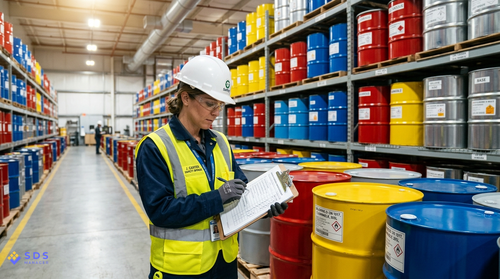
Start with a complete list of every hazardous substance your business manufactures, imports, or supplies. For each one, pull the existing SDS and label documentation and ask one question: Does this use GHS 7 descriptive hazard categories, or does it still reference old HSNO alphanumeric codes?
Any document still referencing HSNO codes is non-compliant. Flag it for update before moving to any other step.
If your business relies on a supplier's SDS rather than producing its own, you remain responsible for confirming that the document meets the NZ standard, including the 24-hour emergency contact number, which most international SDS formats do not include. The EPA publishes a full mapping between old HSNO codes and their GHS 7 equivalents to assist with the conversion.
Step 2: Update Every SDS to the GHS 7 Format
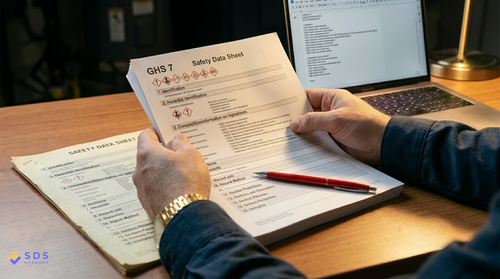
A compliant SDS under GHS 7 has 16 sections in a fixed order, uses approved H-statement and P-statement codes, and carries GHS descriptive classification language throughout. Any SDS that omits H or P statements, uses old HSNO classifications, or departs from the 16-section structure is non-compliant.
Updating an SDS is not a find-and-replace exercise. It is a substantive review. Sections 2, 7, 8, and 11 require the most attention: hazard identification, handling and storage, exposure controls, and toxicological information must all reflect the GHS 7 classification correctly. Swapping out a code while leaving the underlying hazard narrative unchanged produces a document that is internally inconsistent.
That inconsistency will not survive a compliance check. A hazardous chemical management software built for the NZ market can help your team convert legacy HSNO documents to the GHS 7 format and flag any that fall outside the 16-section structure.
Step 3: Update Product Labels and Packaging
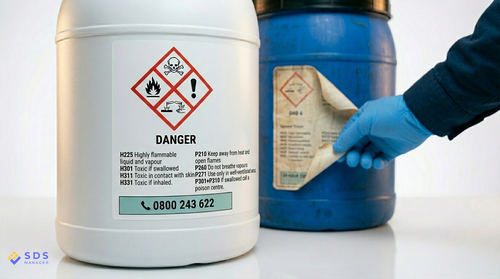
Every label carrying old HSNO codes or outdated terminology must be reprinted. A GHS 7-compliant NZ label requires:
- Product identifier (name as it appears in the SDS)
- GHS hazard pictograms (the standardised symbols for the relevant hazard classes)
- Signal word ("Danger" or "Warning" as determined by the hazard category)
- Hazard statements (H-statements describing the nature and degree of hazard)
- Precautionary statements (P-statements covering prevention, response, storage, and disposal)
- Supplier name and address
- 24-hour emergency contact phone number (NZ-specific requirement)
That last item is where most internationally sourced labels fall short. The label your overseas supplier provides will not carry an NZ 24-hour emergency number. You need to add it before the product reaches the market.
Step 4: Verify Your Group Standard and Self-Assignment Records
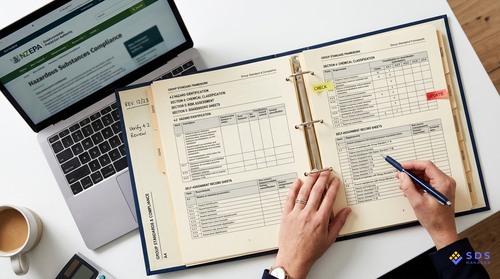
A self-assignment made under the old HSNO code system is not automatically valid under GHS 7. Businesses supplying substances under a group standard must confirm their self-assignment records now reflect GHS 7 classifications, not legacy HSNO codes.
Review the relevant group standard against the EPA's current notices to confirm the substance still qualifies. Where individual approvals are held, check whether those approvals reference classification requirements that have since been updated by the consolidated Notices.
Step 5: Train Staff on the New Classification System
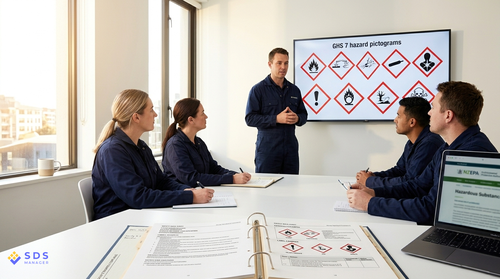
The scope of training depends on the role. A laboratory technician needs deeper SDS literacy than a warehouse worker receiving sealed drums. The legal obligation does not change based on that distinction. Both require training sufficient to act on the hazard information relevant to their work.
For most workplaces, training should cover:
- Reading GHS 7 hazard pictograms and understanding what each symbol indicates
- Locating H-statements and P-statements on a label and knowing what they require
- Navigating a 16-section SDS to find emergency response information quickly
- Knowing when and how to use the 24-hour emergency contact number on the label
Keep records of every training session, every attendee, every date. NZ health and safety legislation requires it, and an inspector will ask for it.
Step 6: Check Whether Alternative Compliance Applies to Your Products

Products that already comply with the labelling requirements of the European Union, Australia, Canada, or the United States may qualify for exemption from certain corresponding NZ requirements under the Labelling Notice.
The exemption is narrow and comes with conditions. It does not cover the 24-hour NZ emergency contact number. It does not apply to all sections of the Notice. And it cannot be claimed retrospectively. To rely on it, you must create a written record stating your intention to use the alternative compliance clause and which jurisdiction you are relying on. That record must exist before an inspection, not because of one.
Common Compliance Mistakes to Avoid
Assuming a foreign SDS is automatically compliant. An SDS produced for the Australian or EU market will not include an NZ 24-hour emergency number. It must be checked against NZ requirements before distribution.
Updating codes without updating the hazard narrative. Changing "3.1B" to "Flammable Liquid, Category 2" in the SDS header while leaving old HSNO-specific language in the body creates a document that is internally inconsistent and will not withstand scrutiny.
Treating the 30 April 2025 deadline as a future concern. The deadline has not been extended. It has passed. Products still carrying old HSNO classifications are non-compliant right now.
Overlooking group standard re-verification. Group standard approval does not carry over automatically. Self-assignment records must reflect GHS 7 classification language.
Skipping documentation for alternative compliance reliance. The written record establishing your reliance on a foreign label format must exist before an inspection. You cannot produce it after the fact.
Conclusion
GHS 7 compliance in New Zealand is achievable. The classification system has changed, but the path to compliance is clear. Audit your existing documentation, update your SDS files and labels to reflect the new GHS 7 standard, verify your group standard records, and make sure your staff understands what the new labels and SDS format mean for their day-to-day work.
The businesses that will find this straightforward are the ones that treat the six steps in this guide as a working checklist rather than background reading. Start with the audit. Everything else follows from knowing exactly where your documentation stands today.
Frequently Asked Questions
What is the difference between GHS 7 and the old HSNO classification system in New Zealand?
The old HSNO system used alphanumeric codes unique to New Zealand, such as "3.1B" for a flammable liquid. GHS 7 replaces those with descriptive hazard category names used internationally, such as "Flammable Liquid, Category 2". NZ labels and SDS documents now use the same language as Australia, the EU, Canada, and the US.
When did GHS 7 become mandatory in New Zealand?
GHS 7 became mandatory in New Zealand on 30 April 2025, after a four-year transition period that began with the EPA's consolidated HSNO Notices in April 2021. Products still carrying old HSNO classification codes are currently non-compliant.
Does an EU or Australian-compliant label satisfy NZ GHS 7 requirements?
Not entirely. The HSNO Labelling Notice allows alternative compliance with EU, Australian, Canadian, or US label formats for specific requirements, provided you hold a written record of that reliance. It does not cover all NZ obligations. The 24-hour emergency contact phone number is a specific NZ requirement that will not appear on foreign-format labels.
Do group standard approvals still apply under GHS 7?
Yes, but they require verification. A substance approved under a group standard must still comply with the updated HSNO Notices, using GHS 7 classification language in self-assignment records, labels, and SDS documents. The approval itself does not automatically update.
What happens if a business is found non-compliant with GHS 7 labelling rules?
The EPA enforces the HSNO Act and associated Notices. Non-compliance can result in formal notices, product recalls, fines, or prosecution, depending on the severity of the breach. Verify the current penalty schedule directly with the New Zealand EPA or a qualified compliance specialist.

Arysha Alif Khan

Arysha Alif Khan is an EHS and chemical safety specialist with a background in biochemistry, biotechnology, and public health. She works closely with the product and regulatory teams to turn complex chemical regulations, SDS requirements, and workplace safety standards into clear, practical guidance for people.