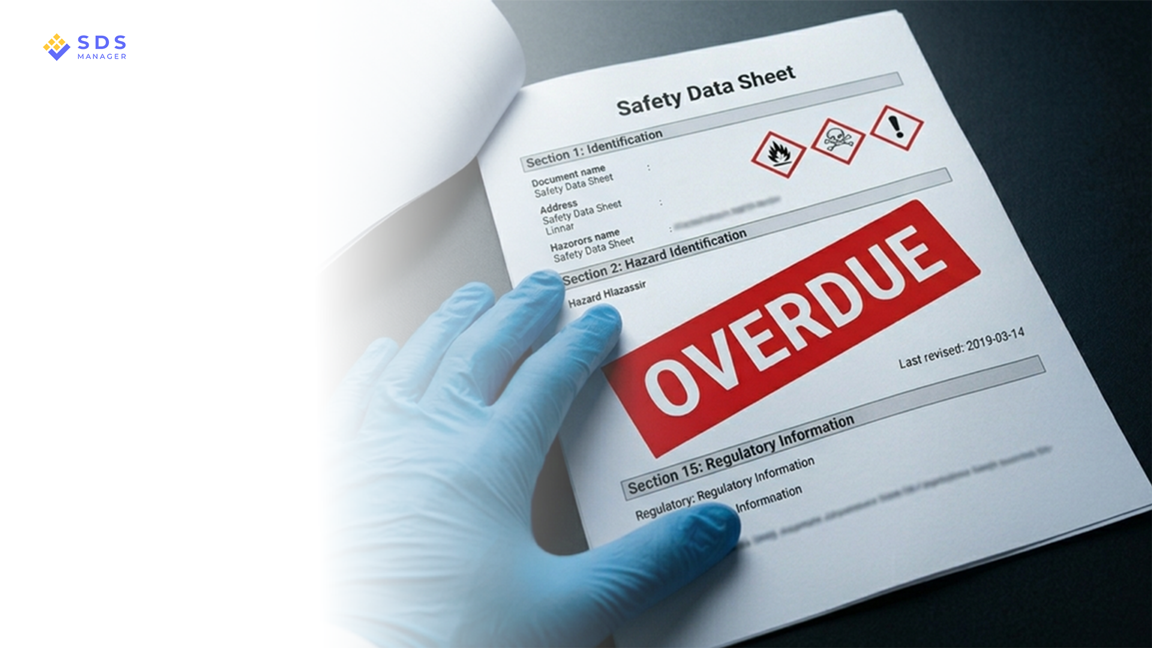
Two-thirds of safety data sheets containing newly flagged hazardous substances have never been revised, according to the first systematic analysis of REACH Candidate List compliance behaviour
The chemical supply chain is taking an average of 20 months to update safety data sheets after the European Chemicals Agency officially designates a substance as being of very high concern, according to new research published by SDS Manager, a safety data sheet management platform with access to documents from more than 2,800 active commercial suppliers.
The study, which analysed 8,611 safety data sheets and substance combinations across Candidate List additions from the past five years, found that 61.6% of affected documents have never been revised since their substance was added to ECHA's Candidate List. Among the minority that were updated, the median delay between the official ECHA publication date and the document revision was 609 days.
Article 33 of the REACH Regulation requires suppliers of articles containing Substances of Very High Concern above a concentration of 0.1% by weight to communicate that information to downstream users without delay. The regulation does not specify a fixed number of days. The data suggests that in practice, "without delay" has meant nearly two years for those who respond at all, and nothing for the majority who do not.
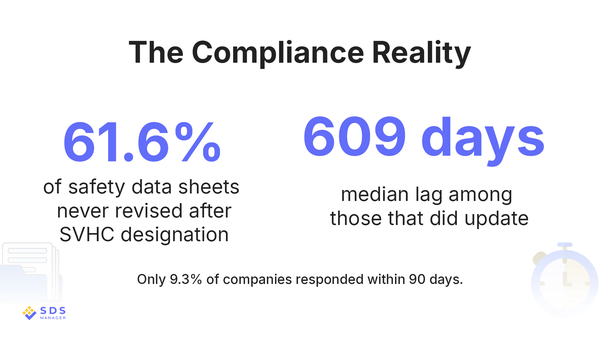
"The legal obligation is clear," said Erlend Bruvik, Founder of SDS Manager. "What our data shows, for the first time with actual numbers, is that for the vast majority of affected documents, the required information never arrives. A 609-day median lag, with six out of ten safety data sheets never updated. That is not the picture that appears in regulatory impact assessments. It is the operational reality of REACH compliance as it actually exists."
The findings are consistent with ECHA's own enforcement data. The agency's REACH-EN-FORCE-6 project, which audited Article 33 compliance among article suppliers, found that only 5 of 45 audited articles met the business-to-business communication requirement, a non-compliance rate of approximately 89%. ECHA described the level of disclosure as "not acceptable."
The Scale of a Single Addition
The most recent Candidate List update, published on 4 February 2026, added 11 new substances including n-hexane, a common industrial solvent used in degreasers, adhesives, and cleaning products and classified as a neurotoxin linked to peripheral neuropathy in workers. The addition illustrates the scale of disruption a single designation can create.
In the SDS Manager database alone, 3,774 active safety data sheets from 1,360 distinct suppliers contain n-hexane. As of the study date, 97 days after the ECHA publication, only 40 of those documents, or 1.06%, had been revised. More than half of the unrevised documents were last updated over five years ago. The oldest revision in the dataset is dated 1979.
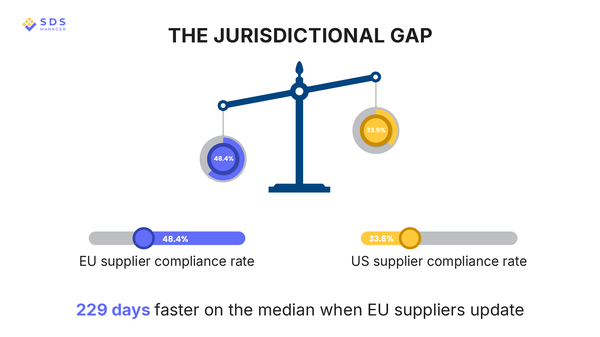
EU-established suppliers achieved a compliance rate of 48.4%, compared with 33.6% for US-established suppliers selling into the European market. When EU suppliers did update their documents, they did so 229 days faster on the median than their US counterparts. The data suggests that equal legal obligations have not produced equivalent compliance behaviour across jurisdictions.
Commercial and Legal Exposure
Non-compliance carries penalties that vary sharply by Member State. In Germany, failure to respond to a consumer information request within the 45-day statutory window under Article 33(2) can result in fines of up to €50,000. Failure to comply with the related SCIP database notification duty can attract penalties of up to €1,000,000.
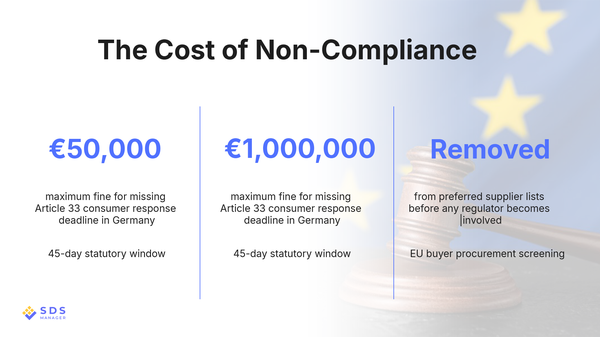
Beyond formal enforcement, major EU industrial buyers increasingly screen incoming suppliers for SVHC-current documentation. An outdated safety data sheet can result in removal from preferred-supplier lists before any regulator becomes involved.
Policy Implications
The research arrives as the European Commission signals work on the next REACH revision package. The study's authors argue the 609-day median and 61.6% non-compliance rates are the kind of operational measurements that should inform two specific policy questions: whether Article 33 requires a statutory deadline to replace the current "without delay" standard, and whether enforcement coordination across Member States needs to be strengthened.
"When regulators write impact assessments for REACH updates, they model what should happen," said Bruvik. "Our data measures what actually happens. We think it should be part of every conversation about whether REACH is working."
609 days is not a compliance statistic. It is a policy failure waiting to be addressed.
The SVHC Candidate List Reaction Study was conducted by SDS Manager using safety data sheets in active commercial use as of 12 May 2026. The analysis covered Candidate List additions published between January 2020 and February 2026. The official ECHA Candidate List publication date was used as the legal trigger event for each substance, joined to SDS records by CAS number.

Arysha Alif Khan

Arysha Alif Khan is an EHS and chemical safety specialist with a background in biochemistry, biotechnology, and public health. She works closely with the product and regulatory teams to turn complex chemical regulations, SDS requirements, and workplace safety standards into clear, practical guidance for people.