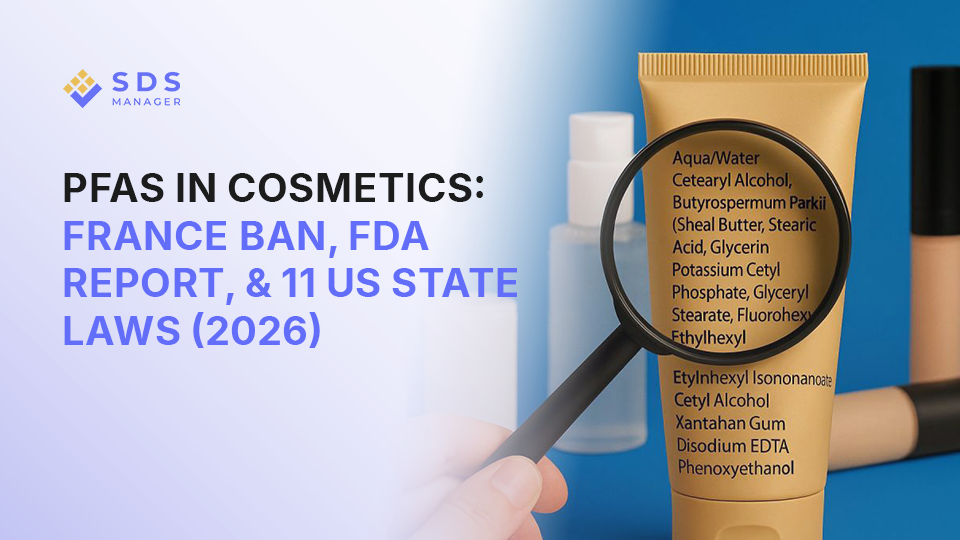
Regulatory pressure on PFAS in cosmetics reached a turning point in early 2026. France banned forever chemicals in beauty products outright, effective January 1. The FDA released its first-ever federal safety assessment of PFAS in cosmetics and found it couldn't confirm the safety of most substances it reviewed. Eleven US states now have bans in force, with ten more advancing legislation.
Here's what changed and what it means for brands and formulators.
Key Takeaways
- The FDA identified 51 PFAS intentionally used across 1,744 cosmetic formulations in the US and could not confirm the safety of 19 out of the top 25 substances it assessed (December 2025).
- France banned all intentionally added PFAS in cosmetics from January 1, 2026, joining Denmark as the only EU countries with a national ban in place.
- Eleven US states have enacted phased PFAS bans with effective dates running through 2028. No federal standard currently exists.
- Eye shadow (20.5 % of affected products), face and neck skin care (15.9 % ), and eyeliner (8.4 % ) are the most exposed product categories.
What Did the FDA's PFAS Report Actually Find?
The FDA's 258-page December 2025 report found 51 distinct PFAS substances intentionally added to 1,744 cosmetic formulations sold in the US, and could not establish the safety of 19 out of the top 25 most-used substances it reviewed. One substance, perfluorohexylethyl triethoxysilane, was flagged as a potential safety concern in body lotion at high concentrations, based on animal data showing nervous system effects.
Published on December 29, 2025, the “Report on the Use of PFAS in Cosmetic Products and Associated Risks” is the first federal assessment of its kind under the Modernization of Cosmetics Regulation Act of 2022 (MoCRA). The data came from mandatory cosmetic product listings that MoCRA now requires manufacturers to file directly with the FDA.
According to the FDA's December 2025 report, 51 PFAS substances were intentionally added to 1,744 cosmetic products listed in the US, and the agency could not definitively confirm the safety of 76 % of the top 25 substances assessed due to insufficient toxicological data.
PFAS Prevalence by Cosmetic Product Category
| Product Category | Share of PFAS-Affected Products | |
|---|---|---|
| Eye shadow | 20.5 % | |
| Face and neck skin care | 15.9 % | |
| Eyeliner | 8.4 % | |
| Face powder | 6.6 % | |
| Foundation | 4.5 % |
Source: FDA Report on PFAS in Cosmetic Products, December 2025
INSIGHT: PTFE (polytetrafluoroethylene) is by far the most common cosmetic PFAS, used for slip, water resistance, and texture in powder formats, which is why eye makeup and face powders dominate the affected category list.
Five of the 25 substances reviewed were considered low risk under normal use. FDA Commissioner Marty Makary stated the agency will continue coordinating with the CDC and EPA to update PFAS recommendations across the consumer product supply chain, signaling sustained federal scrutiny even without an immediate prohibition.
Why Did France Ban PFAS in Cosmetics?
France enacted a comprehensive ban on the manufacture, import, export, and sale of cosmetics containing intentionally added PFAS, effective January 1, 2026. The French government passed the measure in February 2025 under Decree No. 2025-188, citing the persistent accumulation of fluorinated compounds in biological tissue and the precautionary principle, as reported by Personal Care Insights (January 2026).
France is now the second European country after Denmark to impose national-level PFAS restrictions on cosmetics. Products manufactured before January 1, 2026 have a 12-month sell-through window, meaning non-compliant inventory must clear the French market by December 31, 2026.
Does this put pressure on the rest of the EU? Almost certainly yes.
The European Chemicals Agency (ECHA) is evaluating a restriction proposal that would cover approximately 10,000 PFAS substances across multiple product categories, including cosmetics. Multiple European health and environmental organizations have written to European Commission President Ursula von der Leyen urging faster action. France's unilateral move is widely read as political pressure on Brussels to accelerate the bloc-wide timeline.
France's Decree No. 2025-188, effective January 1, 2026, prohibits the manufacture, import, export, and sale of cosmetics containing intentionally added PFAS. Products made before the effective date have until the end of 2026 to clear the market. The EU is evaluating a broader restriction covering approximately 10,000 PFAS substances.
Which US States Have Banned PFAS in Cosmetics?
Eleven US states have enacted bans on intentionally added PFAS in cosmetics, with staggered effective dates running from 2025 through 2028. The most recent additions are Maine and Vermont, both effective January 1, 2026. Connecticut will require manufacturers to notify state regulators by July 1, 2026, ahead of a full prohibition taking effect in 2028.
The compliance picture is fragmented. State definitions of "intentionally added" vary in scope. Some states extend restrictions to product packaging and container materials, not just formulation ingredients. Others focus only on what goes into the formula itself.
Ten additional states have bills pending, including New York, New Jersey, Illinois, and Massachusetts. In 2025, nearly 350 PFAS-related bills were introduced across 39 US states, a number expected to rise further through 2026. Brands selling across multiple US markets can't rely on a single compliance standard. Each jurisdiction needs to be tracked individually.
INSIGHT: The lack of a federal standard creates a genuine competitive disadvantage for smaller brands without dedicated compliance teams. Companies selling nationally effectively need to comply with the strictest applicable state law across their entire product line to avoid market-by-market reformulation.
As of early 2026, eleven US states have active PFAS-in-cosmetics bans, with another ten states advancing legislation. Nearly 350 PFAS bills were introduced in 39 states during the 2025 legislative session. No federal standard currently exists, creating a fragmented compliance landscape that brands must track jurisdiction by jurisdiction.
What Does This Mean for Cosmetic Brands and Formulators?
The regulatory direction is consistent regardless of market. Any brand selling in major US states, France, or planning EU distribution needs to confirm whether its formulations contain intentionally added PFAS. Long-wear foundations, waterproof mascaras, eye shadows, and face powders carry the highest exposure risk, given PTFE's role as the most widely used cosmetic PFAS.
One issue that has caught brands off guard: unintentional contamination. Several companies have traced PFAS in finished products not to deliberate formulation decisions, but to fluorinated container liners, processing equipment, and supplier materials with undisclosed fluorine processing aids. Supplier declarations alone aren't enough. Testing at the supplier level is now the expected standard under MoCRA's safety substantiation requirements.
Every formulation change also requires updated Safety Data Sheets across the supply chain. Sections covering composition, exposure controls, and toxicological properties all need to reflect the current formula, not the prior one.
Brands reformulating to remove PFAS must verify contamination at the supplier level, not just in finished product testing, and must update Safety Data Sheet documentation for every affected ingredient across sections covering composition, exposure controls, and toxicological information.

Mehreen Iqbal

Started with a Bachelors in Microbiology, then a Masters in Public Health; Currently a Workplace Safety Expert.