A chemical storage audit in Australia typically takes less than an hour. What it finds often takes months to fix: expired SDS documents, incompatible chemicals sharing a shelf, containers that were labelled correctly once and weren't updated when the product changed.
Safe Work Australia recorded 146,700 serious workers' compensation claims in 2023-24. Chemical exposures are part of that count, and the businesses behind them weren't all operating recklessly.
This guide covers the chemical storage guidelines in Australia that actually get enforced, and what it takes to stay ahead of them.
Key Takeaways
- Chemical storage in Australia spans WHS Regulations, GHS, and state Dangerous Goods Acts.
- Every workplace needs a current SDS and hazardous chemicals register, regardless of quantity.
- Incompatible chemicals must be segregated; exceeding manifest quantities triggers manifest and placard obligations.
Australian Chemical Storage Laws: What Businesses Need to Know
Depending on what a business stores and how much of it, chemical storage in Australia can fall under the model WHS Regulations, a state Dangerous Goods Act, or both simultaneously. In most workplaces, all three apply to the same chemical at the same time. Following Western Australia's 2022 adoption of harmonised WHS laws, eight of nine jurisdictions now operate under the model WHS Act. Victoria is the only exception, governed by its own Occupational Health and Safety Act 2004.
Each layer has distinct obligations:
1. Model WHS Regulations apply to any Australian business that uses, handles, generates, or stores hazardous chemicals in the workplace, which covers the vast majority of commercial and industrial operations. These regulations define what qualifies as a hazardous chemical, set specific duties for persons conducting a business or undertaking (PCBUs), and establish the obligations that apply when stored quantities exceed manifest thresholds.
They also govern what must happen when a chemical is first supplied: a compliant SDS and GHS label must accompany that first delivery. Non-compliance is enforceable by state and territory regulators, who can issue improvement and prohibition notices without prior notice.
2. State Dangerous Goods Acts are particularly relevant for businesses in manufacturing, logistics, construction, agriculture, automotive, and any sector handling significant quantities of flammable liquids, oxidisers, compressed gases, or explosives. This layer establishes licence thresholds, which are specific quantities above which a business must hold a dangerous goods licence from its state or territory regulator.
3. The GHS applies to any business that purchases chemicals from suppliers, imports products from overseas, or needs to read a chemical label or SDS, making it relevant to virtually every workplace that handles hazardous substances. GHS replaced Australia's previous approach to chemical classification with a standardised international system, meaning that hazard categories, pictograms, signal words, and hazard statements follow consistent rules regardless of where a chemical was manufactured.
How to Store Chemicals Correctly Under AU Regulations?
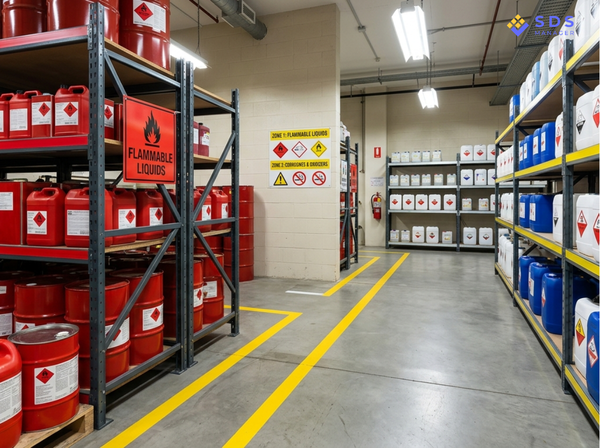
The foundation of safe chemical storage is segregation. The model WHS Regulations, backed by standards like AS 1940 for flammable liquids, require incompatible chemicals to be physically separated (Safe Work Australia, model WHS Regulations). When incompatible chemicals mix through a spill or container failure, fire, explosion, or toxic gas release can follow.
Segregation: What Cannot Go Together
These are the most important pairings to keep apart (check SDS Section 7 and Section 10 for exact incompatibilities):
| Chemical Category | Must NOT Be Stored With | |
|---|---|---|
| Flammable liquids | Oxidisers, acids, ignition sources | |
| Oxidising agents | Flammables, organics, reducing agents | |
| Acids | Bases, oxidisers, flammables | |
| Toxic/poison chemicals | Food, feed, medicines | |
| Compressed gases | Heat sources, direct sunlight |
The Hazardous Chemicals Register
Every workplace storing hazardous chemicals must maintain a register listing every chemical on site and its current SDS, regardless of quantity. It's one of the first things regulators check.
Physical Storage Conditions
Ventilation: Flammable and volatile chemicals need adequate airflow. Vapour concentrations that reach flammable limits don't need a spark.
Bunding: Liquid chemicals must be stored in bunded areas. For flammable and combustible liquids, AS 1940 specifies requirements; verify capacity against state regulations.
Personal protective equipment (PPE): SDS Section 8 specifies the exact PPE required for each chemical you store - gloves, eye protection, respirators, and protective clothing where relevant. PPE must be available, maintained, and accessible in the storage area itself, not just somewhere on site. The right gloves for a corrosive aren't the same as the right gloves for a solvent. Section 8 should be checked before handling any chemical that workers haven't used before.
What Needs to be on Chemical Labels?
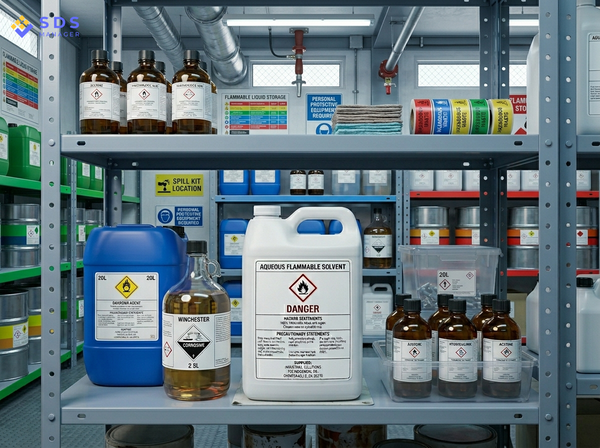
Every hazardous container needs a compliant GHS label before it goes on a shelf: 6 core elements, all in English. Missing one isn't a minor issue. It's a compliance breach.
The 6 Required Elements
- Product identifier: the chemical name or trade name as it appears on the SDS.
- Signal word: either "Danger" or "Warning"; only one per label.
- Hazard statements: standardised phrases describing the hazard, such as "Flammable liquid and vapour."
- Precautionary statements: instructions for handling, storage, disposal, and first aid.
- Hazard pictograms: one or more of the 9 standardised GHS diamond symbols.
- Supplier identification: the Australian supplier or importer's name, address, and phone number.
If a foreign supplier's label isn't in English or is missing any required element, relabelling before use is the employer's obligation, not the supplier's.
Safety Data Sheet (SDS) Requirements and Management
The label tells you what's in the container. The Safety Data Sheet tells you everything else: how to store it, what it reacts with, what to do if something goes wrong. Under Australian WHS Regulations, every hazardous chemical on site needs a current SDS within a five-year review cycle. In an emergency, an outdated SDS is the thing that gets people hurt.
What "current" means: five years from the date of preparation, unless a supplier reformulates or new hazard data emerges, in which case a revised SDS must be issued sooner. Check with suppliers regularly; reformulations don't always come with a notification.
The sections that matter most for storage:
- Section 7: How the chemical must be stored and what conditions to avoid.
- Section 10: Stability and reactivity, including incompatible materials.
- Section 14: Dangerous goods transport classification.
The real test is whether any worker on site could find the right SDS in under two minutes, without asking anyone. If the answer is uncertain, an SDS management system is worth looking at, it keeps every document current, searchable, and reachable from any device without depending on whoever manages the folder.
What Chemical Storage Inspectors Look For
Regulators such as WorkSafe Victoria, SafeWork NSW, and Workplace Health and Safety Queensland (WHSQ) can enter the workplace without prior notice. They'll ask for a hazardous chemicals register, check SDS documents, inspect storage conditions, and look for compliant labelling. Common triggers include routine audits, worker complaints, near-misses, and detected spills.
Under the model WHS Act, a Category 1 offence carries a maximum of approximately $3 million for a body corporate and a Category 2 offence up to approximately $1.5 million. Individual officers face personal liability too. Most jurisdictions have indexed these figures upward. Verify current amounts with the state regulator.
How To Build a Chemical Storage Compliance System?
Safe Work Australia's Managing Risks of Hazardous Chemicals Code of Practice sets out five core obligations: register, SDS maintenance, labelling, segregation, and manifest thresholds (Safe Work Australia). Most compliance failures aren't about ignorance. They're about not having a system to stay current.
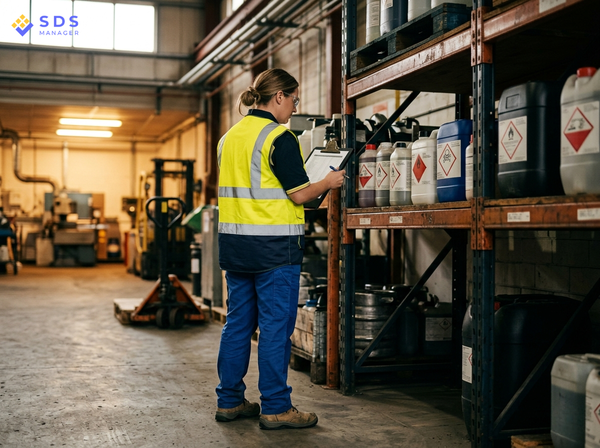
Step 1: Audit your chemical inventory.
List every hazardous chemical on site: name, supplier, quantity, location, and GHS classification. This becomes your register.
Step 2: Verify every SDS.
Check the preparation date for each SDS. More than five years old? Request an update and file everything in a system workers can reach.
Step 3: Map storage against segregation rules.
Check SDS Section 7 and Section 10 for each chemical and flag incompatibles stored near each other.
Step 4: Check quantity thresholds.
Compare stored quantities against the manifest thresholds in the model WHS Regulations and confirm your register, manifest, and placarding obligations are met.
Step 5: Set a review cycle.
Review your SDS register every 12 months, check for updated documents from suppliers, and update your register when products change. A purpose-built SDS management platform can automate this so the cycle runs without relying on someone to remember.
Frequently Asked Questions
What is the difference between hazardous chemicals and dangerous goods in Australia?
These terms aren't interchangeable. Hazardous chemicals cover any substance that can harm health, safety, or the environment. Dangerous goods are narrower, focused on physical hazards during storage and transport. A chemical can be both, triggering obligations under WHS Regulations and state Dangerous Goods legislation. Check SDS Section 14 for dangerous goods classification.
How often do Safety Data Sheets need to be updated?
SDS documents are current for five years from preparation. If a supplier reformulates or new hazard data emerges, a revision must be issued sooner. Check with suppliers regularly; you won't always be notified when a product changes.
What should I do if a chemical spill occurs in my storage area?
Evacuate if the substance is flammable, toxic, or unknown, then go to Section 6 (Accidental Release Measures) of the SDS. Procedures should cover spill response roles, PPE, containment, and when to call emergency services. Stormwater spills may need EPA notification.
Do I need a licence to store chemicals in Australia?
It depends on what you're storing and how much. Most hazardous chemicals don't need a licence, but storing dangerous goods above threshold quantities typically does. That licence comes from your state or territory regulator. Explosives and some Schedule poisons carry permit requirements regardless of quantity. Check with your state dangerous goods regulator to be sure.
Conclusion
Chemical storage compliance is only as reliable as the information behind it. The segregation chart, SDS register, and container labels may have been accurate when they were created, but chemical inventories rarely stay the same. Products are replaced, formulations change, and storage arrangements evolve over time.
A yearly review of the documentation and the physical storage conditions is what keeps it compliant, and for businesses where keeping the documents current is the harder part, an SDS management platform takes that off the list.

Arysha Alif Khan

Arysha Alif Khan is an EHS and chemical safety specialist with a background in biochemistry, biotechnology, and public health. She works closely with the product and regulatory teams to turn complex chemical regulations, SDS requirements, and workplace safety standards into clear, practical guidance for people.