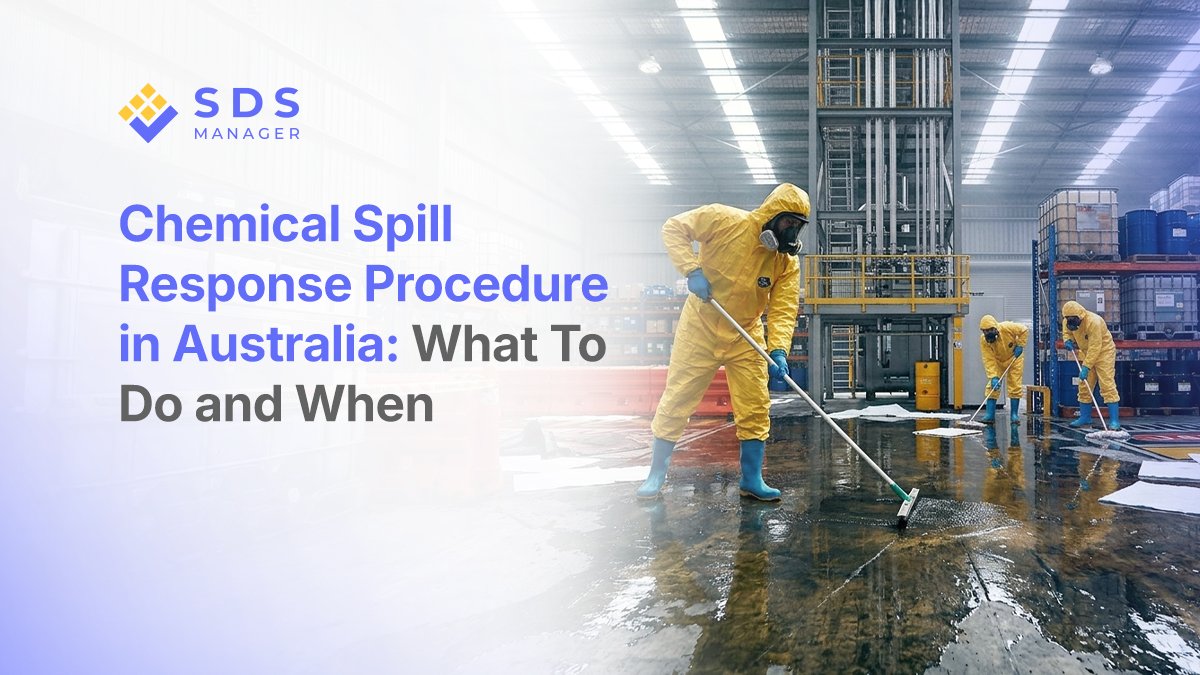
Chemical spills rarely happen at a good time. More often, it's mid-shift, the person who knows the procedure is away, and suddenly workers are looking at a spreading puddle with no clear idea what to do next.
Under Australia's WHS Act, every business handling hazardous chemicals must have a documented chemical spill response procedure in place, and as of July 2025, getting it wrong can cost a body corporate up to $11,839,000 (Safe Work Australia, 2025).
This article covers what Australian law requires, how to classify a spill, the step-by-step response using the 4 Cs framework, what to do if someone is directly exposed, when to call 000, and how to report to the relevant authorities.
Key Takeaways
- Australian WHS law requires documented spill procedures linked to each hazardous chemical on site, backed by recorded worker training.
- Chemical spill responses in Australia follow the 4 Cs: Control the source, Contain the spread, Clean up the hazard, and Communicate with emergency services.
- Large spills, toxic releases, or any incident threatening public health require an immediate call to 000.
- Every state and territory EPA has separate notification obligations. Failure to notify can mean millions in penalties.
What Does Australian Law Require for Chemical Spill Response?
Australian spill response obligations come from two separate legal frameworks, and both can apply to the same incident.
WHS obligations: Every Person Conducting a Business or Undertaking (PCBU) must document spill response procedures under the model WHS Act and Regulations (updated December 2025), linked to each hazardous substance and supported by recorded worker training.
EPA obligations: Every state and territory EPA imposes strict pollution prevention rules. Stormwater contamination is a major focus, and certain spills must be reported immediately. Bunded containment and secure storage are mandatory in many industries.
2026 update: Australia has introduced stricter, enforceable Workplace Exposure Limits (WELs) for airborne contaminants. Even a minor spill of a volatile substance can now exceed legal thresholds, so spill kits at those sites must include high-specification respiratory PPE (Ecospill, 2026).
The 4 Cs of Chemical Spill Response in Australia
Australian chemical spill responses are built around four actions: Control the source, Contain the spread, Clean up the hazard, and Communicate with emergency services.
If a spill is large, threatens public health, or risks polluting the environment, call 000 immediately. Waiting until containment has been attempted is not recommended.
Step 1: Prioritise Safety First
Assess the scene before doing anything else. Do not walk into or touch the spilled substance. Evacuate non-essential personnel and isolate the area.
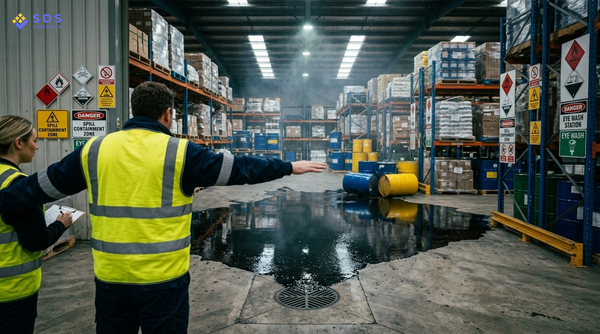
The key questions are: what is it, how much is there, is anyone hurt, and is there a fire or fume risk? A calm 30-second assessment prevents the situation from getting worse. Rushing in without knowing what the substance is can turn a minor spill into a serious injury.
Step 2: Identify the Chemical
Locate the Safety Data Sheet (SDS) for the substance. Australia uses the Globally Harmonized System (GHS) to classify chemicals, and every SDS includes a dedicated section on accidental release measures. For sites managing multiple hazardous substances, a centralised SDS management system makes it faster to locate the right sheet during an incident.
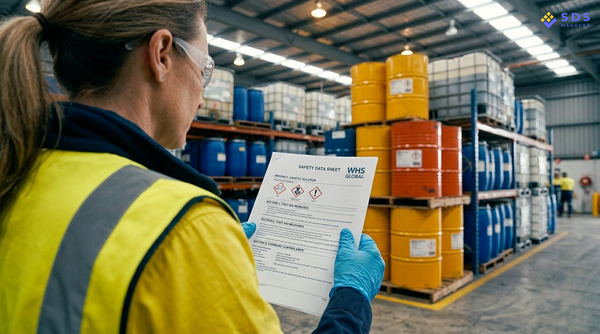
The SDS specifies exactly what PPE is required, how to contain the substance, and how to clean it up. This step should not be skipped, even when the chemical seems familiar.
Step 3: Wear Appropriate PPE
Put on the necessary gear before approaching the spill. For most hazardous liquid spills, that means chemical-resistant gloves, safety goggles, and protective overalls at minimum.
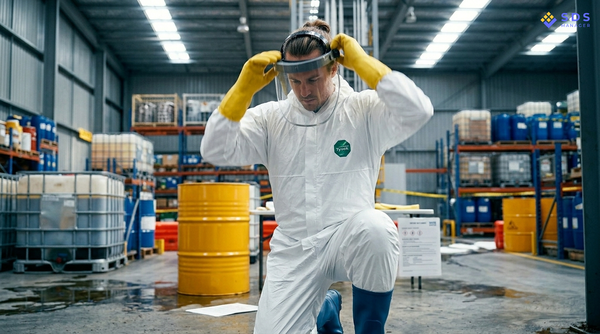
Corrosives need a full face shield and chemical-resistant apron. Under Australia's 2026 WEL updates, volatile substances may require a respirator even for spills that look small. When in doubt, err on the side of more protection.
Step 4: Control the Source
(C1: Control) If it is safe to do so, stop the spill at its origin. Right an overturned container, close an open valve, or plug the leak. Even a partial fix here can dramatically cut the total volume released.
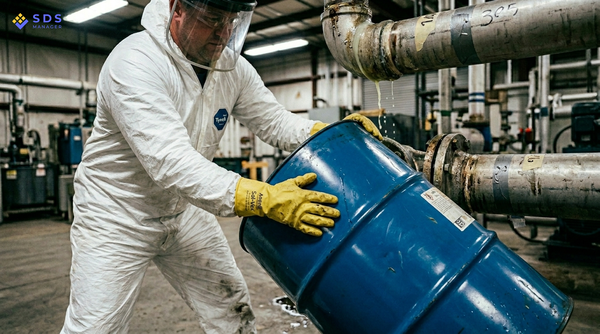
This should not be attempted if there is any risk of fire, explosion, or toxic fume exposure. In those cases, step back and call 000.
Step 5: Contain the Spill
(C2: Contain) Use absorbent socks, booms, or granular materials like vermiculite to build a barrier around the spill. Work from the outer edges inward, not from the centre out, to stop the chemical spreading further.
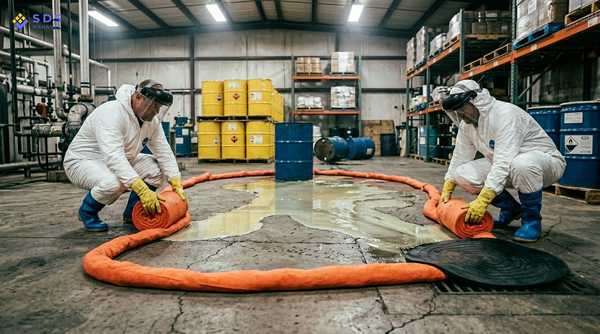
The first priority is sealing off stormwater drains. If a hazardous chemical reaches the stormwater system, EPA notification obligations apply immediately.
Step 6: Clean Up and Neutralise
(C3: Clean Up) Apply absorbent pads or granular absorbents to soak up the liquid. For acid or alkali spills, neutralise before absorbing where it is safe to do so.
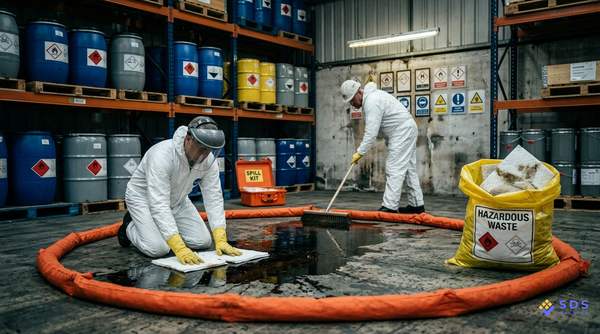
Sweep up contaminated material and place it in leak-proof, labelled hazardous waste bags. Used absorbents, gloves, and PPE all count as hazardous waste if the substance itself is hazardous. Bagging contaminated materials with general waste is not compliant; licensed disposal is required.
The clean-up must be logged in the site spill register. That record is required during WHS audits and EPA reporting.
Step 7: Decontaminate
Remove PPE carefully to avoid cross-contamination. Do not pull contaminated clothing over the head; cut it off if needed. Seal it in double-layered plastic bags and await disposal instructions.
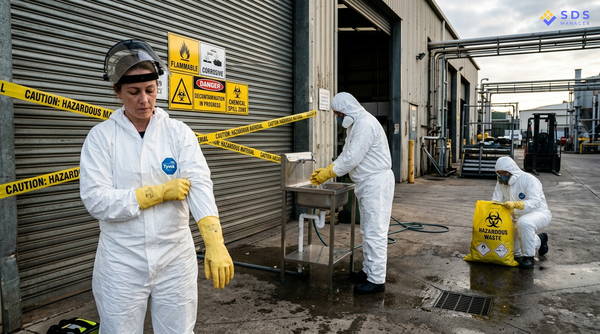
Wash hands thoroughly. Return the spill kit to its storage location, mark it as used until restocked, and arrange restocking straight away.
What to Do If Someone Is Directly Exposed
If a person makes contact with the chemical during a spill, act immediately. Waiting to see if symptoms develop is not recommended.
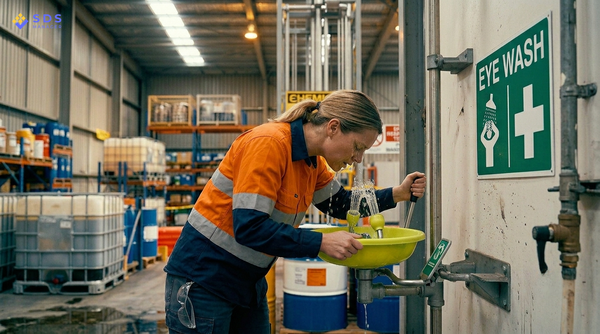
Skin exposure: Do not rub the affected area. Blot the chemical off gently with a clean cloth or sponge, then flush with large amounts of soap and water. Check the SDS for specific first aid guidance and seek medical attention.
Eye exposure: Rinse eyes immediately with clean, running water for at least 10 to 15 minutes. Remove contact lenses if possible and keep the eyelids open during rinsing. Call 000 or take the person directly to an emergency department.
Contaminated clothing: Do not pull clothing over the head. Cut it off, place it in double-layered sealed plastic bags, and await emergency response instructions. The person should not re-enter the spill area.
Every exposure incident must be documented in the workplace incident register, regardless of how minor it appears at the time.
When to Call 000
(C4: Communicate). Some spills go beyond what on-site staff can safely manage. Call 000 immediately if:
- The chemical is highly toxic, volatile, or releasing dangerous vapours
- There is an immediate risk of fire, explosion, or uncontrolled chemical reaction
- Someone has been injured or exposed and needs medical attention
- The spill is too large or unpredictable to be safely handled on site
When calling, the dispatcher should be told what chemical has spilled, the approximate volume, and whether anyone has been exposed. That information shapes how emergency services respond from the moment they leave the station.
When and How to Report a Chemical Spill in Australia
Every spill should be reported to the site supervisor or WHS manager straight away. For significant incidents, two external reporting tracks may also apply.
WHS notifiable incidents: The relevant state WHS regulator must be notified immediately if the spill results in a death, serious injury, or a dangerous incident, which includes releasing a large quantity of hazardous substance even when no one is hurt.
EPA environmental notification: The relevant state or territory EPA, or local council, must be notified if the spill poses a significant threat of environmental harm, threatens waterways, or causes land contamination. In NSW, failure to notify under the POEO Act 1997 attracts up to $4,000,000 per offence for corporations, plus $240,000 per day for continuing offences (EPA NSW, 2025).
When in doubt, report. Notifying about a minor spill costs nothing. Not reporting a significant one can cost everything.
What a Chemical Spill Response Plan Must Include
A verbal understanding among staff is not a spill response plan. Under WHS law, the procedure must be documented, current, and linked to the specific chemicals on site.
A compliant plan covers:
- A chemical register with GHS classification, volumes, and SDS location for every hazardous substance on site. Managing these through a dedicated SDS management platform keeps records accessible, current, and audit-ready.
- Spill classification thresholds specific to the substances and site layout, so the right response level is triggered for each incident.
- Named role assignments with documented training records, confirming who is responsible and that staff are competent to act.
- Spill kits matched to actual hazard types on site, not generic off-the-shelf options, so containment equipment works for the specific chemicals present.
- Notification pathways for both internal escalation and regulatory reporting, removing confusion about who to contact and when.
- A post-incident review process to restock, investigate root cause, and update the plan, preventing the same incident from occurring twice.
The most common compliance gap isn't the absence of a plan. It's a plan that hasn't been touched since the last chemical inventory change, or where the named spill coordinator left the business six months ago. A plan is only as good as its last review date.
Conclusion
Chemical spill response comes down to two things: knowing what to do and having the right information to do it.
The 4 Cs cover the first part. Keeping Safety Data Sheets accurate, accessible, and linked to every hazardous substance on site covers the second. That's where most workplaces fall short, and where most incidents become more serious than they need to be.
Frequently Asked Questions
What is the chemical spill response procedure in Australia?
The standard chemical spill response procedure in Australia follows the 4 Cs: Control the source, Contain the spread, Clean up the hazard, and Communicate with emergency services and authorities. Before any of those steps, workers must assess the scene, identify the chemical using the Safety Data Sheet, and don appropriate PPE. If the spill is large, toxic, or uncontrollable, call 000 first before attempting any response.
Is it a legal requirement to have a chemical spill response plan in Australia?
Yes. The model Work Health and Safety Regulations require every business handling hazardous chemicals to maintain a documented spill response procedure linked to each substance and supported by recorded worker training. As at 1 July 2025, WHS Category 1 penalties for gross negligence reach $11,839,000 for a body corporate.
When does the EPA need to be notified about a chemical spill in Australia?
The relevant state or territory EPA, or local council, must be notified when a spill poses a significant threat of environmental harm, including any release that enters or risks entering stormwater drains, waterways, or causing land contamination. In NSW, failure to notify under the POEO Act 1997 can attract $4,000,000 per offence for corporations, plus $240,000 per day for continuing offences.
What should be done if a chemical gets on skin during a spill?
Do not rub the affected area. Blot the chemical off gently with a clean cloth or sponge, then flush the skin thoroughly with soap and water. Check the Safety Data Sheet for the specific chemical to confirm first aid steps, and seek medical attention if there is any doubt. Eye exposure requires at least 10 to 15 minutes of continuous rinsing with clean water and immediate emergency care.
What PPE is required for a chemical spill response in Australia?
PPE requirements are specified in each chemical's Safety Data Sheet. At minimum, most hazardous liquid spills require chemical-resistant gloves and eye protection. Corrosives need a full face shield and chemical-resistant apron. Under Australia's updated 2026 Workplace Exposure Limits, high-specification respiratory PPE is now required for volatile substances that can generate airborne concentrations exceeding new WEL thresholds during a spill.

Arysha Alif Khan

Arysha Alif Khan is an EHS and chemical safety specialist with a background in biochemistry, biotechnology, and public health. She works closely with the product and regulatory teams to turn complex chemical regulations, SDS requirements, and workplace safety standards into clear, practical guidance for people.