Two terms get thrown around on Australian construction sites as though they mean the same thing: Job Safety Analysis (JSA) and Safe Work Method Statement (SWMS). Plenty of people use them interchangeably. So if you've heard both and assumed they're basically the same, you're not alone. Turns out they aren't the same document.
This mix-up is not just limited to job sites. Even RMIT University's own construction training resources describe the Safe Work Method Statement as "also known as the Job Safety Analysis," which tells you a lot about how tangled the two terms have become in everyday use.
In short, both documents are doing a similar job. Each one breaks a task down into steps and lists ways to control the risk in every step. But only one of them actually carries legal weight. The SWMS is a legal requirement in Australia and follows a fixed structure, while the JSA doesn't.
The difference in legal requirements is what sets the two documents apart. This guide walks you through: what a JSA is, what a SWMS is, where the two differ, what the law actually says, and how the rules shift depending on which state you're working in.
Key Takeaways
- A Job Safety Analysis is a method for breaking a task into steps, hazards, and controls.
- A Safe Work Method Statement is required by law before high-risk construction work begins.
- Regulation 299 requires a SWMS to do four things: identify the high-risk construction work, specify the hazards and risks, describe the controls, and describe how those controls will be implemented, monitored and reviewed.
- The SWMS became a national legal duty when most states adopted the shared Work Health and Safety laws on 1 January 2012, South Australia and Tasmania a year later, and Western Australia not until 2022.
- Eighteen activities in regulation 291 trigger the SWMS duty, among them any risk of a person falling more than two metres and any trench or shaft deeper than 1.5 metres.
- Victoria never adopted the shared national rules, South Australia lowered its fall threshold from three metres to two on 1 July 2026, and sixteen days later the Northern Territory raised its threshold to three metres for residential construction work, so the two-metre rule is still not universal.
- A template carrying a different job's hazards is the most common reason a principal contractor rejects a SWMS.
- A JSA cannot satisfy the SWMS duty on high-risk construction work, though it is a sound basis for writing one.
Job Safety Analysis and Safe Work Method Statement, Side-by-Side Comparison
Before we get into the details, here's a simple side-by-side view of the two:
| Job Safety Analysis (JSA) | Safe Work Method Statement (SWMS) | |
|---|---|---|
| What it is | A simple way to break a task into steps and think through the risks in each step | A formal document that must be in place before certain construction work can start |
| Is it required by law? | No, there's no legal definition for it in Australia | Yes, it's defined and required under regulation 299 |
| What must it include | Nothing specific, no fixed format | Four required parts: identify the high-risk construction work, specify the hazards and risks, describe the control measures, and describe how those controls will be implemented, monitored and reviewed |
| Who usually writes it | The workers doing the task | The PCBU (Person Conducting a Business or Undertaking) carrying out the work, though regulation 299(1)(b) allows it to rely on a SWMS already prepared by someone else |
| Who needs to see it | No one in particular; it's mainly for the workers' own use | The principal contractor, who must have it before work begins |
| Other names for it | Called a Job Hazard Analysis (JHA) in the US | No other common name |
What Is a Job Safety Analysis?
A Job Safety Analysis (JSA) is a way of planning and evaluating the steps of a job before starting it. You break it into steps, and at each one you ask two things: what could go wrong here? and what stops it from going wrong?
Here's the thing, though: no Australian law actually defines a JSA. There's no set format, and no regulator keeping watch over it. Even so, most JSAs land on the same basic pattern of steps, hazards, and controls, regardless of the job or the site.
That same pattern goes by different names depending on where you are, though the idea underneath stays the same. In the United States, it's usually a Job Hazard Analysis (JHA), the term OSHA uses in its own guidance.
Some sites call it a "job hazard breakdown," others a "task risk assessment." Whatever the label, the method underneath doesn't change.
What Goes Into a JSA?
Two things repeat for every step of a job in a JSA:
- The hazard, whatever could go wrong at that specific step
- The control, exactly what will be done about it, spelled out clearly enough that someone else could follow it
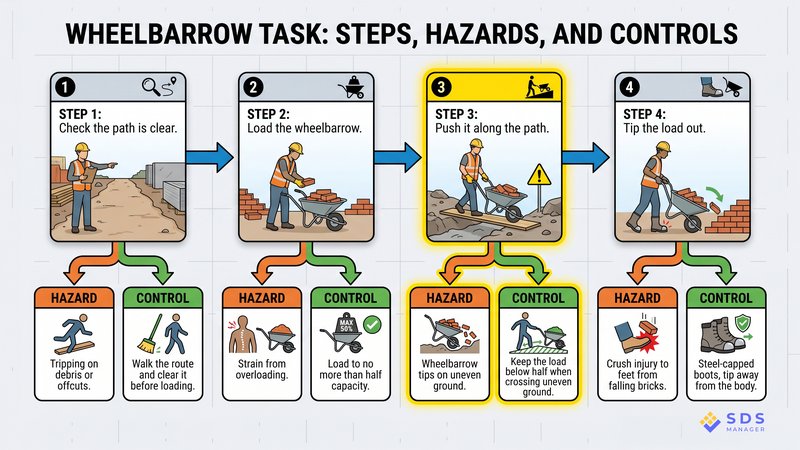
Take a worker moving a load of bricks across a site by wheelbarrow. Four steps make up this job:
- Check if the path is clear of anything you could trip on
- Load the wheelbarrow, without overfilling it
- Push it along the path to its destination
- Empty the load by tipping the wheelbarrow
A JSA works through each step on its own. Instead of one catch-all note at the bottom of the page reading "be careful when lifting things," the risk gets placed exactly where it happens.
So the wheelbarrow tipping over on bumpy ground belongs next to Step 3, "push it along the path," since that's the moment it could actually occur. A general risk assessment might just note "this job has a risk of falls" and leave it at that. A JSA has to name which step carries that risk.
The control needs that same level of precision. "Be careful" gives a worker at Step 3 nothing to act on. "Keep the wheelbarrow no more than half full when crossing uneven ground" is something a supervisor can actually check just by looking.
Nothing about a JSA's format is fixed, so it might be a quick sketch on a whiteboard before a shift starts, or a formal record inside a company's safety management system. Either works fine. What matters is that the hazards and controls stay clear and specific.
And that flexibility points to another way of drawing the line between the two documents: a JSA answers to whoever writes it. A SWMS, as you'll see next, answers to a regulation.
What Is a Safe Work Method Statement?
Where a JSA answers to nobody in particular, a SWMS is the opposite. A Safe Work Method Statement (SWMS) is a legally required document. Before starting certain high-risk construction work, the business doing the job must already have a SWMS prepared, laying out what the work is, the hazards it carries, and how those hazards get controlled.
That requirement, along with the four things a SWMS must contain, comes from regulation 299, part of the same model regulations adopted by every Australian state and territory except Victoria.
A note on citations: the regulation numbers used throughout this article are the model WHS Regulation numbers, which every adopting jurisdiction uses. New South Wales remade its regulation as the Work Health and Safety Regulation 2025 on 22 August 2025, keeping the chapter 6 numbering.
Preparing it falls to the business doing the work, the PCBU, not to individual workers the way a JSA does. Under regulation 301, a copy has to reach the principal contractor before work starts, but only where the job is a construction project, meaning construction work costing $250,000 or more.
This only applies where the job is part of a "construction project," meaning construction work costing $250,000 or more (regulation 292).
In the Northern Territory, that threshold rose to $1 million on 28 May 2026. On smaller jobs, there is often no principal contractor to give it to, but the SWMS is still required and still has to be accessible to the workers doing the work.
The regulation also requires the document to be written so the people using it can actually follow it.
A SWMS has to describe the specific job in front of you. You can't take an SWMS written for a different site and use it unchanged, no matter how well written it is, because the hazards it lists belong to someone else's work, not yours.
What Must a SWMS Contain?
Four things have to appear in a SWMS, set out in regulation 299:
- Identify the work that counts as high-risk construction work
- Specify the hazards in that work, and the risks to health and safety they create
- Describe the controls that will be put in place to manage those risks
- Describe how those controls will be implemented, monitored, and reviewed
Of these four, the fourth item is the one most often left out, because it takes more thought than the others. Listing a control is easy. Explaining who puts it in place, how anyone will know weeks later that it's still working, and what would trigger a review is harder.
Say the job involves working at height using anchor points. A SWMS that stops at "install a harness anchor point rated for the load" has only answered three of the four requirements. The hazard's named, the control's named, but nothing says how that control gets checked as time goes on.
Written properly, the fourth part reads something like this: the leading hand rigs the anchor point and checks it each morning against the manufacturer's rated load, and the document goes back for review if the roof pitch or the access route changes.
There's no fixed layout for a SWMS. The four requirements can be written as a table, a form, or plain prose, as long as all four are present and all four describe the actual work being done, not a generic version of it.
What Happens If the Work Doesn't Follow the SWMS?
Regulation 300 requires high-risk construction work to stop immediately if it isn't being carried out in accordance with the SWMS, or as soon as it's safe to stop. Work resumes only once it matches the method in the SWMS, or once the SWMS has been revised.
Regulation 299 gets the document written. Regulation 300 makes the business run the job the way the document says. A business can satisfy the first and fail the second.
Take the roofing SWMS that specifies a harness rigged to a scaffold anchor point. The scaffold comes down early, and the crew finishes the last tiles off a ladder.
The work has stopped matching the SWMS, so the work has to stop.
There are two ways forward, and only two. Go back to the method in the SWMS, or revise the SWMS before carrying on.
What Does a SWMS Not Need to Include?
A SWMS doesn't need nearly as much as most people put in one. Regulation 299 asks for the four content requirements above, plus two more things that are easy to miss:
- The document has to be prepared taking into account the circumstances at the workplace and, on a construction project, the WHS management plan (reg 299(3)(a));
- It has to be "set out and expressed in a way that is readily accessible and understandable to persons who use it" (reg 299(3)(b)).
That's the legal obligation. Everything else that shows up in a typical SWMS is common practice, not law.
Risk scores are the clearest example. Giving each hazard a number, before and after controls are applied, is common practice on Australian sites, and it's genuinely useful for deciding what to fix first. But regulation 299 doesn't ask for it. A SWMS without a risk matrix isn't missing anything it legally needs.
The same goes for company policy statements, sign-on sheets, and site photos. It's common to see a 14-page SWMS where nine pages are company policy and only two paragraphs actually cover the work, but those nine pages of policy aren't what makes the document compliant. Only the four requirements that are covered within it do.
Victoria runs a different list again. Its regulation 324 asks for five things rather than four, but stops at describing how controls "are to be implemented". It does not require the monitoring and review step the national regulation does.
Separately, WorkSafe Victoria's guidance says duty holders should name the person responsible for implementing each control. That is good practice, not a legal requirement.
The takeaway: length is a poor way to judge whether a SWMS is compliant. A short SWMS that answers all four requirements meets the legal standard. A long one that stops at "controls" and skips monitoring and review does not.
Why Is a SWMS Required by Law but a JSA Is Not?
The Job Safety Analysis began as a workplace technique rather than a legal instrument. It came out of American industrial safety practice in the late 1920s, and no legislature ever wrote it down.
The Safe Work Method Statement went the other way. It appeared as national guidance in the National Standard for Construction Work, declared on 27 April 2005, then became a legal duty as jurisdictions adopted the shared Work Health and Safety laws. Most commenced on 1 January 2012, South Australia and Tasmania a year later, and Western Australia in 2022.
When Is a SWMS Not Required?
A SWMS isn't required in two situations, and the second one is more often misunderstood than the first.
The obvious case is work that simply doesn't fall into any of the high-risk construction work categories.
The second is narrower than most people think. The "minor nature" exclusion sits in regulation 289, the definition of construction work itself: "testing, maintenance or repair work of a minor nature carried out in connection with a structure" is not construction work at all.
So it isn't a way of exempting a job that already counts as high-risk construction work. It operates one step earlier, by keeping small maintenance tasks outside the construction chapter entirely. The regulations don't define "minor," so it's a judgment call, and regulators point to Safe Work Australia's Construction Work Code of Practice for it.
If the work clearly falls under one of the high-risk categories, this exclusion won't apply just because the job feels small.
This is a narrow exception, not a general way to avoid preparing a SWMS. If the work clearly falls under one of the high-risk categories, the minor-work exclusion won't apply just because someone decides the job feels small.
Do You Need a JSA or a SWMS for Your Job?
Whether you need a JSA or a SWMS comes down to one test: does the work appear on the high-risk construction work list?
If it does, you need a SWMS, and a JSA can't substitute for it. If it doesn't, neither document is legally required, though a JSA is still a sensible thing to prepare.
Consider a roof replacement on a two-storey house. Anyone working on that roof risks falling more than two metres, which puts the job on the high-risk list. That means a SWMS has to exist before the first tile is lifted, and this is true in every Australian state.
Now move the same crew next door to a single-storey extension. Until recently, whether they needed a SWMS for that job depended entirely on which state they were working in.
What Is the 2 Metre Fall Rule, and What Changed in South Australia?
The most common trigger for high-risk construction work is the fall height rule: if there's a risk of someone falling more than two metres, the job goes on the list. A separate rule applies to trenches and shafts, where anything deeper than 1.5 metres also puts the work on the list.
South Australia used to be the exception. Until 1 July 2026, its threshold was three metres, not two. That meant most single-storey roof work in South Australia fell below the SWMS requirement, since a typical single-storey roof sits somewhere between two and three metres off the ground.
On 1 July 2026, South Australia lowered its threshold to two metres. The change was made by the Work Health and Safety (High Risk Construction Work) Amendment Regulations 2025 (SA), gazetted on 30 October 2025, which deleted "3 metres" from regulation 291(a) and substituted "2 metres".
The change was driven by injury data. SafeWork SA and ReturnToWorkSA recorded roughly 1,585 workers' compensation claims from construction falls since 2016/17, costing more than $64 million.
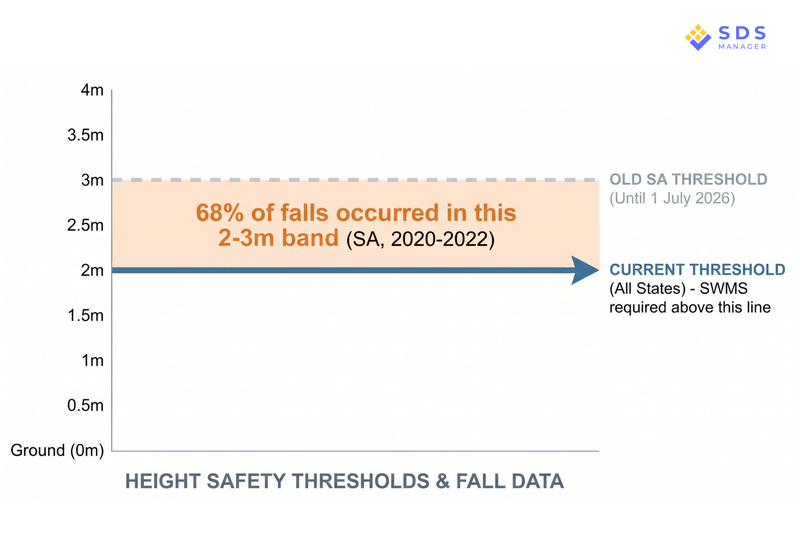
Between 2020 and 2022, there were 149 recorded falls from over two metres in South Australia; more than 100 of those were in residential construction, and 68% of the residential falls happened in the two-to-three-metre band the old rule didn't cover. These were the figures cited when the change was announced in mid-2026.
If your crew works near the South Australian border, this is the change to know: a single-storey reroof in Mount Gambier needed no SWMS in June 2026. The same job needs one now.
The Northern Territory Just Moved the Other Way
Two metres stopped being a national number on 17 July 2026. The Northern Territory amended its regulation 291 so residential construction work only triggers the SWMS duty above three metres. Everything non-residential in the NT stays at two.
"Residential construction work" follows the National Construction Code: Class 1 buildings, plus Class 10 structures like garages and carports attached to them.
NT WorkSafe is clear that this narrows the SWMS trigger and nothing else. The duty to identify fall hazards and control them is untouched. A fall from 2.5 metres onto a slab is the same fall in Darwin as in Adelaide.
What Counts as High Risk Construction Work?
Construction work that happens near anything dangerous, or are dangerous by nature themselves count as high-risk construction work.
High-risk construction work covers 18 kinds of work, set out in regulation 291. Fall risk is one of them and depth risk is another. Note that in the regulation, shafts and trenches deeper than 1.5 metres and tunnels sit together in a single paragraph, which is one reason different sources arrive at different totals. The rest fall into two broad groups, as we stated above.
The first group covers work near something dangerous, where what the work happens close to matters just as much as the work itself:
- Live (energised) electrical installations or services
- Pressurised gas distribution mains or piping
- Chemical, fuel or refrigerant lines
- Roads, railways, shipping lanes or other traffic corridors in use
- Areas with any movement of powered mobile plant
- An area that may have a contaminated or flammable atmosphere
- Water or other liquid deep enough to present a drowning risk
The second group is different: rather than being about what's nearby, it covers work that's dangerous by its very nature:
- Demolition of a load-bearing element, or one otherwise related to the structure's physical integrity
- Disturbing asbestos
- Structural alterations or repairs that require temporary support to prevent collapse
- Confined spaces
- Use of explosives
- Tilt-up and precast concrete
- Artificial extremes of temperature
- Telecommunication towers
- Diving work
If a job touches any one of these, it's high-risk construction work, and a SWMS is required before it starts.
Because these categories aren't mutually exclusive, plenty of jobs land on more than one at the same time, hitting two entries at once. Say a crew is cutting an opening through a load-bearing wall right next to a live switchboard.
That single task already ticks two boxes: demolition of a load-bearing structure and work near live electrical services, before anyone's even climbed a ladder or gone near a height risk.
Worth clearing up before moving on, since you'll see this list described as "18 items" in some places and "19" in others: both figures are correct; they're just describing different lists. The national list in regulation 291 has 18.
Victoria isn't on that list at all, and defines its own 19 categories under regulation 322 of its Occupational Health and Safety Regulations 2017, with different wording throughout. If a source says 19, it's describing Victoria.
Do SWMS Rules Change Between Australian States?
Yes, SWMS rules do change between states, but only in two specific ways, so it's worth being precise about what actually changes. Victoria runs an entirely separate system of its own. Western Australia, on the other hand, did join the shared national system, just later than every other state, and it kept one extra division nobody else has.
The table below covers every Australian jurisdiction, so you can check the two figures that actually move: the fall height that triggers the SWMS duty, and the project cost that brings a principal contractor into it.
| Jurisdiction | Main instrument | Fall trigger | Project threshold | Watch for |
|---|---|---|---|---|
| NSW | WHS Regulation 2025, from 22 August 2025 | 2 m | $250,000 | Remake of the 2017 Regulation, chapter 6 numbering kept |
| Victoria | OHS Act 2004, OHS Regulations 2017 | 2 m | Own Victorian definition | Separate scheme, 19 categories, regs 322, 324 and 327 |
| Queensland | WHS Regulation 2011 | 2 m | $250,000 | Mining sits outside the WHS framework entirely |
| South Australia | WHS Regulations 2012, amended 1 July 2026 | 2 m, was 3 m | $250,000 | Threshold dropped on 1 July 2026 |
| Western Australia | WHS Act 2020, WHS (General) Regulations 2022 | 2 m | $250,000 | Falls transition ends 30 September 2026, separate Mines regs |
| Tasmania | WHS Regulations 2012, from 1 January 2013 | 2 m | $250,000 | Follows the model wording |
| Northern Territory | WHS (National Uniform Legislation) Regulations 2011 | 3 m residential, 2 m otherwise | $1,000,000 | Both figures changed in 2026 |
| ACT | WHS Regulation 2011 | 2 m | $250,000 | Follows the model wording |
| Commonwealth | WHS Regulations 2011, Comcare scheme | 2 m | $250,000 | Follows the model wording |
Two things fall out of that. The fall threshold is no longer uniform, and hasn't been since July 2026. And the most generous threshold in the country now sits in the Northern Territory, not South Australia.
Western Australia carries one more date. WorkSafe WA's transitional arrangement for falls from height in construction runs to 30 September 2026, followed by a six-month Statement of Regulatory Intent. It covers how falls are managed, not the SWMS trigger.
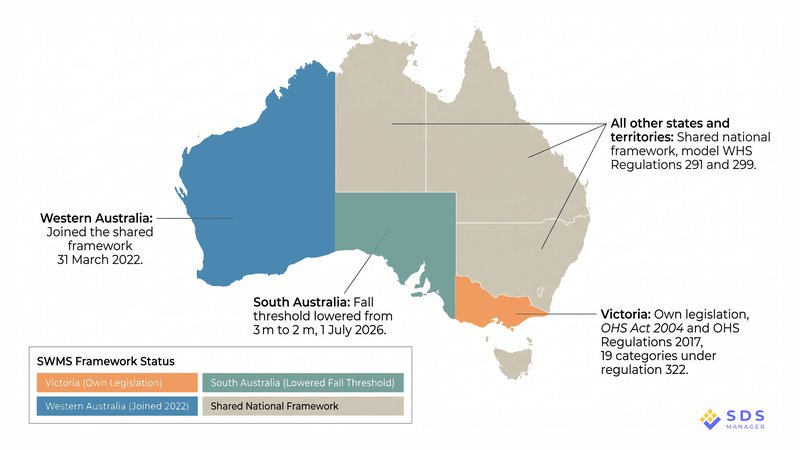
So while a handful of details shift state to state, such as Victoria's narrower content rule, WA's separate mining regulations, South Australia's new fall threshold, the Northern Territory's residential carve-out, the core idea running through all of it stays the same. Work out whether your job counts as high-risk construction work, and if it does, a properly built SWMS, not a JSA, has to exist before anyone starts, in every state.
What Does One Roof Job Look Like as a JSA and as a SWMS?
Having covered the legal side in the abstract, it helps to see it applied to one concrete step. Return to the Adelaide roof replacement from earlier, and look at just the first step: putting up edge protection before anyone climbs onto the roof.
Written up as a JSA, and written up as a SWMS, this step starts out looking almost identical. The difference only shows up once the JSA runs out of room.
A JSA for this step records three things:
- The step: installing edge protection before work begins
- The hazard: a worker falling from the edge while the guardrail is still being put in place
- The control: a harness, rigged to an anchor point on the scaffold, worn before anyone moves along the edge
That's the whole document. One row, three columns, and it ends there, which is exactly where a SWMS picks up and keeps going.
Written up as a SWMS, though, that same exact step doesn't stop there. It has to add:
- Why this is high-risk work: because of the fall height, something the JSA never has to mention at all
- How the control is actually carried out: not just "use a harness," but who checks it, how often, and what would trigger a review of that control
- Where the document goes: a copy has to reach the principal contractor before the first worker arrives on site, while the JSA typically never leaves the crew that wrote it
The takeaway? The step is the same in both documents. So is the hazard. What's different is everything built around them: the legal justification at the top, the added detail on how each control is implemented and monitored, and the simple fact that one document has to travel to the principal contractor while the other can stay with the crew that wrote it.
That difference, in the end, sums up the whole story of JSA vs SWMS. Same underlying thinking: break the job into steps, spot the hazard in each one, name a control. But only one of them is something the law requires you to write, check, and hand over before work starts.
Who Writes a JSA, and Who Signs a SWMS?
The crew doing the job writes the JSA. The business carrying out the work writes the SWMS. Neither legally requires a signature, though most sites collect one.
Timing follows from that split. A JSA comes together in the ten minutes before a shift, on site. The SWMS duty sits with the business rather than any individual, so it's rarely written on the spot. A JSA records how the crew intends to work that day. A SWMS commits the business to a method it can be held to later.
Signatures matter less than sites assume. Regulation 299's content requirements don't mention a signature block, so a SWMS without one still meets the legal standard. Principal contractors collect them as proof the document reached the people using it.
Consultation is the duty that does bite. Workers carrying out the work must be consulted while the SWMS is written, not handed it afterwards to sign. That comes from sections 47 to 49 of the WHS Act.
A signature proves the document reached someone on a given day. It says nothing about whether it still matches the work.
How Often Do a JSA and a SWMS Have to Be Reviewed?
Neither document runs on a fixed schedule. A SWMS has to be reviewed and revised whenever the work it covers changes, under regulation 302. The trigger is the change, not a date.
Say the Adelaide roofing crew gets up and finds the timber battens rotted through. Lifting and replacing tiles becomes stripping the roof surface and replacing the timber underneath. That's a genuine change, so the SWMS goes back for revision before anyone carries on.
The other triggers work the same way. A new hazard on site, a control that turns out not to work, an incident during the job. A health and safety representative can also require a review, and the business has to carry it out.
Nothing requires an annual review, and a SWMS has no expiry date.
Retention is a separate duty. Regulation 303 requires the SWMS to be kept and accessible to anyone engaged to carry out the work. That runs until the work is finished. A notifiable incident in connection with the work extends it to at least two years from the incident.
A JSA doesn't get reviewed at all. It gets rebuilt. A crew writing tomorrow's JSA starts fresh rather than checking whether yesterday's still applies.
Keeping a document current doesn't help if it was the wrong document. A perfectly up-to-date JSA still can't replace a SWMS.
What Happens if You Use a JSA Instead of a SWMS?
Where a job legally needs a SWMS, a JSA won't do instead, however well it's written.
Say the Adelaide roofing crew turns up with a JSA and nothing else. It might be a good JSA, covering the same steps, hazards and controls a SWMS would carry. None of that matters, because it's the wrong document for this job.
The first cost lands the same morning. Principal contractors require a SWMS as a condition of site access. A JSA doesn't satisfy that, so the morning goes on writing the document that does.
The second is a legal problem from the moment work starts. A business doing high-risk construction work without a SWMS has already failed a duty before anything goes wrong. A SWMS also has to be available for inspection, and a JSA won't satisfy that.
The third only shows up after an incident. A regulator investigating will ask what the method was, who owned each control, and how it was monitored. A SWMS answers those ahead of time. A JSA was never built to.
Having the right document type doesn't guarantee acceptance either. A properly written SWMS can still be sent back for revision.
Why Do Principal Contractors Reject a SWMS?
Most rejections come down to one thing. The SWMS is a template built for another job and never adjusted for this one.
A roofing SWMS pulled off the internet will list falls as a hazard. It will list working at height. It won't mention the steep pitch of this roof, the powerlines along the boundary, or the single access gate. Those are the details a principal contractor checks first.
The commercial risk is real. A subcontractor keeps one generic SWMS on file. An incident happens, and the principal contractor asks for the SWMS covering that task. No version matching the actual work exists, and the subcontractor loses the rest of the contract.
Three other issues send a SWMS back:
- Controls described too vaguely to verify
- The monitoring and review section left blank
- A method the crew has no intention of following
All three share a cause. The document was written to exist rather than to be used. The same site inspection and audit checks that catch a missing handrail will catch a blank monitoring section. That only works if the SWMS sits inside the inspection scope rather than beside it.
Can a JSA and a SWMS Work Together?
They can, and this happens far more often than the two documents competing, given how much ground they already share.
Here's how a JSA feeds into a SWMS: that shared ground is structural. The step-by-step breakdown a crew produces in a JSA is the same breakdown a SWMS needs, so plenty of businesses build their SWMS starting directly from the JSA the crew has already written.
Here's roughly how it plays out: the crew works through the task step by step, and the hazards and controls emerge from that process. The business then adds the legal framing, the implementation and monitoring detail, and the review triggers that regulation 299 asks for.
So, the JSA supplies the method, while the SWMS supplies what the law requires around it.
If your crew already fills in a JSA before each shift, most of a SWMS is sitting in those rows before anyone opens a template. What the business adds on top is the legal framing and the monitoring detail, not the method.
Businesses managing this across many jobs at once often handle it with EHS management software that stores a standard set of controls for each hazard, so the same hazard gets the same control every time, rather than a different answer depending on which site or crew wrote it up.
But the relationship does not run both ways. An SWMS can always do everything a JSA does, since it covers the same ground plus the extra legal requirements on top.
However carefully it's written, a JSA can never satisfy the legal SWMS requirement for high-risk construction work.
So here's the simple rule to remember, which brings this whole guide back to the one test it opened with: for work outside the list, a JSA on its own is enough, and it is what most crews use. For work on the list, the SWMS is not optional, and a JSA remains a good way to start writing one.
Frequently Asked Questions
Is a JSA Legally Required Anywhere in Australia?
No, a JSA is not legally required anywhere in Australia, because no regulation defines the document or requires one to exist. The duties it helps you discharge are real, since a business has to manage risks to health and safety and consult the workers exposed to them. The document itself is practice rather than law.
Can One SWMS Cover a Whole Site?
No, one SWMS cannot cover a whole site as a single generic document, since a SWMS covers specified high-risk construction work rather than a location. A site running several of those activities needs each one addressed. One document can cover more than one activity, as long as it describes each of them and the hazards present on that particular site.
Do You Need a SWMS for Maintenance Work on an Existing Building?
Whether you need a SWMS for maintenance work on an existing building depends on the work rather than the building, because maintenance and repair fall inside the definition of construction work at regulation 289. Maintenance involving any of the eighteen high-risk activities needs one. Replacing a roof sheet two storeys up does. Changing a light fitting at ground level does not.
What Is the Difference Between a SWMS and a Risk Assessment?
The difference between a SWMS and a risk assessment comes down to scope: a risk assessment works out what could cause harm and how serious it would be, and a SWMS sets out how one specific piece of high-risk construction work will be carried out safely. A SWMS does not replace a risk assessment, and a risk assessment does not satisfy the SWMS duty.
Does a JSA Work Outside Construction?
Yes, a JSA works outside construction, and that is where most of them are used, because the method suits any job you can break into steps. It turns up in manufacturing, warehousing, maintenance and mining as readily as on a building site. The SWMS requirement is confined to high-risk construction work; the JSA has no such boundary.
Can a Subcontractor Use the Principal Contractor's SWMS?
No, a subcontractor cannot use the principal contractor's SWMS, since the duty to prepare one sits with the business carrying out the high-risk construction work. A subcontractor doing that work prepares its own and gives a copy to the principal contractor. The principal contractor's document covers the principal contractor's work.
Does a SWMS Expire?
No, a SWMS does not expire, because nothing in the regulations sets an expiry date. What does apply is a review trigger: the document has to be reviewed and revised when the work it covers changes, when a control turns out not to work, or after an incident. Many businesses review annually as a matter of policy, which is a practice rather than a requirement.
Is a Digital or App-Based SWMS Acceptable?
Yes, a digital or app-based SWMS is acceptable, because the regulations prescribe content rather than format. One held in an app meets the requirement as readily as one on paper. The practical test is the same either way: the people carrying out the work have to be able to read it, which means access on site rather than a file sitting on an office computer.

Arysha Alif Khan

Arysha Alif Khan is an EHS and chemical safety specialist with a background in biochemistry, biotechnology, and public health. She works closely with the product and regulatory teams to turn complex chemical regulations, SDS requirements, and workplace safety standards into clear, practical guidance for people.