If you want to improve warehouse safety, you must control high-risk activities, enforce clear procedures, and build a culture where safety is operational. Sustainable improvement comes from structured hazard control, consistent supervision, and measurable performance standards.
This guide shows you exactly how to implement those controls in 12 practical, measurable ways.
Why Is Safety Important in a Warehouse?
Warehouses combine vehicle traffic, elevated storage, heavy loads, and often hazardous substances. That mix creates compounding risk.
In the United States, the warehousing and storage sector consistently reports injury rates above the national private-industry average. According to the Occupational Safety and Health Administration, common warehouse injuries involve struck-by incidents, falls, overexertion, and powered industrial truck accidents.
Poor safety performance leads to:
- Workers’ compensation claims
- Regulatory penalties
- Downtime and damaged inventory
- Increased insurance premiums
- High employee turnover
Safety is not separate from productivity. Stable operations depend on predictable, controlled risk.
Common Warehouse Safety Challenges
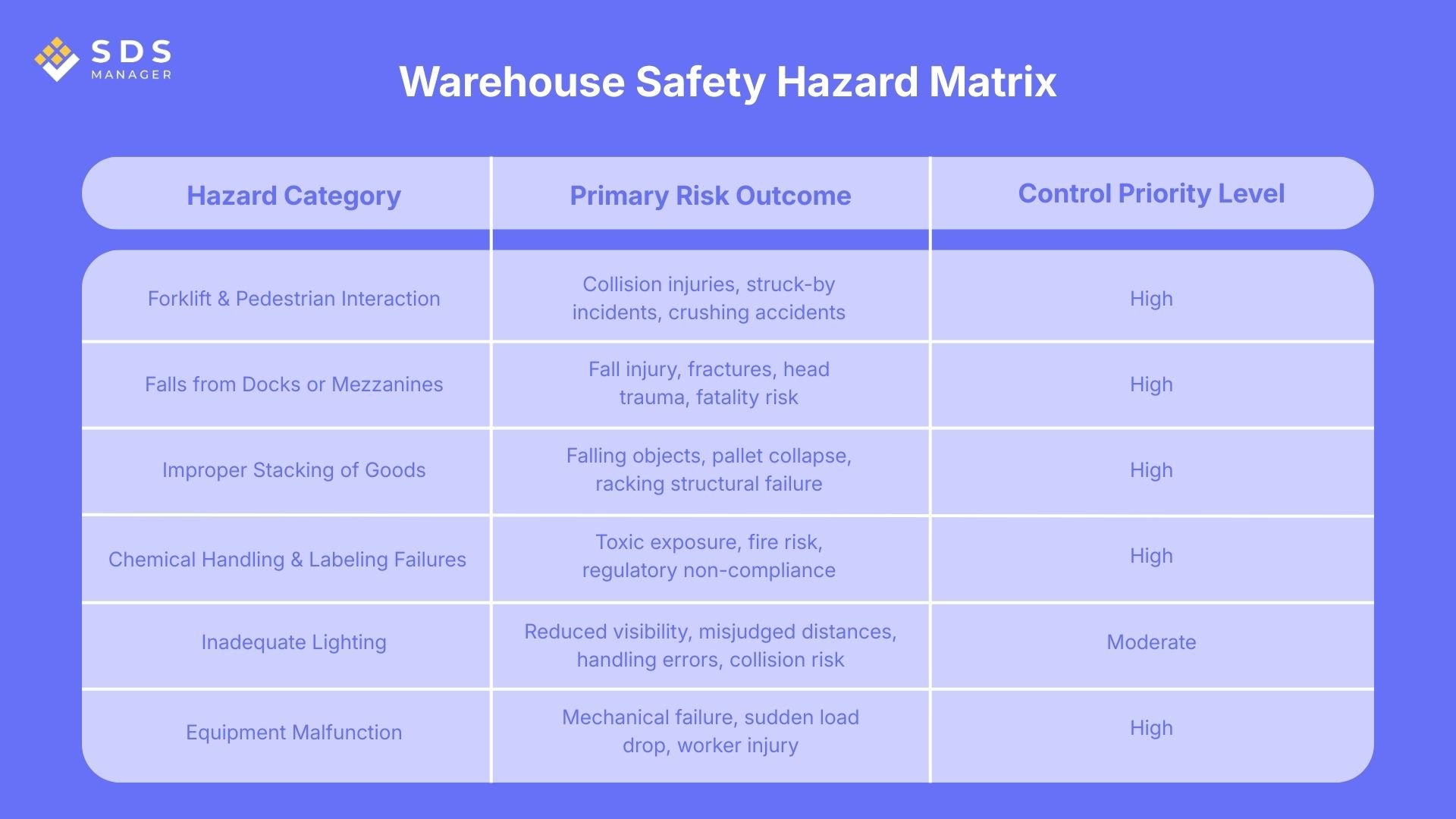
Before implementing improvements, identify your highest exposure areas and the operational factors driving risk. Common hazards include:
Forklift and pedestrian interaction
Collisions between forklifts and pedestrians are a leading cause of warehouse injuries. Poorly marked walkways, blind spots, and lack of traffic rules increase risk.
Falls from docks or mezzanines
Unprotected edges, damaged guardrails, and misaligned trailers create serious fall hazards. Mezzanines without proper protection amplify injury likelihood.
Improper stacking of goods
Overloaded or unstable pallets and inconsistent racking inspections can cause falling objects and structural failures. Standardized stacking protocols reduce risk.
Chemical handling and labeling failures
Improper segregation, outdated labels, or inaccessible SDSs increase exposure and regulatory liability. Secondary container labeling is essential.
Inadequate lighting
Low visibility in aisles or loading zones contributes to collisions, misjudged distances, and handling errors.
Equipment malfunction
Faulty forklifts, racking damage, or unmaintained dock levelers create preventable hazards. Documented inspections are critical.
12 Practical Strategies to Strengthen Warehouse Safety
1. Enhance Chemical Safety Management
If chemicals are stored onsite, the risk profile increases significantly.
Focus on:
- Correct secondary container labeling
- Up-to-date Safety Data Sheets
- Segregation of incompatible substances
- Ventilation and spill containment
If your facility transfers chemicals into smaller containers, ensure compliant labeling. You can generate compliant labels using a dedicated secondary container labeling system designed for operational environments.
For broader risk control strategies, read on chemical warehouse safety.
2. Conduct Structured Safety Audits
As part of improving warehouse safety, run safety audits. Routine inspections uncover small issues before they escalate.
Perform monthly internal inspections and quarterly comprehensive reviews. Use standardized checklists. Document corrective actions and completion dates. A written audit trail demonstrates due diligence during regulatory inspections.
Download this warehouse safety audit checklist to make audits easier to run.
3. Redesign Traffic Flow
Vehicle and pedestrian separation reduces collision risk dramatically.
Mark forklift lanes clearly. Install barriers where feasible. Establish one-way traffic patterns in narrow aisles. Use mirrors at blind corners. Enforce speed limits and monitor compliance.
4. Improve Lighting and Visibility
Insufficient visibility contributes to accidents.
Increase illumination in high-traffic zones. Use reflective floor markings. Install motion-activated lighting in storage areas. Ensure loading docks are evenly lit.
5. Reinforce Hazard Communication Practices
Clear labeling and chemical management prevent exposure incidents.
Ensure all hazardous materials are labeled properly. Keep all Safety Data Sheets organized and easily accessible with an online SDS management tool.Train workers on handling procedures. Review chemical storage compatibility.
Hazard communication failures often lead to serious regulatory consequences.
6. Enforce Personal Protective Equipment Standards
Protective gear is effective only when used consistently.
Conduct periodic PPE compliance checks. Replace damaged equipment promptly. Match protective gear to specific job tasks. Explain the reasoning behind PPE requirements.
7. Establish Incident Reporting Systems
Near-miss reporting reveals hidden risks.
Encourage employees to report hazards without fear of retaliation. Investigate incidents promptly. Track trends and recurring issues. Share lessons learned across teams.
8. Leverage Digital Systems
Paper records often fail under daily warehouse demands. Digital safety management systems keep safety documentation, inspections, training logs, and corrective actions organized, accessible, and audit-ready. Reliable data ensures consistent compliance and strengthens operational discipline.
9. Use Signage and Visual Controls Strategically
Visual reminders reinforce safe behavior.
Post clear signage in high-risk areas. Mark emergency exits visibly. Display load capacity limits. Use floor tape to define walkways and storage zones.
10. Maintain Equipment Proactively
Mechanical failure is predictable if maintenance is ignored.
Inspect forklifts daily. Schedule preventive servicing. Replace worn parts immediately. Maintain documented maintenance logs. Remove defective equipment from service without delay.
11. Optimize Layout and Storage Systems
Poor layout increases strain and accidents.
Store heavy items at waist height. Secure pallets properly. Avoid overstacking. Ensure adequate aisle width. Maintain clear emergency exits.
12. Build a Safety-Driven Culture
Procedures reduce risk, but a strong culture sustains results. Encourage employees to report hazards, participate in supervisor walk-throughs, and discuss near-miss events openly.
Recognize proactive safety behavior and make it clear that safety matters as much as productivity. When employees see that commitment, compliance becomes part of daily operations rather than an obligation.
Final Takeaway
To improve warehouse safety, you must systematically identify hazards, enforce controls, and verify compliance through documentation and supervision. Isolated improvements are insufficient. Safety performance improves when systems, training, and leadership align.
Warehouse environments are inherently high-risk. However, with structured planning and consistent oversight, those risks become manageable.
Frequently Asked Questions
How often should warehouse safety audits be conducted?
Monthly internal inspections are recommended. High-risk facilities may require more frequent reviews.
What are the most common warehouse hazards?
Forklift incidents, falls, struck-by events, ergonomic strain, and chemical exposure.
Why is safety important in a warehouse from a business perspective?
Strong safety performance reduces regulatory risk, lowers insurance costs, and improves operational continuity.
What are the most effective warehouse safety improvement ideas?
Focus on clear traffic flow, proper equipment maintenance, hazard audits, consistent training, chemical handling controls, and a safety-focused workplace culture.
Why is safety important in a warehouse?
Safety reduces injuries, prevents downtime, lowers regulatory and insurance risks, and ensures smooth, productive operations.
What is the 5S rule in warehousing?
The 5S rule in warehousing is a workplace organization method designed to improve efficiency, safety, and cleanliness. It comes from five Japanese words, each representing a step:
- Sort (Seiri) – Remove unnecessary items from the warehouse to reduce clutter and hazards.
- Set in Order (Seiton) – Organize tools, materials, and products so they are easy to find and access.
- Shine (Seiso) – Clean the workspace regularly to maintain safety and detect issues early.
- Standardize (Seiketsu) – Establish consistent procedures for organization and cleanliness across all areas.
- Sustain (Shitsuke) – Maintain the system through ongoing training, audits, and employee accountability.
Applied correctly, 5S increases efficiency, reduces accidents, and makes warehouse operations more predictable and safe.

Samiha Fairooz Audrika

Samiha is a workplace safety expert and writer at SDS Manager. She translates complex safety standards into clear, practical guidance rooted in real-world challenges and industry insight. Her work helps businesses strengthen compliance, protect workers, and make safer decisions with confidence.