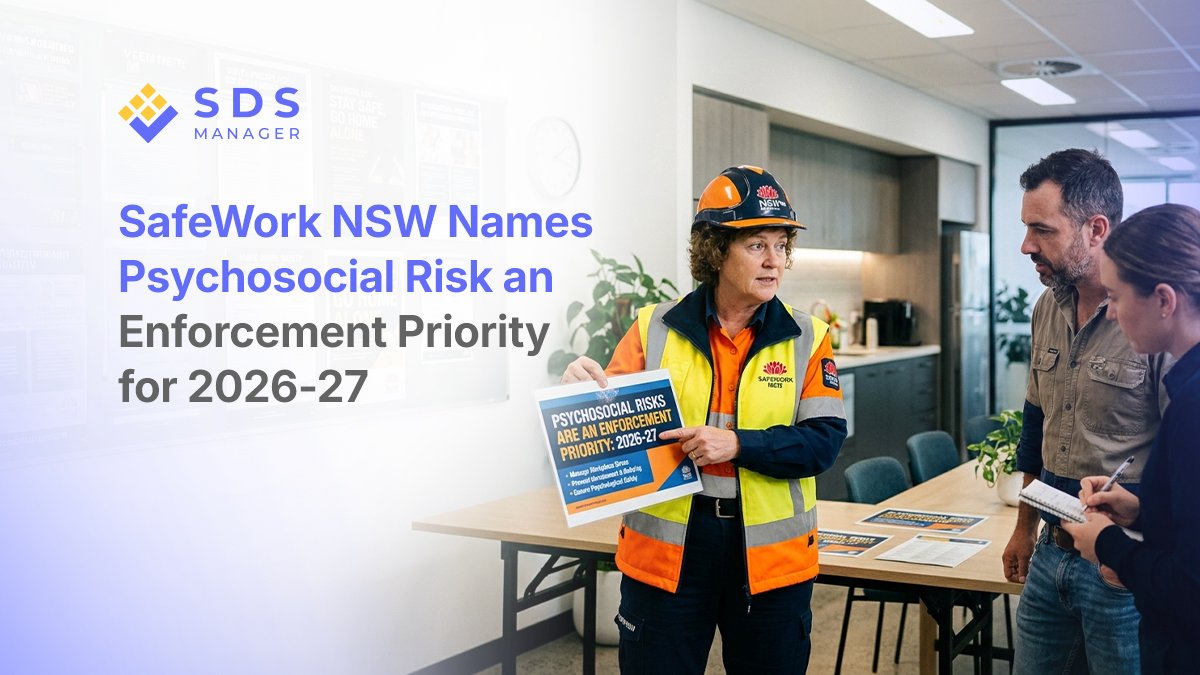
SafeWork NSW released its 2026-27 Regulatory Statement on July 1, 2026, confirming psychosocial risk as one of four compliance and enforcement priorities for the coming financial year. NSW Codes of Practice became legally enforceable the same day, which changes what businesses have to show.
The other three are falls from height, hazardous substances, and mobile plant, vehicles, and fixed machinery. All four carried over from the previous year's statement, which named five priorities; the one that didn't return was harms to workers in the health care and social assistance sector.
Why Psychosocial Risk Made the List Again
SafeWork NSW received more than 2,200 requests for service and over 190 incident notifications tied to psychosocial hazards in the past 12 months. The regulator's focus for 2026-27 centers on risk factors linked to psychological harm, including bullying and harassment, along with violence and aggression directed at frontline and customer-facing workers.
The other three priorities carry their own weight. Falls from height accounted for more than 600 reported incidents, including five fatalities. Mobile plant, vehicles, and fixed machinery were linked to more than 500 incidents and eight fatalities over the same period. Hazardous substances drew more than 145 silica-related notices and over 45 reported silicosis cases in the same period.
What Changed With Codes of Practice
Codes of Practice in NSW have historically functioned as guidance material, something inspectors and courts could reference when weighing what was reasonably practicable. That changed under section 26A of the Work Health and Safety Act 2011 (NSW), introduced by the Industrial Relations and Other Legislation Amendment (Workplace Protections) Act 2025 and commencing in stages through 2025 and 2026.
The provision covering Codes of Practice took effect on July 1, 2026. Businesses that don't follow a relevant approved Code now have to show their own approach meets or exceeds its standard, and failing to do either exposes them to a separate penalty on top of any existing breach of their general safety duty.
For psychosocial risk specifically, the Managing Psychosocial Hazards at Work Code now serves as the enforceable benchmark. Businesses are expected to show that psychosocial hazards have been identified, assessed, controlled, monitored, and documented.
SafeWork NSW has said it wants to see higher order controls, not just policies, training, or employee assistance programs, especially in workplaces where bullying, harassment, or violence toward frontline and customer-facing staff is a known risk.
What's Backing This Push
The NSW Government has committed $127.7 million toward expanding the psychosocial inspectorate and establishing a Psychosocial Advisory Service. SafeWork NSW also set up a tripartite SafeWork Advisory Council over the past year, bringing together workers, employers, safety experts, and families with lived experience to advise the regulator directly.
"Since becoming a standalone regulator, we've not seen much of a change in our regulatory priorities between 2025/26 and 2026/27," said SafeWork NSW Commissioner Janet Schorer, framing the continuity as a floor rather than a reason for businesses to ease off.
This is the second Regulatory Statement released since SafeWork NSW became a standalone regulator in July 2025.
Businesses managing hazardous substances as one of the four priority areas can strengthen that side of compliance by keeping a current hazardous chemicals register and up-to-date safety data sheets in one accessible place rather than scattered across departments.
References: SafeWork NSW, "SafeWork NSW redefines its priorities in new 2026-27 Regulatory Statement" | DLA Piper GENIE, "SafeWork NSW releases 2026-2027 Regulatory Statement" | Actevate, "SafeWork NSW Has Named Its 2026-27 Priorities"

Mehreen Iqbal

Started with a Bachelors in Microbiology, then a Masters in Public Health; Currently a Workplace Safety Expert.