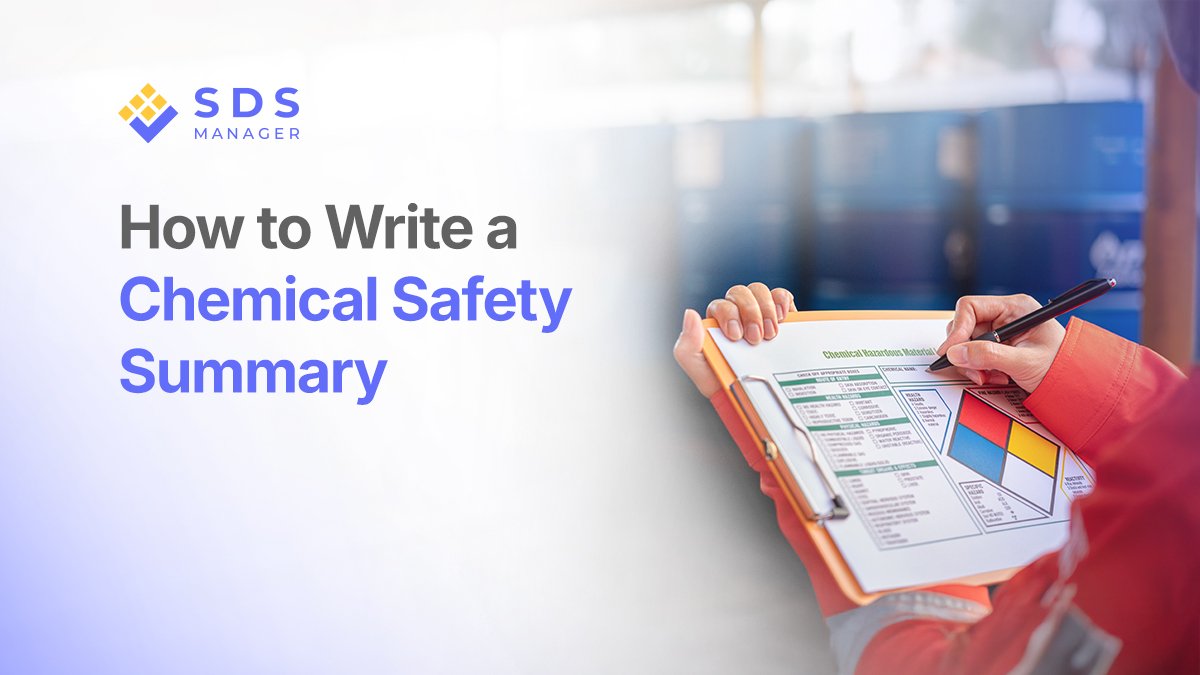
Every chemical that enters the EU market needs clear safety documentation. A chemical safety summary is where the most critical information lives. It pulls key hazards, protective measures, and emergency steps from a full 16-section Safety Data Sheet (SDS) and puts them in a format anyone can read and act on quickly.
Whether you call it a Laboratory Chemical Safety Summary (LCSS) or a hazard overview sheet, the purpose is the same. Give people what they need to handle a substance safely, without making them dig through hundreds of pages.
In the EU, this document must align with both REACH and CLP regulations. Getting it wrong means compliance gaps. Getting it right means safer workplaces and smoother audits.
Key Takeaways
A chemical safety summary pulls the essential hazards, PPE requirements, and emergency steps from a full SDS into a short, plain-language document anyone can act on quickly. In the EU, it must align with both REACH and CLP regulations, including the new hazard classes and labelling rules taking effect in 2026. Use the seven-step process in this guide to write, review, and maintain summaries that hold up under inspection.
What Is a Chemical Safety Summary?
A chemical safety summary is a short, focused document that highlights the essential hazards of a chemical substance and the steps needed to use it safely. It pulls key information from the full 16-section Safety Data Sheet (SDS) and presents it in a way that is easy to scan and act on.
Think of it as the front page of your chemical's safety story. It covers what the chemical is, what makes it dangerous, how to protect yourself, and what to do if something goes wrong.
In the EU, this summary sits at the intersection of two major regulations. REACH governs how chemical data is gathered, assessed, and shared across supply chains. CLP determines how hazards are classified and communicated through labels and Safety Data Sheets. Your chemical safety summary must align with both.
The people who read it range from lab technicians and warehouse workers to EHS managers and regulatory inspectors. It needs to serve all of them.
What to Include in a Chemical Safety Summary
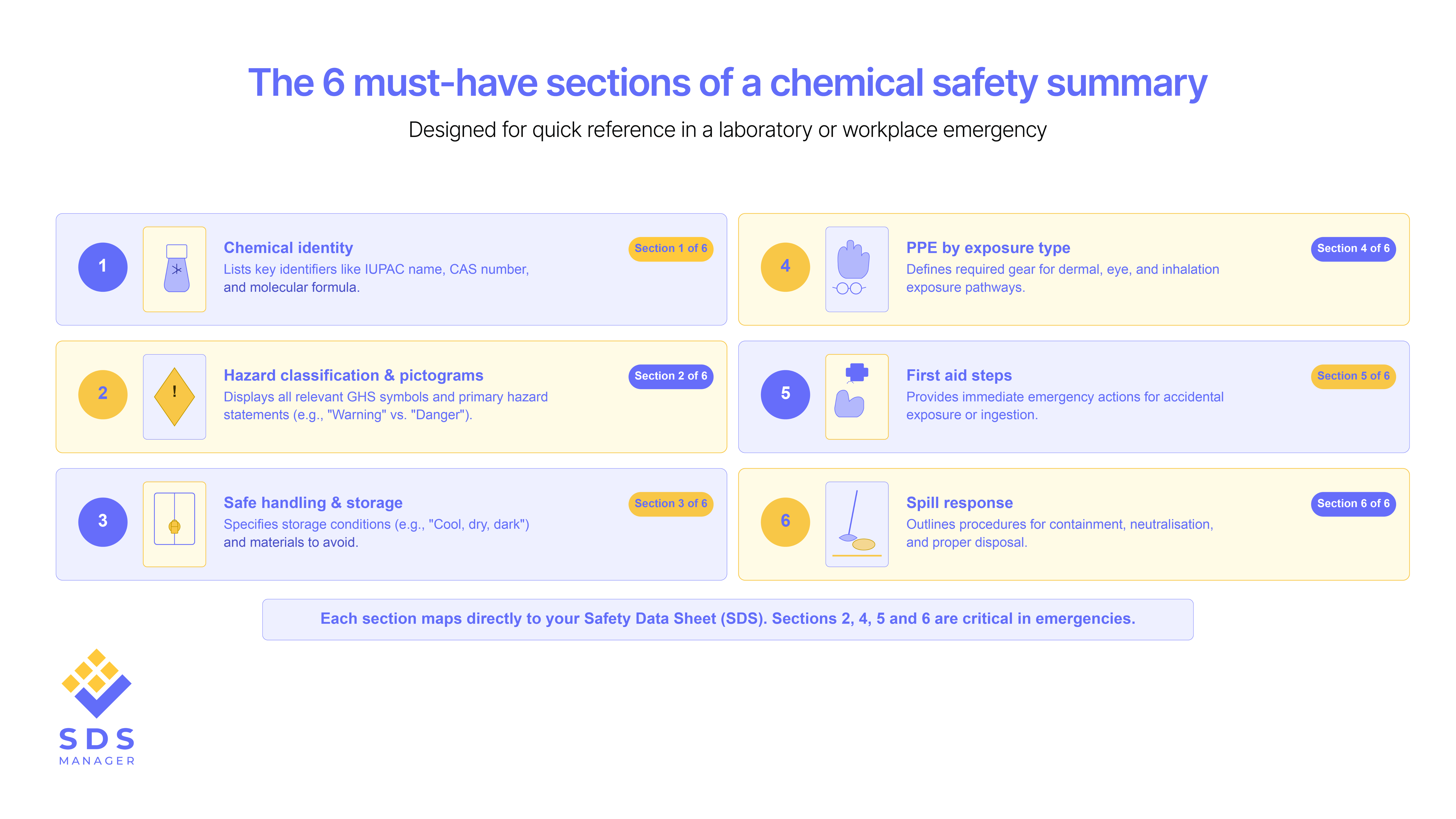
A strong chemical safety summary covers a consistent set of elements, each mapped from REACH-compliant reports and CLP-classified data.
Start with substance identification. Include the chemical name, CAS number, EC number, supplier details, and emergency contact. If it is a mixture, list the concentration of hazardous ingredients that trigger CLP classification.
Next comes hazard identification. This is the most important section. List all applicable GHS pictograms, the signal word (Danger or Warning), and every relevant H-statement and P-statement. As of May 2026, the new CLP hazard classes for endocrine disruptors, PBT/vPvB, and PMT/vPvM substances also apply to mixtures. If your substance falls under these, your summary must reflect it.
Then specify PPE requirements. Be precise. "Wear nitrile gloves and chemical splash goggles" is useful. "Wear appropriate PPE" is not.
Include handling and storage guidelines. Note ventilation needs, incompatible materials, temperature requirements, and container specifications. This maps from Section 7 of your SDS.
Finish with emergency procedures. Cover first aid for each exposure route, spill containment steps, and firefighting measures. Write these as direct commands. Short sentences. Zero ambiguity. Someone reading this during an emergency does not have time to interpret complex instructions.
How to Write a Chemical Safety Summary in 7 Steps
Step 1: Gather information from the full SDS. Focus on Sections 2 (hazards), 4 (first aid), 7 (handling and storage), and 8 (exposure controls and PPE). Always use the current version.
Step 2: Evaluate risks using the RAMP method. RAMP stands for Recognize hazards, Assess risks, Minimize risks, and Prepare for emergencies. It is endorsed by the American Chemical Society and gives your summary a logical backbone. Identify the GHS classification first, then assess how severe the hazards are under your specific conditions of use.
Step 3: Summarise hazards with GHS pictograms and statements. List the formal classification, then add a plain-language explanation. "H314: Causes severe skin burns and eye damage" is the regulatory line. "Direct skin contact causes chemical burns. Rinse immediately with water for 15 minutes" is the human translation. Include both.
Step 4: Define protective measures. List engineering controls first, such as fume hoods or ventilation. Then specify PPE for each exposure route. Include occupational exposure limits where they exist.
Step 5: Write clear emergency steps. Use direct commands. "Move the person to fresh air." "Remove contaminated clothing." "Call a poison control centre." Cover spills, first aid, and fire response.
Step 6: Keep it concise and scannable. Aim for one to two pages. Use bold text for critical warnings. Break paragraphs after two to three sentences. Design the layout for someone reading it under pressure.
Step 7: Review for accuracy. Check the summary against your current SDS. Confirm it reflects the latest CLP classification. Verify SVHC status if the substance appears on the ECHA Candidate List, which now stands at 253 entries. Have a competent person review it before distribution.
Mistakes That Create Compliance Gaps
The most common errors are using outdated classification data, missing SVHC information, copying SDS text instead of summarising it, ignoring exposure scenarios from Extended Safety Data Sheets, and failing to update the summary when regulations change. Each of these creates a gap that surfaces during inspections and customer due diligence.
Final Takeaways
A chemical safety summary is not a formality. It is how you communicate risk to the people who handle your substances every day. Use the RAMP method to structure your thinking. Use GHS standards to communicate hazards. Use plain language to make it actionable.
The EU regulatory environment is tightening. The SVHC Candidate List keeps growing. New CLP hazard classes now apply to mixtures. Your documentation must keep pace.
For teams managing large substance portfolios, AI-powered SDS authoring tools like ExactSDS by SDS Manager can remove the manual burden of keeping safety documentation aligned with every regulatory update. This ExactSDS review covers features and pricing if you want to evaluate the fit.
Write clearly. Update consistently. Protect people first.
Frequently Asked Questions
What is the difference between a Safety Data Sheet and a chemical safety summary?
An SDS is a manufacturer-produced technical document required under EU REACH and CLP. A chemical safety summary is the shorter, plain-language version the employer creates for internal use, written so workers can read and act on it quickly.
Who is responsible for writing a chemical safety summary in the EU?
The employer or a designated safety officer. The SDS comes from the manufacturer under REACH obligations, but adapting it into a workplace-ready document is the employer's responsibility.
Does a chemical safety summary need to follow a specific format under EU law?
No mandatory format exists, unlike the SDS which follows a strict 16-section structure under CLP. Every summary should cover chemical identity, hazards, PPE, first aid, handling, storage, and spill response as a minimum.
How do I know if my summaries are out of date under the revised CLP Regulation?
Cross-reference each summary against the current manufacturer SDS. If hazard classifications, signal words, pictograms, or PPE recommendations differ, or if newer hazard classes such as endocrine disruptors are missing, the summary needs updating.
What is a UFI and do I need to include it?
A UFI (Unique Formula Identifier) is a code required under EU poison centre notification regulations so emergency services can identify a product's exact formulation quickly. If your chemical is subject to these requirements, the UFI must appear on the label and in your chemical safety summary.

Mehreen Iqbal

Started with a Bachelors in Microbiology, then a Masters in Public Health; Currently a Workplace Safety Expert.