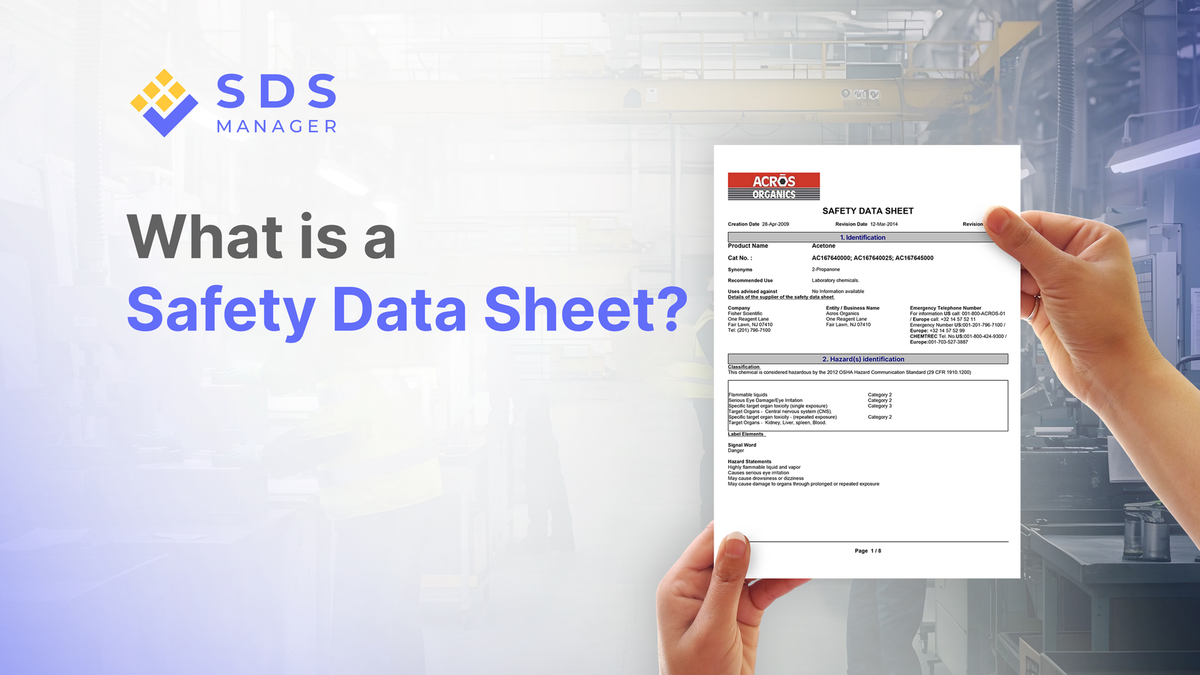
When a spill happens or a smell hits the room, guessing is dangerous. A Safety Data Sheet (SDS) is the document that removes guesswork. It explains what the chemical is, what it can do to people and the environment, and exactly how to handle, store, and respond step by step.
What is a Safety Data Sheet?
A Safety Data Sheet (SDS) is the official information sheet for a chemical. It tells you what the product is, what hazards it has, and how to use, store, and respond safely, step by step.
Every SDS follows the same 16-section format (GHS). That means key details like hazards, first aid, and PPE are always in the same place, no matter the supplier.
For instance, if a worker accidentally gets exposed to a chemical when handling it, the first thing you should reach for is an SDS. The first aid section of an SDS lists exactly how to respond in situations like this preventing more harm.
That’s why the SDS is the manual for a chemical, it spells out hazards, PPE, accidental responses, and emergency steps so we respond fast and right.
Why Do We Need an SDS?
Before global standards, chemical sheets varied wildly, with different layouts, missing info, and unclear hazards. Workers, supervisors, and first responders often had to guess in a crisis.
To fix this, regulators aligned on the Globally Harmonized System (GHS) format. In practice, that means OSHA’s HazCom in the U.S. and CLP/REACH in the EU require a consistent SDS with the same core sections and terms.
The goal was simple: make critical safety information available so anyone can find it fast anywhere on a production line, in a lab, at a loading dock, or during an emergency.
The 16 sections of an SDS
All SDSs follow the same layout (GHS/CLP/REACH worldwide; OSHA HazCom in the U.S.). You don’t need to memorize it, just know where to look:
| # | Section | What it covers | Why it matters | Go-to uses |
|---|---|---|---|---|
| 1 | Identification | Product name, intended use, supplier contact, emergency number | Confirms you’ve got the right SDS; who to call fast | Verify product; emergency contact |
| 2 | Hazard Identification | Pictograms, signal word, H/P statements, hazard classes | Quick view of risks before handling | Pick PPE; align labels |
| 3 | Composition / Ingredients | Components, CAS numbers, concentrations | Helps medical care and risk assessment | Exposure/poison info |
| 4 | First-Aid Measures | What to do for eyes/skin/inhalation/ingestion | Step-by-step action to reduce harm | Immediate response |
| 5 | Fire-Fighting Measures | Extinguishers to use, special fire hazards, advice | Safer fire response; right media | Fire plan for this product |
| 6 | Accidental Release Measures | Spill containment, cleanup, personal/environmental protection | Limits spread and exposure | Spill kits & drain protection |
| 7 | Handling & Storage | Safe use, storage conditions, incompatibilities | Prevents incidents before they start | Where/how to store |
| 8 | Exposure Controls / PPE | Exposure limits, ventilation, required PPE | Prevents incidents before they start | Select PPE; set controls |
| 9 | Physical & Chemical Properties | Appearance, odor, pH, flash point, etc. | Predicts behavior; ignition risk | Flammable handling rules |
| 10 | Stability & Reactivity | What makes it unstable/reactive: incompatibles | Avoids dangerous reactions | Segregation; process safety |
| 11 | Toxicological Information | Health effects, routes, symptoms (acute/chronic) | Guides medical care and protection | Health risk briefings |
| 12 | Ecological Information | Aquatic toxicity, persistence, bioaccumulation | Prevents environmental harm | Drain protection; disposal planning |
| 13 | Disposal Considerations | How to dispose of the product/container per rules | Legal, safe end-of-life handling | Waste labeling & pickup |
| 14 | Transport Information | UN number, shipping name, hazard class, packing group | Safe, legal transport and documents | Shipping papers and labels |
| 15 | Regulatory Information | Applicable laws (e.g., REACH/CLP, local regs) | Keeps you compliant | Compliance checks |
| 16 | Other Information | Revision date, sources, abbreviations | Ensures you use the latest info | Version control; training notes |
Who needs to understand SDSs?
Anyone who buys, stores, moves, mixes, uses, cleans, or responds around chemicals, like production and warehouse teams, lab and cleaning crews, supervisors, EHS managers, and first responders. Safety isn’t just an EHS job, it’s for everyone on the floor near and around hazardous chemicals.
Why a Safety Data Sheet is Important
When something spills or a smell hits the room, we don’t guess; we open the SDS. It’s the one place that tells us the hazards, the PPE, and the first-aid steps fast enough to prevent harm. Here are some ways an SDS helps us:
1) It prevents injuries.
SDSs show the real risks (fire, toxicity, corrosion, environmental harm) and the controls that stop them PPE, ventilation, storage conditions, incompatibilities. When teams check Section 2 and Section 8 before work, incidents drop.
2) It speeds up first aid and spill response.
If something goes wrong, you don’t improvise. You open Section 4 and follow the first-aid steps exactly; you use Section 6 to contain spills and protect drains; you check Section 5 to pick the right extinguishing media. Panic becomes a plan.
3) It keeps labels and training honest.
Workplace and secondary container labels should match Section 2 same pictograms, signal word, and H/P statements. Training then reinforces those rules, so language stays consistent across signs, labels, and drills.
4) It proves compliance.
Laws expect current SDSs to be readily accessible on every shift. A clean SDS programme, one SDS per product, archived history, and quick access turn audits into show-and-tell instead of a scramble.
5) It protects the environment.
SDSs explain ecological risks (Section 12) and proper disposal (Section 13). Following those steps prevents pollution, fines, and unplanned costs.
Is an SDS legally required?
Yes, if the chemical is hazardous. According to the European Union, CLP and REACH require SDSs in the official language(s) of the market, with updates when new hazard info appears. Wherever you operate, the rule of thumb is the same: current SDSs must be readily accessible to workers on every shift with every hazardous chemical on the floor.
Best practices to manage SDSs
Tools like SDS Manager just make those habits easier with one searchable library, QR/offline access, and labels that match, so safety becomes routine and compliance is the receipt for the work we’ve already done.
In the end, an SDS isn’t paperwork; it’s the playbook that keeps people safe when seconds matter. When we keep one SDS per product, make access instant, and align labels to the same data, the floor gets calmer and decisions get faster.
Quick FAQ
Is an SDS the same as an MSDS?
MSDS was the older format. SDS is the GHS-aligned, 16-section standard used today.
Do all chemicals need an SDS?
No. But hazardous chemicals do, and many employers keep SDSs for borderline products to train and respond confidently.
Where do I find the right SDS?
Start with the supplier or manufacturer. Ensure the revision date is current and the product identifier matches what you actually use.
How often should an SDS be updated?
Whenever new hazard or regulatory information becomes available, the supplier updates the SDS. On our side, we review libraries at least annually and replace older versions so only one live SDS is in use.
What if the SDS and the label don’t match?
Treat the SDS as the source of truth. Update the workplace label to match Section 2 (pictograms, signal word, H/P). Replace old templates, and keep one SDS per product so training, labels, and audits stay aligned. If in doubt, request the latest SDS from the supplier.

Mehreen Iqbal

Started with a Bachelors in Microbiology, then a Masters in Public Health; Currently a Workplace Safety Expert.