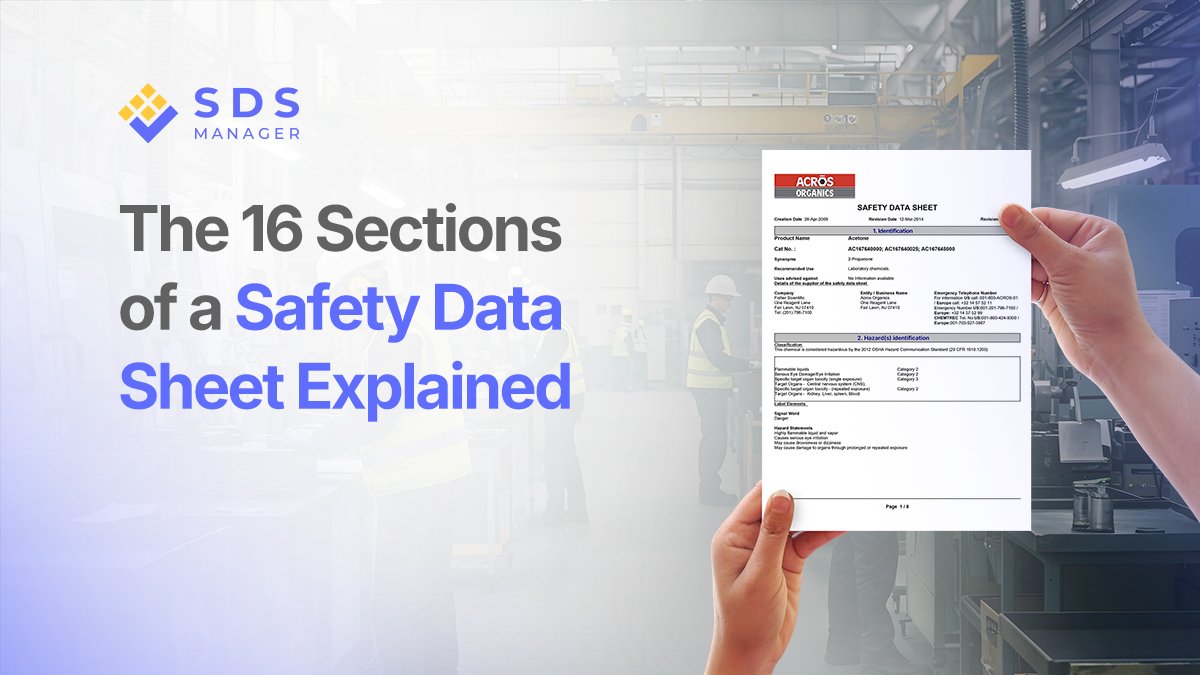
Safety Data Sheets (SDS) follow a standard 16 section format under the Globally Harmonised System (GHS), providing critical information about chemical hazards, safe handling, storage, transport, and disposal.
The 16 sections of an SDS are standardised globally, making sure information is consistent across all sheets. This helps anyone to quickly find the necessary details in one place, regardless of region, country, or language, especially during an emergency.
Understanding these sections helps you protect people and the environment and comply with safety regulations across different countries, whether under EU CLP and REACH, OSHA HazCom in the United States, or other national standards.
Following a standardised 16-section format under GHS, SDSs help workplaces stay safe, comply with regulations, and respond quickly to incidents.
What Are the 16 Sections of a Safety Data Sheet (SDS)
Knowing what each section contains allows you to respond effectively during routine work or emergencies. Below is a detailed overview of the 16 SDS sections and why they matter.
The 16 Sections of a Safety Data Sheet
| Section | Purpose | Contents | Why It Matters |
|---|---|---|---|
| 1. Identification | Confirms the chemical’s identity and supplier information | Product name and identifiers Supplier or manufacturer contact details Emergency contact number Recommended use and restrictions | Always verify you are using the correct chemical. Supplier contacts are critical during spills, exposures, or other incidents. |
| 2. Hazard Identification | Outlines the chemical’s main hazards and risks | Hazard classification under GHS Signal word (Danger or Warning) Hazard statements Precautionary statements Pictograms | Essential for risk assessments, PPE selection, and emergency response planning. Referenced in EU, US, and international regulations. |
| 3. Composition / Information on Ingredients | Details the chemical’s composition | Ingredient names and concentrations CAS numbers Trade secret information where applicable | Supports medical treatment, emergency response, and accurate chemical inventories globally. |
| 4. First Aid Measures | Instructions for immediate response to exposure | First aid for inhalation, ingestion, skin, or eye contact Symptoms to watch for When to seek medical attention | Reduces harm from exposure and is critical in workplaces worldwide. |
| 5. Firefighting Measures | Guidance on responding to fires involving the chemical | Suitable and unsuitable extinguishing media Specific hazards from combustion Protective equipment for firefighters | Supports fire safety planning, in compliance with international safety practices. |
| 6. Accidental Release Measures | Instructions for spill or leak management | Personal precautions and protective equipment Emergency procedures Containment and clean-up methods Environmental precautions | Protects people and the environment and ensures regulatory compliance in multiple jurisdictions. |
| 7. Handling and Storage | Guidance on safe use and storage | Safe handling practices Hygiene measures Storage conditions Incompatible materials | Prevents accidents and supports compliance with local, national, or international standards. |
| 8. Exposure Controls / Personal Protection | Defines exposure limits and protective measures | Occupational exposure limits (e.g., EU WES, OSHA PEL) Engineering controls such as ventilation Required PPE (gloves, goggles, respirators) | Helps you select appropriate controls across different regulatory environments. |
| 9. Physical and Chemical Properties | Describes the substance’s characteristics | Appearance, odour, state, pH, melting and boiling points Flash point and flammability Solubility and vapour density | Supports safe storage, handling, and identification of unknown spills globally. |
| 10. Stability and Reactivity | Information on chemical stability and reactions | Chemical stability Possible hazardous reactions Conditions to avoid Incompatible materials Decomposition products | Prevents dangerous reactions and informs emergency planning internationally. |
| 11. Toxicological Information | Health risks and exposure data | Routes of exposure Immediate and delayed symptoms Toxicity data Chronic health risks | Supports health monitoring and emergency response worldwide. |
| 12. Ecological Information | Environmental impacts of the chemical | Ecotoxicity Persistence and degradability Bioaccumulation potential Mobility in soil | Supports environmental compliance in EU, US, and other regions. |
| 13. Disposal Considerations | Guidance for safe and legal disposal | Recommended disposal methods Packaging disposal: Applicable local, national, or international regulations | Ensures environmental protection and legal compliance globally. |
| 14. Transport Information | Information for safe chemical transport | UN number and proper shipping name Transport hazard class and packing group Environmental hazards Special precautions | Essential for legal transportation of dangerous goods under ADR, IMDG, IATA, or US DOT rules. |
| 15. Regulatory Information | Lists applicable regulations and compliance requirements | Relevant EU, US, or other national safety legislation Chemical inventories (e.g., EU REACH, US TSCA) Other national or international regulations | Supports compliance audits and ensures awareness of legal obligations. |
| 16. Other Information | Additional details and references | Date of preparation or last revision Additional safety notes or disclaimers | Always confirm that you are using the most current SDS version to ensure safety and compliance globally. |
Final Thoughts
Understanding all 16 sections of a Safety Data Sheet is key to managing chemical risks effectively. Knowing where to find hazard information and safety instructions helps prevent accidents, protect people and the environment, and maintain compliance across workplaces worldwide.
Training staff to understand all 16 sections of a Safety Data Sheet is essential for workplace safety. When employees can quickly identify hazards, know the correct handling procedures, and respond appropriately in an emergency, risks are reduced significantly.
Proper SDS knowledge empowers teams to prevent injuries, protect the environment, and ensure compliance with regulations worldwide, creating a safer and more prepared workplace.

Mehreen Iqbal

Started with a Bachelors in Microbiology, then a Masters in Public Health; Currently a Workplace Safety Expert.