Chemical laboratories have substances that can burn, corrode, ignite, or release harmful vapors. Lab safety rules help to stay compliant with GHS and other regulatory bodies such as CLP, REACH, and OSHA.
This article explains the core lab safety rules and how to apply them.
The Core Safety Rules in Chemical Laboratory Practice
The most important safety rule in chemical labs is reading the SDS. Then comes labeling and storing chemicals correctly. Followed by using proper ventilation, wearing PPE, and knowing emergency equipment locations.
Rule 1: Plan Before You Handle Chemicals
Before starting any experiment, we check an SDS for 4 things.
- hazard classification
- exposure limits
- incompatibilities
- First-aid instructions.
Having access to accurate Safety Data Sheets is central to chemical laboratory safety.
It is now discouraged to store SDSs inside binders. It leads to outdated or misplaced documents. During an emergency, it is slow to access and difficult to track revisions. In this regard, it is recommended to have a Digital SDS library. It helps keep documents current and organised. While also making them readily available during routine work and inspections.
Rule 2: Storage and Chemical Compatibility
Proper chemical storage is not just about keeping shelves organised. It is about preventing reactions that can happen if incompatible substances are stored side by side. Even sealed containers can leak, degrade, or break over time.
Understanding compatibility groups helps reduce fire risks, toxic gas release, and pressure build-up incidents. Storage decisions should be based on chemical properties, not alphabetical order or convenience.
Common incompatibilities in a lab are usually grouped as follows:
i. Acids and Bases
Acids should not be stored next to bases because reactions can occur if containers leak or break.
ii. Oxidisers and Organics
Oxidising agents must be separated from organic materials to reduce fire risk.
iii. Flammable Liquids
Flammable chemicals should be stored in approved cabinets with appropriate ventilation.
iv. Water Reactive Substances
Water reactive materials must be kept away from sinks, moisture sources, and aqueous chemicals.
Rule 3: Engineering Controls and Ventilation
Engineering controls reduce exposure by controlling the hazard at its source. It does not rely only on personal protective equipment. In laboratory environments, this means managing vapours, dust, and fumes before they are inhaled.
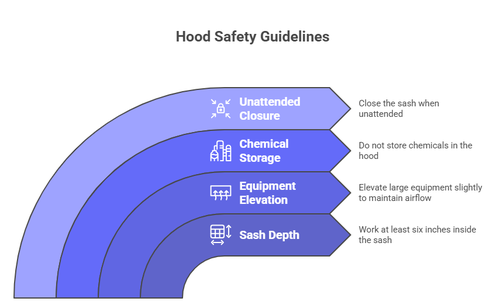
If vapors, dust, or aerosols may form, they use a chemical fume cupboard.
Good practice inside a hood of a fume cupboard:
Respirators are not a substitute for proper ventilation. They are used only when other controls cannot reduce exposure.
Rule 4: PPE in Chemical Laboratories
PPE is the final layer of protection after substitution and engineering controls. Selection depends on chemical type, exposure route, and task duration.
PPE Requirements and Significance
| PPE Item | Protects Against | Typical Use | Correct Practice | Common Mistakes |
|---|---|---|---|---|
| Safety glasses | Minor splashes and debris | General bench work | Use side shields, proper fit | No side protection |
| Splash goggles | Liquid splashes and mists | Acid dilution, solvent transfer | Full face seal | Swapping for glasses mid task |
| Face shield over goggles | Large splashes and fragments | Reactive mixing, large transfers | Always wear over goggles | Using shield alone |
| Chemical resistant gloves | Skin contact and permeation | Liquid handling, cleanup | Check SDS and permeation chart | Choosing by thickness alone |
| Lab coat | Torso and arm splashes | Routine lab work | Fully fastened | Rolled sleeves |
| Chemical apron | High volume splashes | Drum transfer, acid baths | Wear over lab coat | Using incompatible material |
| Closed toe shoes | Spills and glass | All lab work | Sturdy and enclosed | Open footwear |
| Respirator | Vapors and aerosols | Emergency cleanup | Fit tested and task specific | Wrong cartridge type |
Some laboratories use a brief PPE checklist to support consistent equipment selection. This is useful during routine work and audits.
Rule 5: Emergency Preparedness
Even with strong safety practices in place, incidents can still happen. Chemical splashes, spills, fires, and unexpected reactions need fast responses to reduce harm.
Emergency preparedness focuses on clear procedures, accessible equipment, and regular training. When workers know what to do and where to go, response time improves and the impact of an incident can be reduced.
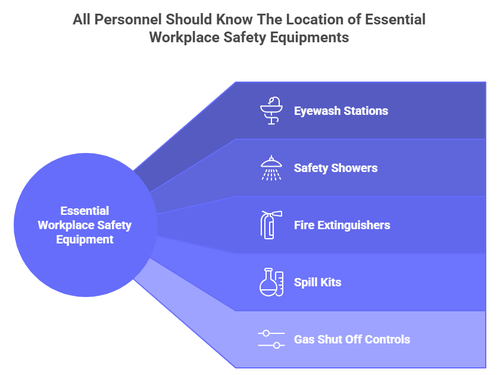
All personnel should know the location of essential workplace safety equipment. During an emergency, like if a chemical contacts the eye, employees should locate the eyewash basin immediately.
Rule 6: Waste Management and Housekeeping
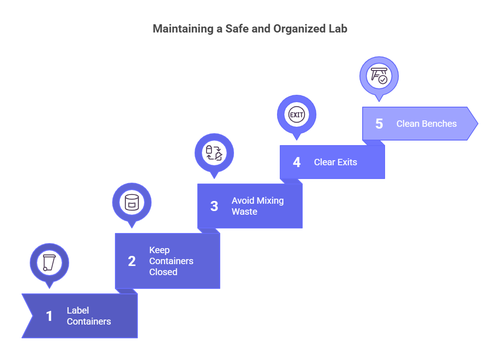
Waste management and housekeeping are part of everyday laboratory safety. Improperly stored waste elevates the risk of spills, incompatible reactions, and accidental exposure. Examples of this would be open containers or cluttered benches.
Risks can be reduced by maintaining certain habits. These include:
- regular disposal routines
- clear labelling of waste containers
- clean work surfaces
- Keeping exits, emergency equipment, and walkways clear
All this supports a faster response if an incident occurs and maintains a safe and organised lab.
Turning Safety Rules into Daily Practice
Strong safety rules in chemical laboratory environments depend on consistency. Hazard communication, compatible storage, proper ventilation, trained PPE use, and clear reporting systems must work together.
PPE is the last layer of protection in laboratory safety. The first priority should always be to remove the hazard entirely or control it through measures such as ventilation and containment. Protective equipment is used when those controls cannot fully reduce exposure.
When these controls are applied routinely, laboratory risks become predictable and manageable.
FAQs
What are the most important safety rules in a chemical laboratory?
The most important safety rules in a chemical lab are:
- Reading the SDS
- Correct labeling
- Compatible storage
- Ventilation use
- Task-based PPE selection
How long should I rinse if a chemical gets in my eye?
Flush for at least 15 to 20 minutes and seek medical care.
Do I need a respirator if I am working in a fume cupboard?
Usually not. Respirators are used only when ventilation cannot reduce exposure sufficiently.
How do I choose the right chemical resistant gloves?
Check the SDS and the glove manufacturer permeation chart. Select gloves that provide adequate breakthrough time for the chemical.
When is a laboratory accident reportable?
If the injury or incident meets legal reporting thresholds, it must be reported.

Mehreen Iqbal

Started with a Bachelors in Microbiology, then a Masters in Public Health; Currently a Workplace Safety Expert.