Managing a commercial pool means more than maintaining the right pH balance. Chlorine, pH adjusters, and algaecides are industrial-strength substances that can cause serious harm when mishandled. In a commercial setting, the consequences go beyond a single injury. They include facility closures, regulatory fines, and long-term reputational damage.
Pool chemical injuries lead to thousands of emergency department visits every year. The most common cause is inhalation of toxic fumes, often from something as routine as opening a chlorine container without the correct protective equipment. The majority of these incidents are entirely preventable.
In the EU, pool chemical safety is governed by two key regulations:
- CLP Regulation (EC No 1272/2008) – which sets requirements for the classification, labelling, and packaging of hazardous chemicals
- REACH Regulation (EC No 1907/2006) – which governs the safe use of chemicals and mandates Safety Data Sheet (SDS) provision for every hazardous substance
Every pool chemical comes with a Safety Data Sheet (SDS). It is a legally required document that tells you exactly how to handle, store, and respond to emergencies involving that substance. Keeping SDS documents accessible and up to date is the foundation of every tip in this guide.
Here are the 10 pool chemical safety tips every commercial facility should have in place.
Tip 1: Always Read the Safety Data Sheet Before Handling Any Chemical
Before any staff member opens a container of pool chemicals, they need to know more than just the product name. They need to understand the hazards, the correct PPE, and what to do in an emergency.
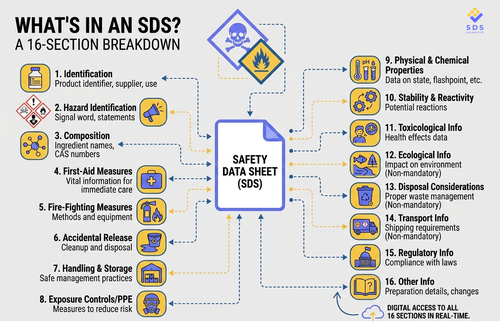
That information lives in the Safety Data Sheet (SDS). An SDS contains 16 standardised sections covering toxicology, first aid measures, spill response, and storage requirements. It is the single most important document for anyone handling chemicals on site.
Make reading the SDS non-negotiable for any new product entering your facility. Ensure your team can access it instantly, not after searching through a filing cabinet.
Quick Checklist:
| Action | Done? | |
|---|---|---|
| Locate the SDS for every chemical in your inventory | ☐ | |
| Ensure all staff know how to access SDS documents instantly | ☐ | |
| Confirm SDS documents are in the correct EU member state language | ☐ | |
| Use SDS Manager to store and retrieve SDS by product name or QR code scan | ☐ | |
| Review the SDS whenever a supplier changes product formulation | ☐ |
Tip 2: Store Chemicals in a Dedicated, Ventilated Area
Pool chemicals, particularly oxidisers like calcium hypochlorite, are highly reactive. Storing them incorrectly can cause fires, explosions, or the release of toxic gases. These are not theoretical risks. They are among the most documented causes of serious incidents at commercial pool facilities worldwide.
Your chemical storage area must be cool, dry, and well ventilated. Incompatible chemicals must be kept physically separated at all times. Your SDS will tell you exactly which chemicals must not be stored near one another.
Storage areas should be clearly marked with hazard signage and locked when not in use. A well-organised storage area is also one of the first things a safety inspector will look at.
Quick Checklist:
| Action | Done? | |
|---|---|---|
| Separate oxidisers from acids at all times | ☐ | |
| Keep storage areas locked and labelled with GHS hazard signage | ☐ | |
| Ensure storage areas are well ventilated and temperature controlled | ☐ | |
| Maintain a storage map that reflects your SDS records | ☐ | |
| Check storage conditions as part of weekly facility inspections | ☐ |
Tip 3: Never Mix Chemicals, Even If You Think You Know
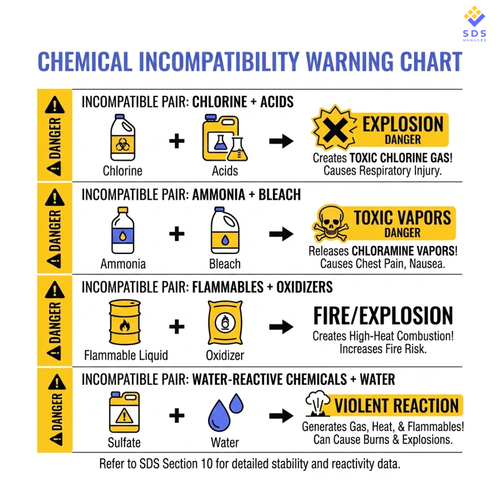
This is one of the most dangerous mistakes made in pool facilities. Mixing incompatible products is one of the most common contributing factors to pool chemical injuries, alongside spills, lack of PPE, and fumes generated when opening containers.
The rule is simple. Add chemicals to water, never water to chemicals. Never mix two products before they are fully diluted and dispersed in the pool. Even chemicals that appear similar can react violently when combined.
The incompatibility warnings for each chemical are documented in Section 10 of its SDS. This section is one of the most important for pool facility staff to understand. Make it part of your onboarding process for anyone who handles chemicals on site.
Quick Checklist:
| Action | Done? | |
|---|---|---|
| Use separate dedicated tools for each chemical | ☐ | |
| Add chemicals to the pool at different locations and times | ☐ | |
| Brief staff on chemical incompatibilities during onboarding | ☐ | |
| Refer to Section 10 of the SDS for specific incompatibility warnings | ☐ | |
| Never reuse containers that held a different chemical | ☐ |
Tip 4: Provide and Enforce Proper Personal Protective Equipment (PPE)
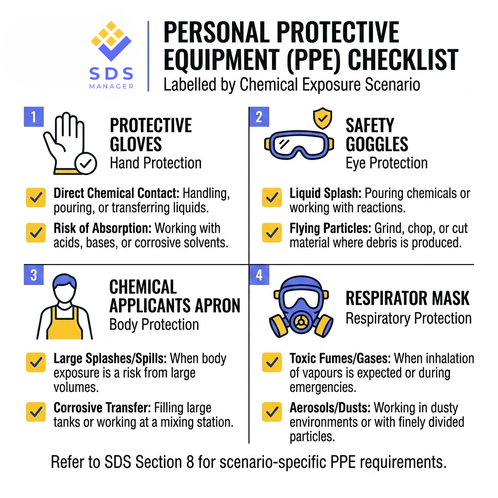
Every chemical in your facility has specific PPE requirements. Gloves, goggles, respirators, and chemical-resistant aprons are not optional. The specific PPE required for each chemical is detailed in Section 8 of its SDS.
Providing PPE is only half the obligation. Employers must also ensure that PPE is suitable for the hazard, maintained in good working condition, and actually being worn during chemical handling. A pair of gloves sitting on a shelf does not meet your duty of care.
Regular checks and a clear enforcement policy are essential. If a staff member is handling pool chemicals without the correct PPE, that is a compliance failure and a safety risk that needs to be addressed immediately.
Quick Checklist:
| Action | Done? | |
|---|---|---|
| Cross-reference PPE requirements from Section 8 of each product's SDS | ☐ | |
| Store PPE near the chemical handling area for easy access | ☐ | |
| Inspect PPE regularly and replace damaged items immediately | ☐ | |
| Document PPE requirements in staff training records | ☐ | |
| Enforce PPE use with a clear written policy for all chemical handlers | ☐ |
Here is a more detailed checklist for PPE inspection and other requirements available, if you need it.
Tip 5: Train Every Staff Member Who Touches Pool Chemicals
Chemical safety is not just the responsibility of your head engineer or senior technician. Anyone who might come into contact with pool chemicals needs basic safety training. This includes maintenance staff, lifeguards who report spills, and cleaning crews.
Training should cover safe handling procedures, emergency response, and how to access safety information through your SDS management system. It is not a one-time obligation. Training must be repeated regularly and updated whenever new chemicals are introduced or procedures change.
Practical drills for spill and exposure scenarios are strongly recommended. Reading about a spill response is not the same as practising one.
Placing QR code posters around your facility gives staff instant access to the SDS for any chemical by scanning with their phone. No login required, no searching through binders.
Quick Checklist:
| Action | Done? | |
|---|---|---|
| Conduct chemical safety training at onboarding and annually | ☐ | |
| Include SDS access training as part of every induction | ☐ | |
| Document all training with dates and signatures | ☐ | |
| Run practical drills for spill and exposure scenarios | ☐ | |
| Update training whenever new chemicals are introduced | ☐ |
Tip 6: Label Every Container, Every Time
Mislabelled or unlabelled containers are a recurring source of accidents in commercial pool facilities. If a chemical is transferred from its original container into a secondary one, even temporarily, that new container must be labelled immediately.
Labels must include the product name, hazard information, and supplier details. All containers holding hazardous substances must display the correct GHS hazard pictograms, signal words, and hazard statements. This applies to secondary containers as well as original packaging.
If you are unsure what to include, your SDS contains everything needed to generate a compliant label. SDS Manager allows you to generate compliant secondary container labels directly from the SDS record, removing any guesswork.
Quick Checklist:
| Action | Done? | |
|---|---|---|
| Never use unmarked containers for any chemical | ☐ | |
| Generate CLP-compliant secondary container labels from SDS Manager | ☐ | |
| Include GHS hazard pictograms on all secondary labels | ☐ | |
| Check labels during every chemical inventory audit | ☐ | |
| Dispose of containers that cannot be properly labelled | ☐ |
Tip 7: Conduct Regular Chemical Inventory Audits
Knowing exactly what chemicals you have on site, in what quantities and condition, is essential for both safety and compliance. Expired or degraded chemicals can behave unpredictably. They may no longer perform as described in the SDS, which means your safety procedures may no longer be accurate either.
Regular audits also help you identify products that are no longer in use but still sitting in storage. Unused chemicals are an unnecessary risk. They take up space, create potential incompatibility hazards, and in some cases require formal disposal through specialist waste services.
A well-maintained chemical inventory cross-referenced against your SDS library is one of the simplest ways to demonstrate compliance during an inspection.
Quick Checklist:
| Action | Done? | |
|---|---|---|
| Audit your chemical inventory at least monthly | ☐ | |
| Cross-check physical stock against your SDS library | ☐ | |
| Dispose of expired chemicals according to SDS disposal guidance | ☐ | |
| Flag chemicals no longer in use for proper removal | ☐ | |
| Maintain inventory records to support REACH compliance documentation | ☐ |
Tip 8: Have a Spill Response Plan and Make Sure Everyone Knows It
A spill response plan is not a document you keep in a drawer. It should be practised, posted in your chemical storage area, and instantly accessible to every member of staff who works near pool chemicals.
Section 6 of every SDS contains specific spill and accidental release guidance for that substance. For commercial facilities managing multiple chemicals, your plan needs to account for each substance individually. A chlorine spill requires a different response to an acid spill. Treating them the same way can make a bad situation significantly worse.
Spill kits must be stocked, accessible, and checked regularly. Assigning clear roles for spill response removes hesitation in an emergency. Every second matters when hazardous chemicals are involved.
Quick Checklist:
| Action | Done? | |
|---|---|---|
| Post spill response procedures near chemical storage areas | ☐ | |
| Keep spill kits stocked and accessible at all times | ☐ | |
| Assign clear roles for spill response within your team | ☐ | |
| Conduct practical spill response drills at least annually | ☐ | |
| Review and update the plan whenever a new chemical is introduced | ☐ |
Tip 9: Keep Your SDS Library Updated and Accessible at All Times
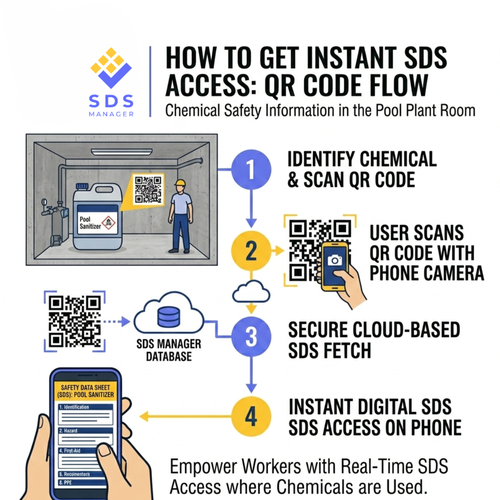
SDS documents must be available to workers at all times during their shift. That means no locked filing cabinets, no binders kept only in the manager's office, and no outdated versions. Accessibility is a requirement, not a courtesy.
Manufacturers update SDS documents when formulations change, when new hazard information becomes available, or when safety standards are revised. Your records need to reflect the current version at all times. Outdated SDS documents are not just a compliance risk. They are a practical safety failure.
The right chemical safety software makes it more manageable by giving workers instant access to the correct SDS from any device via a simple QR code scan. No binders, no delays, no outdated documents.
Quick Checklist:
| Action | Done? | |
|---|---|---|
| Ensure SDS documents are accessible to all staff during every shift | ☐ | |
| Use SDS Manager to automatically receive updated SDS documents | ☐ | |
| Place QR code posters in your pool plant room and chemical storage areas | ☐ | |
| Confirm SDS documents are available in the correct member state language | ☐ | |
| Assign responsibility for SDS library maintenance to a specific role | ☐ |
Tip 10: Report and Document Every Incident, No Matter How Minor
A near-miss today is a serious accident waiting to happen. Every chemical spill, exposure incident, or equipment failure should be documented. This includes the chemical involved, the circumstances, the response taken, and any follow-up actions.
Documentation is not just a formal obligation. It is one of the most effective tools you have for improving safety over time. Patterns only become visible when incidents are consistently recorded. A review of your incident log may reveal that spills are happening more frequently in a particular area, or that a specific chemical is involved in a disproportionate number of near-misses.
Linking incident records directly to the relevant SDS in your system makes it easier to identify whether a safety procedure needs updating and provides a clear audit trail if your facility is ever inspected.
Quick Checklist:
| Action | Done? | |
|---|---|---|
| Create a simple incident reporting form for your team | ☐ | |
| Document every incident including near-misses and minor spills | ☐ | |
| Link incident records to the relevant SDS in your system | ☐ | |
| Review incident reports quarterly to identify patterns | ☐ | |
| Check national reporting obligations for your specific member state | ☐ |
Key Takeaway
Pool chemical safety is not a matter of caution alone. It is a professional standard and a legal obligation in every jurisdiction. For facility managers, the difference between a well-run operation and a serious incident often comes down to whether staff can access the right information at the right moment.
The common thread running through every tip in this guide is access to accurate, up to date safety information. When staff can find the right SDS at the right moment, they can handle chemicals correctly, respond to incidents effectively, and demonstrate compliance with confidence.
That is why maintaining a complete, accessible, and regularly updated SDS library is not just one item on your checklist. It is the foundation that every other safety measure depends on.
Frequently Asked Questions
What is the most dangerous pool chemical mistake at commercial facilities?
Mixing incompatible pool chemicals is the most dangerous mistake. Even small quantities of incompatible substances can produce toxic gases or trigger fires. Always check Section 10 of the SDS for incompatibility warnings before handling any chemical.
How often should pool chemical safety training be conducted?
At minimum annually, and at onboarding for any new staff handling pool chemicals. Training should also be updated whenever new chemicals are introduced or procedures change. Practical spill and exposure drills are strongly recommended alongside any classroom training.
Are SDS documents legally required for pool chemicals?
Yes. Safety Data Sheets are a legal requirement for every hazardous chemical in every major jurisdiction worldwide. They must be accessible to workers at all times during their shift, not stored in locked cabinets or managers' offices.
What should I do if a pool chemical is spilled?
Follow your spill response plan and refer to Section 6 of the relevant SDS immediately. Evacuate if there is any risk of toxic gas. Use your spill kit, assign a response lead, and document the incident fully once the situation is under control.
How can SDS Manager help with pool chemical safety?
SDS Manager gives your team instant access to an always updated SDS library via QR codes, mobile app, and any device. It automatically updates SDS documents, generates compliant secondary container labels, and supports multi-site management across multiple locations.
What PPE is required when handling pool chemicals?
PPE requirements vary by chemical but typically include chemical-resistant gloves, safety goggles, a respirator, and a chemical-resistant apron. The exact requirements for each product are listed in Section 8 of its SDS.

Mehreen Iqbal

Started with a Bachelors in Microbiology, then a Masters in Public Health; Currently a Workplace Safety Expert.