Chemical safety awareness in the workplace is not something most organizations get right on the first try. According to the International Labour Organization, more than 1 billion workers globally are exposed to hazardous substances at work each year, yet many of them lack the training or awareness needed to handle those substances safely. In the EU, around 17% of workers report being exposed to chemical products or substances for at least a quarter of their working time. This figure has barely shifted in over two decades.
The consequences are serious. EU-OSHA estimates that approximately 74,000 work-related deaths each year in the EU may be linked to hazardous substances at work, around ten times more than deaths caused by workplace accidents.
Here is what often gets overlooked: awareness is not the same as training. You can put employees through a compliance course and still have a workforce that does not truly understand the risks they face every day. Building genuine chemical safety awareness means changing how people think, not just what they know on paper. This guide walks you through how to do exactly that.
What Is Chemical Safety Awareness in the Workplace?
Chemical safety awareness is the ongoing process of making sure every worker understands the chemicals they are exposed to, the risks those chemicals carry, and the safe practices needed to handle them. It goes beyond regulatory compliance. It is about building a workforce that recognizes hazards before they become incidents.
Most employers treat chemical safety as a documentation exercise. Train the team, file the paperwork, pass the inspection. But this mindset misses the point entirely.
A 2024 study published in Scientific Reports found that even among workers in chemical enterprises, there was widespread unfamiliarity with standard hazard pictograms. Around 80.56% of workers could not correctly identify symbols for toxic materials. The same study found that 84.62% of workers in smaller companies received no structured chemical safety education at all.
No checklist can close that kind of gap. Real awareness is built through consistent communication, visible leadership, and a culture where safety is not an afterthought.
Why Chemical Safety Awareness is Important
The Human and Business Cost of Getting It Wrong
The numbers make the case plainly. Workplace hazards kill approximately 140,000 workers in the U.S. every year. Chemical exposures are a significant part of that, and most of them are preventable. Beyond the human cost, the AFL-CIO estimates that workplace injuries and illnesses cost between $174 billion and $348 billion annually.
REACH, the EU's primary chemical safety regulation, is among the most scrutinized areas in workplace compliance inspections across member states. Chemical companies failed to provide important safety information in nearly three quarters of registration cases checked by authorities, and non-compliance can carry criminal penalties of up to €5,000,000. This proves that many employers are still falling well short of the basics.
Why Awareness Is Not the Same as a Training Certificate
Completing a safety course does not mean a worker is truly aware. Awareness is what happens when knowledge becomes habit. It is the worker who notices an unlabeled container and reports it. The supervisor who stops a process because something feels off. The team that looks out for each other without being asked.
That kind of culture does not come from a one-day induction. It is built deliberately, over time, through the steps below.
Types of Chemical Hazards You Need to Know
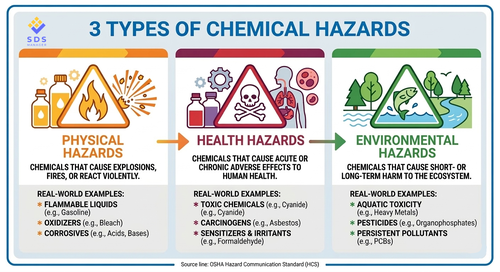
Chemical hazards fall into three main categories:
- Physical Hazards: Such as flammable, explosive, or reactive substances like gasoline or ammonium nitrate.
- Health Hazards: Like toxic, carcinogenic, or irritant chemicals that enter the body through inhalation, skin contact, or ingestion.
- Environmental Hazards: These are substances that damage ecosystems if mishandled or improperly disposed of, governed under REACH in the EU.
Understanding which category a chemical falls into shapes how it should be stored, handled, labeled, and responded to in an emergency.
How to Create Chemical Safety Awareness in Your Workplace
- Start With Your Chemical Inventory
You cannot protect your team from hazards you have not identified. Start by auditing every chemical present in your workplace. Raw materials, cleaning products, solvents, and finished products all count.
For each chemical, you need an up-to-date Safety Data Sheet (SDS). An SDS tells employees what the chemical is, what risks it carries, how to handle it safely, and what to do in an emergency. The key word here is accessible. An SDS locked in a binder in a back office is useless. Make them available digitally and make sure your team knows how to find and read them.
2. Use Your Inventory to Drive a Chemical Risk Assessment
A chemical inventory tells you what is in your workplace. A risk assessment tells you what those chemicals could actually do to your people. Once your inventory is in place, the next step is working through each substance and asking the harder questions: who is exposed, how often, at what levels, and what happens if something goes wrong.
A formal risk assessment should also consider the toxicity and physical properties of each chemical, the potential for dangerous reactions when mixed or exposed to certain conditions, and the appropriate control measures, whether that means substituting a less hazardous chemical, improving ventilation, or updating PPE requirements. Without this step, your inventory is just a list. Organizations that take this seriously do not wait for an incident to run a Chemical Risk Assessment. They build it into the process from the start, and they update it whenever new chemicals or processes are introduced.
3. Label Every Container Correctly the First Time
A secondary label is what goes on any container that a chemical has been transferred into from its original packaging. These are among the most commonly mislabeled items in a workplace because they are created on the fly and rarely get the same attention as primary labels. A GHS Compliant Secondary Label Generator pulls the required hazard information into a print-ready format, so every container in your facility carries the right information regardless of how it got there.
4. Stay Compliant When Chemicals Leave Your Facility
The moment a chemical moves off-site, a different set of labeling rules kicks in. DOT transport requirements are specific about what information needs to appear on a label and how it should be formatted. Getting this wrong exposes your organization to regulatory risk and puts handlers down the chain at risk too. A GHS Compliant Transport Label Generator covers those formatting requirements so your team is not guessing when a shipment goes out the door.
5. Store and Handle Chemicals the Right Way
Improper storage is one of the leading causes of chemical accidents. Chemicals that react dangerously with each other need to be stored separately. Keep acids and bases in separate cabinets. Store oxidizers away from anything that can burn. Flammable chemicals should be kept in fire-resistant cabinets, and all storage areas should be well ventilated to prevent the buildup of harmful fumes.
Secondary containment systems, such as containment trays, should be in place to prevent leaks or spills from spreading. Workers should know not to transfer chemicals into unmarked or incompatible containers, check for leaks or deterioration during routine walkthroughs, and know exactly what to do if a storage failure occurs. Employees who feel comfortable flagging a concern before an incident occurs are your best early warning system.
6. Choose PPE Based on Real Risk
Not every job requires the same level of protection. Personal protective equipment should be selected based on the specific chemicals being used and the nature of the work being done. Nitrile gloves work well for most solvents. Respirators are necessary when working with harmful vapors or dust. Face shields are appropriate where there is a risk of splashing from corrosive liquids.
Make sure everyone knows how to put PPE on correctly, remove it safely, and clean or replace it when needed. Protective equipment only works when it is used properly.
7. Walk Through Each Task With a Job Hazard Analysis
A Job Hazard Analysis breaks down every task that involves chemical contact, step by step, and identifies where things could go wrong before they do. The value is not just in writing it. It is in running through it with the people who actually do the work, since frontline workers often know exactly where the gaps are. Building that process into your standard procedures starts with a proper JHA assessment.
8. Provide Training That Is Role-Specific and Practical
Avoid one-size-fits-all training. A lab technician, a warehouse worker, and a cleaner face different chemical risks and need training that reflects that. Sessions should cover hazard identification, correct procedures for storing and handling chemicals, how to read an SDS, and how to respond to emergencies including spills and exposures.
Keep training sessions short, practical, and interactive. Real-life examples are more effective than technical language. Regular refresher sessions, toolbox talks, and safety drills throughout the year keep awareness active rather than treating it as a once-a-year obligation. Mock spill exercises in particular help workers apply what they have learned and react faster when something actually goes wrong.
9. Build a Clear Emergency Response Plan
Despite the best safety measures, chemical accidents can still happen. Every workplace that handles hazardous substances needs a documented emergency response plan that covers spill containment and cleanup procedures, clear evacuation routes, and the location and use of emergency equipment including eyewash stations, emergency showers, and fire extinguishers.
Specific roles and responsibilities should be assigned to trained personnel so that responses are fast and coordinated. The plan should be practiced regularly. A plan that only exists on paper provides little protection when something actually goes wrong.
10. Make It Easy to Report Hazards
Workers are your most reliable source of early warning. Build a simple, accessible way for anyone to report a spill, leak, unlabeled container, or unsafe storage condition. Make clear that raising concerns is expected and valued, not something to avoid for fear of causing disruption.
Small issues that get reported and fixed are the ones that never become serious incidents.
11. Track, Measure, and Keep Improving
Chemical safety awareness is not a one-time initiative. Run regular audits to identify where your program is strong and where it is falling short. Keep incident and near-miss logs. Near-misses are the most valuable data point you have because they show you where accidents almost happened before they actually do.
According to a 2024 State of Workplace Safety survey, 83% of companies now use technology to deliver safety training, and 59% use it for SDS management. Digital tools can help track chemical inventories, monitor SDS updates, and flag compliance gaps before they become violations. Real-time monitoring systems can also track environmental conditions such as temperature and humidity to ensure chemicals are stored safely. If your organization is still relying on paper-based systems, there is significant room to improve.
12. Keep Chemical Storage and Disposal on Record
A chemical log gives you a centralized record of what is in your facility, where it is stored, and how it is being disposed of. When an auditor walks in or an incident needs to be investigated, that record is what keeps your team from piecing together answers from scattered spreadsheets. Staying ahead of that starts with a Chemical Usage Log your whole team can actually use.
Common Mistakes That Undermine Chemical Safety Awareness
Even well-intentioned programs break down over time. The most common reasons are one-time training that never gets reinforced, overly technical language that loses people fast, Safety Data Sheets that are outdated or hard to locate, and failing to include office staff or contractors in training at all. Keeping safety communication clear, frequent, and inclusive across every role in the building is what makes awareness last.
Building a Culture Where Safety Sustains Itself
Steps and checklists will only take you so far. The organizations that truly protect their workers are the ones that build chemical safety into their culture, not just their procedures.
That means leaders who take safety walkthroughs seriously. Managers who reward employees for raising concerns rather than brushing them off. Teams that look out for each other without being asked. When safety becomes a shared value rather than a mandate, awareness sustains itself without constant reminders.
The data backs this up. Companies with strong safety cultures report fewer incidents, lower costs, and higher employee engagement. People perform better when they feel genuinely protected at work. That is not a soft outcome. It is a business result.
Frequently Asked Questions
What is chemical safety awareness in the workplace?
It is making sure employees understand the chemicals they work with, the risks they carry, and the safe practices needed to handle them properly every day.
What is the first step in creating chemical safety awareness?
Start by identifying all hazardous chemicals in your workplace and making up-to-date Safety Data Sheets (SDS) accessible to every worker.
How often should chemical safety training be refreshed?
At minimum once a year, and immediately whenever new chemicals, processes, or employees are introduced.
Do office employees need chemical safety training?
Yes, especially if they work near storage or chemical use areas. Even everyday products like cleaning agents can carry risks.
What is an SDS and why is it important?
A Safety Data Sheet outlines a chemical's hazards, safe handling steps, and emergency response measures. It is a legal requirement under the EU's REACH regulation, which mandates that any hazardous chemical produced in or imported into the EU must be accompanied by a compliant SDS. This makes it both a regulatory obligation and a practical daily reference.
What are GHS pictograms and do workers need to know them?
They are standardized symbols that communicate chemical hazards at a glance. Yes, workers need to know them, and most do not without proper training.
What role does management play in chemical safety awareness?
A significant one. Safety culture starts at the top. When leaders take it seriously, employees follow.
What should a workplace chemical emergency plan include?
Spill response procedures, evacuation routes, first aid protocols, emergency equipment locations, and a clear communication chain. It should be practiced regularly, not just written down.
How can I make chemical safety training more engaging?
Tailor it to specific roles, use real-life examples, keep sessions short and interactive, and run regular drills. Recognition programs and safety challenges can also help maintain engagement over time.
What tools help manage chemical safety awareness?
Digital SDS management systems, training logs, incident reporting apps, real-time environmental monitoring tools, and audit checklists all support a well-documented and measurable program.

Mehreen Iqbal

Started with a Bachelors in Microbiology, then a Masters in Public Health; Currently a Workplace Safety Expert.