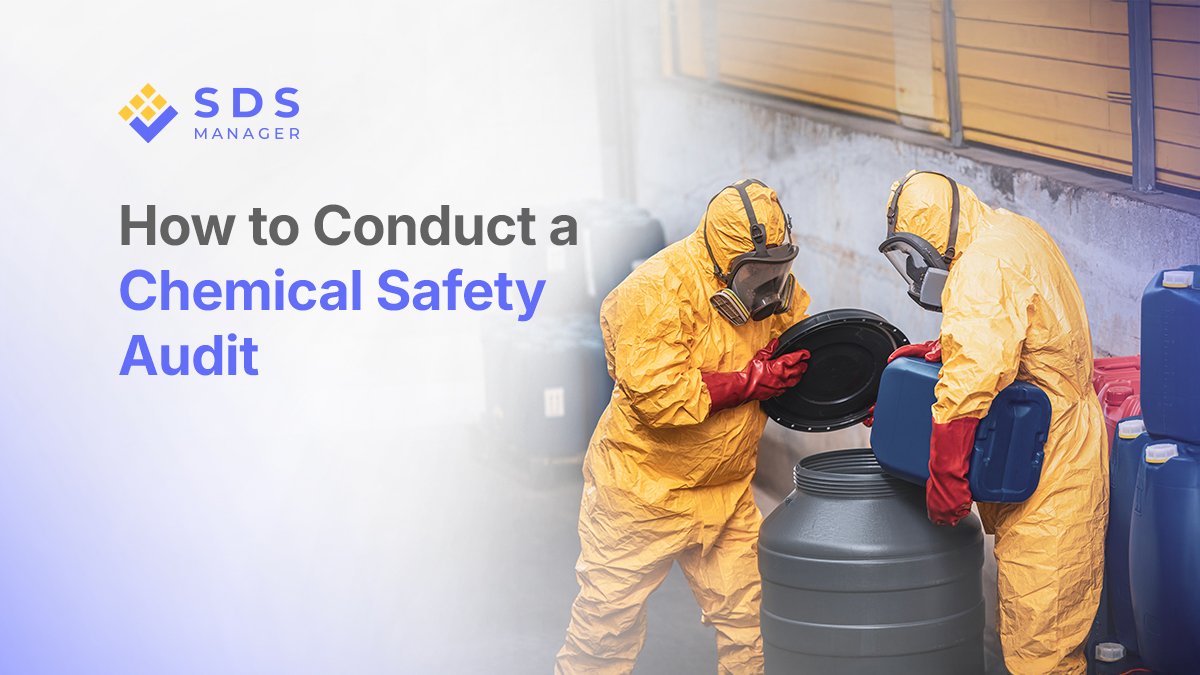
Chemicals are used every day in many workplaces. You can find them in factories, labs, warehouses, hospitals, and maintenance areas. Each of these places relies on chemicals for various tasks. When handled correctly, they help work run smoothly. But unsafe handling can cause injuries, fires, toxic exposure, and environmental damage.
A chemical safety audit helps workplaces find and fix risks before accidents happen. It checks chemical management systems. It makes sure rules like REACH and CLP Regulation are followed. It also helps employees understand chemical safety.
What Is a Chemical Safety Audit?
A chemical safety audit is a careful check of how chemicals are used and stored. It looks at whether:
- Chemical inventory lists are accurate
- Safety Data Sheets (SDS) are current and easy to access
- Labels on containers are clear and complete
- Chemicals are stored safely
- Workers follow proper handling procedures
- Personal protective equipment (PPE) is used correctly
- Emergency equipment is ready
The goal is to compare what is written in procedures with what actually happens on the floor. Many problems are only visible when someone inspects the workplace carefully.
How to Conduct a Chemical Safety Audit
A chemical safety audit is more than a quick check; it reviews how chemicals are managed. Chemical accidents can cause injuries, environmental damage, fines, and loss of reputation. Regular audits also help maintain compliance with EU regulations such as REACH and CLP, keeping your workplace safe and legally protected. Start by deciding who will do the audit, such as a safety officer, supervisor, or trained employee. Some workplaces hire outside consultants for an independent review.
Step-by-Step: How to Do a Chemical Safety Audit
- Define the Scope of the Audit
Start by deciding exactly what you are reviewing.
Will the audit cover the whole facility or just specific areas such as production, maintenance, laboratories, or storage rooms? Identify which regulations and internal policies apply to each area.
Set clear goals for the audit. For example:
- Check for regulatory compliance
- Review SDS accuracy and accessibility
- Prepare for an external inspection
- Strengthen chemical safety awareness across teams
A defined scope keeps the audit focused and prevents important areas from being missed.
2. Review the Chemical Inventory
An accurate chemical inventory is the foundation of any strong chemical safety program.
Walk through the facility and compare the chemicals you find physically to your official inventory list. Look for:
- Products that are not on the list
- Old or expired chemicals
- Unlabeled containers
- Trial products that were brought in without approval
Every chemical on-site must have a matching Safety Data Sheet. A physical walkthrough often reveals risks that paperwork alone would miss.
Keeping your inventory current is one of the most practical ways to build chemical safety awareness. It makes sure everyone knows exactly what chemicals are present in the workplace.
3. Verify Safety Data Sheet (SDS) Management
Every chemical in your workplace must have an accessible and up-to-date SDS.
Check that:
- SDS documents match the exact product and formulation being used
- Revision dates are current
- Employees can access SDS quickly during every shift, including nights and weekends
- A backup system is in place in case of a digital or system failure
Also, review how new chemicals get approved before they enter the workplace. Ideally, an SDS review should happen before any new chemical is introduced into operations.
Good SDS management supports compliance and gives workers confidence that the safety information they rely on is accurate.
4. Inspect Chemical Labeling
Labels are your first line of communication about chemical hazards.
Make sure manufacturer labels on primary containers are intact and easy to read. Then inspect secondary containers such as spray bottles, transfer containers, and smaller working vessels.
Secondary labels must clearly show:
- The product name
- Hazard warnings
- Key precautionary statements
Faded, damaged, or missing labels are among the most common findings in chemical safety audits. Correct labeling prevents confusion and reduces the risk of accidental misuse.
5. Evaluate Chemical Storage and Segregation
Improper chemical storage can lead to fires, toxic releases, or dangerous chemical reactions.
Inspect all storage areas carefully. Look for:
- Acids separated from bases
- Flammable liquids are stored away from ignition sources
- Oxidizers should be kept away from combustible materials
- Compressed gas cylinders are secured upright
- Spill containment systems that are in place and functional
Also, check ventilation in areas where chemical vapors may build up.
Getting storage right is not just about passing an inspection. It is about stopping serious incidents before they have a chance to start.
6. Assess Safe Handling Practices
Watch how employees handle chemicals during their normal tasks.
Check whether workers:
- Follow written procedures for each chemical
- Use safe transfer methods to avoid spills or splashes
- Avoid mixing chemicals that are not compatible
- Wear the correct PPE for each specific task
A key example: when diluting acids, acid must always be added to water, never the other way around. Small handling errors can cause serious burns or release toxic fumes.
An audit should confirm that safe handling practices are consistent across all shifts, not just when someone is watching.
7. Review Personal Protective Equipment (PPE)
PPE must match the specific hazards of each task.
Verify that:
- Gloves are rated as chemical-resistant for the substances being used
- Goggles or face shields are available where splashing is a risk
- Respirators are provided where vapors, gases, or dust may be present
- PPE is stored correctly and replaced when worn or damaged
Each chemical’s Safety Data Sheet (SDS) identifies the required protective equipment. Use this information to complete your PPE checklist and ensure all necessary gear is available, inspected, and in good condition before work begins. Remember, PPE is the last line of defense; it should complement other safety controls, not replace them.
8. Evaluate Training and Competency
Chemical safety awareness starts with proper training.
Review training records to make sure all employees have completed hazard communication training and any job-specific chemical safety training required for their role.
Go beyond the records. Speak directly with workers and ask:
- Where do you go to access SDS documents?
- What would you do if a chemical spill occurred?
- Which PPE is required for this task?
If workers cannot answer with confidence, more training is needed. Regular refresher sessions keep knowledge current and build safe habits over time.
9. Review Emergency Preparedness
Every facility must be ready to respond to a chemical incident quickly and safely.
Inspect the following:
- Spill kits - are they stocked, accessible, and in the right locations?
- Eyewash stations and safety showers - are they functional and within the required distance?
- Fire extinguishers - are they charged, inspected, and rated for chemical fires?
- Emergency contact information - is it clearly posted and up to date?
Make sure all emergency equipment is regularly inspected and that inspection records are documented.
Running brief scenario discussions during the audit helps reveal gaps in how your team would actually respond during a real emergency. Fast, informed action can make a significant difference in outcomes.
10. Examine Chemical Waste Management
Chemical safety does not end when a chemical is no longer needed. Waste handling carries its own risks.
Inspect waste storage areas and check that:
- Waste containers are clearly labeled with contents and hazard information
- Incompatible wastes are stored separately
- Containers are kept sealed when not in active use
- Disposal records are documented and up to date
Poor waste management can cause environmental harm and lead to significant regulatory penalties. Clear procedures and visible signage help employees follow the right process every time.
11. Document Findings and Take Action
The final step is documenting what you found and turning those observations into meaningful improvements. An audit has little value unless findings are clearly recorded, ranked by risk, and resolved.
Write each finding in clear, objective language. Include:
- The exact location of the issue
- A description of what was observed
- Why is it a concern? whether safety, compliance, or operational risk
- Supporting evidence, such as photos or document references
- The related policy, procedure, or regulatory requirement
Classify findings based on risk level:
- Critical - Immediate danger that could cause serious injury, fire, a toxic release, or a regulatory shutdown. Requires urgent correction, possibly stopping work.
- Major - A significant compliance gap or unsafe condition that could lead to injury or enforcement action if not corrected promptly.
- Moderate - A control weakness or procedural gap that raises risk but is unlikely to cause immediate harm.
- Minor - A low-risk issue, such as a housekeeping or documentation gap, that does not pose an immediate safety concern.
After classifying each finding, assign corrective actions with a clearly defined solution, a responsible person or department, a realistic deadline, and a method for verifying that the fix was completed properly.
Follow-up is critical. Check that corrective actions were carried out correctly and that the root issue has been resolved.
An audit only creates value when improvements are put in place, tracked, and maintained. Following through on what the audit uncovered is what turns findings into stronger systems and builds lasting chemical safety awareness across the organization.
How Often Should a Chemical Safety Audit Be Conducted??
A chemical safety audit should be done at least once a year. Annual reviews help ensure safety procedures stay up to date.
Audits are also needed when workplace conditions change, such as:
- New chemicals are introduced
- Equipment or processes are changed
- A spill, near-miss, or accident occurs
- A regulatory inspection is approaching
- New staff are added
Regular audits find small problems early. This stops serious hazards. It helps keep the workplace safe for everyone.
Pre-Audit Preparation
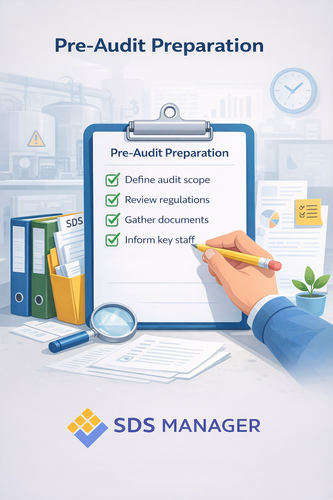
Before starting the audit, it is important to prepare. Good preparation helps the audit run smoothly and ensures important areas are not missed. Review key documents such as the chemical inventory, Safety Data Sheets (SDS), previous audit reports, and training records.
Decide who will take part in the audit and clearly define their roles. It is also helpful to inform supervisors ahead of time so that normal work activities can still be observed. Preparing a simple checklist or audit template will help keep the process organized and consistent.
Quick Chemical Safety Audit Checklist
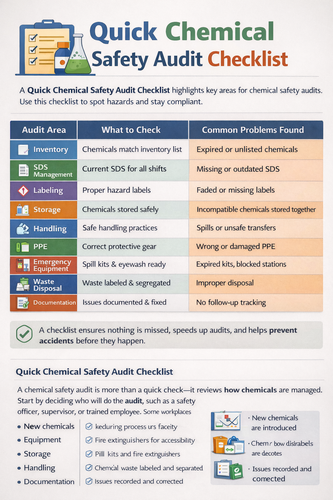
A Quick Chemical Safety Audit Checklist helps auditors check key chemical safety areas easily. It highlights essential aspects like inventory accuracy, SDS availability, labeling, storage practices, worker handling, PPE, emergency equipment, and waste management.
Common Mistakes in Chemical Safety Audits
While chemical safety audits help prevent risks, certain mistakes are common. Knowing these pitfalls in advance helps teams focus on what matters most and ensures the audit actually improves workplace safety. The table below highlights the most frequent mistakes and why they matter.
| Common Mistake | Why It Matters | |
|---|---|---|
| Focusing only on paperwork | Documents may look correct, but real practices on the work floor may be unsafe. | |
| Missing or unclear chemical labels | Workers may not know what hazards are present in containers. | |
| Outdated Safety Data Sheets (SDS) | Employees may rely on incorrect safety information. | |
| Ignoring chemical waste areas | Waste chemicals can create safety and environmental risks if stored incorrectly. | |
| No follow-up after the audit | Safety only improves when problems are corrected and tracked. |
Key Takeaway
Chemical accidents can cause injuries, environmental damage, fines, and loss of reputation. Even small mistakes, such as poor storage or incorrect PPE, can lead to serious incidents.
Chemical safety audits are important to make sure workplaces find problems before they become dangerous.
They review how chemicals are stored, handled, labeled, and documented across the facility.
It also supports effective chemical risk management by identifying hazards early and ensuring the right controls are in place, and improving employee awareness. Fixing risks early helps prevent spills, fires, and worker exposure.
Over time, they strengthen the overall safety culture.
Regular audits help:
- Prevent workplace accidents
- Improve chemical safety awareness
- Maintain regulatory compliance
- Reduce costly incidents
A clear plan, a simple checklist, and consistent follow-up make audits effective. When safety becomes part of daily operations, it protects people, saves money, and builds a responsible workplace culture.
FAQ
What is a chemical safety audit?
A chemical safety audit is a structured review of how chemicals are inventoried, labeled, stored, handled, and documented to confirm that day‑to‑day practices match written procedures and regulatory requirements.
How often should a chemical safety audit be done?
At minimum, audits should be conducted annually and anytime there are significant changes, such as new chemicals, process changes, incidents, or upcoming regulatory inspections.
What should be included in a quick chemical safety audit checklist?
A quick checklist should cover chemical inventory accuracy, SDS availability, labeling, storage and segregation, worker handling practices, PPE usage, emergency equipment, and waste management.
How do Safety Data Sheets (SDS) support a chemical safety audit?
SDS provides verified information on hazards, safe handling, storage, and required PPE, helping auditors confirm that controls and training match the actual risks of each chemical.
Why is PPE important in a chemical safety audit?
PPE verifies that workers have task‑specific protection based on SDS guidance and risk assessments, but it should be treated as the last line of defense, supporting—not replacing engineering and administrative controls.

Jawad Monzur

As an EHS specialist, Jawad believes that safety happens in the field, not just on paper. With a background in chemical handling, Jawad focuses on hazard mitigation, incident investigation, and hands-on safety training. He is committed to ensuring every team member returns home safe, every single day.