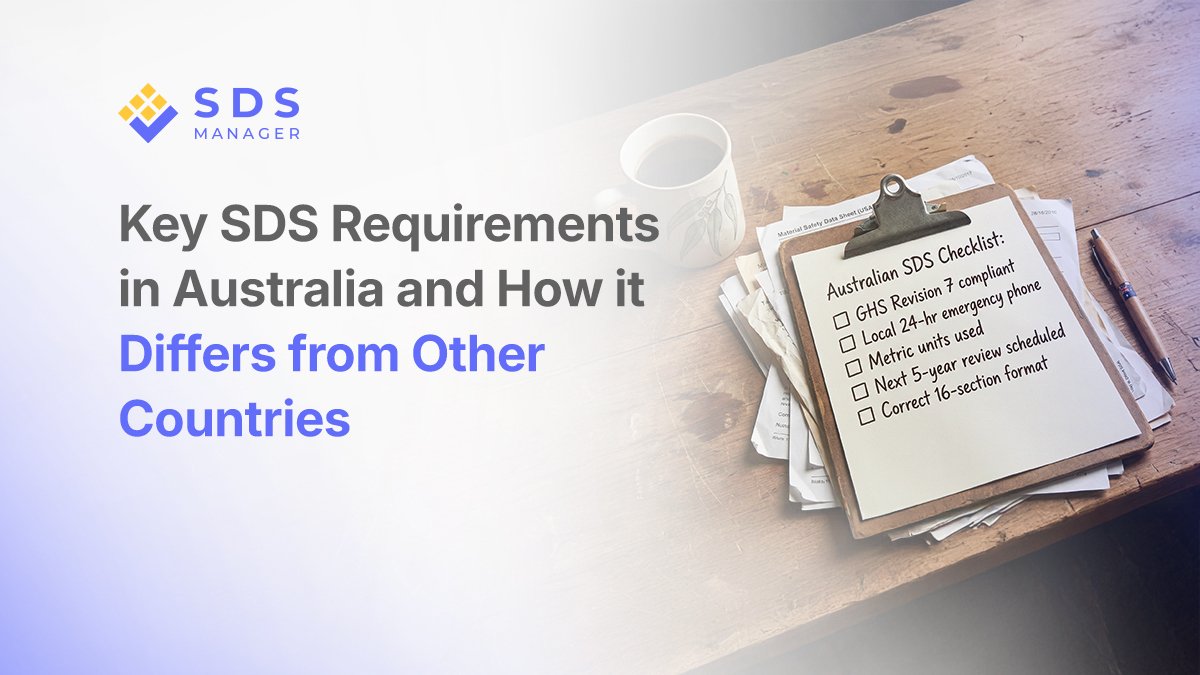
Australia enforces strict Safety Data Sheet rules under Work Health and Safety laws that differ from international standards. Australia requires mandatory 5-year reviews, local emergency contact details, and GHS Revision 7 compliance. These requirements create challenges for companies in international chemical trade.
This guide covers the key requirements for Safety Data Sheets in Australia and highlights critical differences from the USA, Canada, and Europe.
Format Requirements
Australian SDS must follow the 16-section format set by the Globally Harmonized System. Each section appears in a specific order with required content.
Sections 1-8 provide essential information about the chemical, its hazards, and safe handling procedures. Workers rely on these sections during emergencies.
Sections 9-11 and 16 contain technical details including physical properties, chemical behavior, and preparation dates.
Sections 12-15 address environmental impact, disposal methods, transport requirements, and regulatory compliance. The USA doesn't enforce these sections, but Europe does under REACH regulations.
Language and Measurement Standards
Every SDS in Australia must be written in English using Australian legal units of measurement under the National Measurement Act 1960. Foreign measurements must be converted to comply.
The document must clearly state its preparation date or last review date. All technical data, concentrations, and exposure limits must appear in metric measurements.
Review and Update Requirements
Manufacturers and importers must review SDS every 5 years from the original preparation date or last revision. This periodic requirement is unique to Australia. The USA has no time-based review mandate. Canada eliminated its 3-year requirement in 2015.
Updates are also required immediately when new hazard information becomes available or chemical classifications change. This includes new toxicological data, revised exposure standards, or GHS classification changes.
Australian Contact Information
Each SDS must include an Australian address and business telephone number for the manufacturer or importer. More importantly, it must provide a 24-hour emergency contact number available outside business hours.
This requirement differs significantly from the USA, Canada, and most European countries that accept international contact numbers. Companies using global SDS templates must add Australian-specific contact information.
GHS 7 Compliance
From January 1, 2023, Australia requires GHS Revision 7 for all newly manufactured and imported hazardous chemicals. This replaced GHS Revision 3.
GHS 7 introduced new hazard categories including pyrophoric gases, chemically unstable gases, and desensitized explosives. It expanded eye irritant categories to 2A and 2B and updated precautionary statements.
Products manufactured before 2023 can retain GHS 3 labels, but their SDS must comply with GHS 7 regardless of label version. Workplaces must obtain updated SDS before using chemicals with changed classifications.
Quick Reference: Australia vs Other Countries
| Requirement | Australia | USA | Canada | Europe |
|---|---|---|---|---|
| Periodic Review | 5 years mandatory | None | None (eliminated 2015) | None specific |
| Update Timing | Immediate + 5-year | 3 months | 90 days | Without delay |
| GHS Version | Revision 7 (2023) | Rev 3→7 (by 2027) | Rev 7 + some Rev 8 | Rev 7 |
| Sections 12-15 | Mandatory | Not enforced | Mandatory | Enforced (REACH) |
| Emergency Contact | Australian 24/7 number | No local requirement | No local requirement | Country-specific |
| Language | English only | English only | English + French | Local language(s) |
Who is Responsible for Preparing SDS
Manufacturers and importers
Manufacturers and importers create SDS for each hazardous chemical they produce or bring into Australia. They bear responsibility for accuracy and must update information as requirements change.
Suppliers
Suppliers provide current SDS to buyers and anyone requesting them. When supplying chemicals manufactured or imported after January 1, 2023, they must ensure GHS 7 compliance.
Employers
Employers obtain up-to-date SDS for every hazardous chemical at their workplace and ensure worker access during all shifts.
Workers
Workers must receive training on reading and accessing SDS using both primary and backup systems.
Where to Access and Download SDS
Finding and accessing SDS for Australian products involves several reliable sources depending on your needs.
Manufacturer and supplier websites
These typically provide SDS downloads in their product information sections. Most major chemical manufacturers maintain searchable databases where you can find SDS by product name or CAS number. Simply visit the manufacturer's website and look for "Safety Data Sheets" or "Product Safety" sections.
Commercial SDS databases
SDS databases offer comprehensive collections of safety data sheets. SDS Manager is among the leading Australian providers, maintaining over 16 million SDS compliant with Australian legislation and GHS 7 standards. Many Australian universities and large organizations subscribe to SDS Manager for centralized SDS management.
Retailer websites
Retailer sites also provide SDS access for chemicals they sell. Major hardware chains like Bunnings, industrial suppliers like Recochem, and laboratory suppliers like Sigma-Aldrich maintain online SDS libraries for their product ranges.
Direct requests
This work when online access isn't available. Contact the supplier or manufacturer directly by phone or email. Under Australian law, suppliers must provide current SDS to anyone who requests them, particularly if you're likely to be affected by the chemical.
For workplaces, establishing accounts with commercial databases ensures automatic updates when manufacturers revise SDS. This eliminates manual tracking and ensures continuous compliance with the 5-year review requirement.
Exemptions
WHS Regulations exempt certain chemicals from SDS requirements:
- Chemicals in batteries incorporated in plant or equipment
- Fuel in vehicle containers for operational use
- Hazardous chemicals in portable firefighting or medical equipment
- Food packaged for human consumption
- Therapeutic goods at point of intake
- Veterinary products at point of administration
- Consumer products used the same way as household use
These exemptions align with international GHS standards, though specific categories vary by country. Medicine requires SDS when stored at pharmacies but not during patient administration.
Common Compliance Challenges
Tracking 5-year reviews across large chemical inventories requires systematic record-keeping. Many organizations struggle without automated tracking tools or designated personnel.
Foreign SDS rarely meet Australian requirements without modification. Importers must verify or modify every document for contact details, measurement units, and GHS version alignment.
Different GHS revisions between countries cause classification discrepancies. The same chemical may have different hazard ratings depending on the market.
Database failures during emergencies leave workers without access when they need information most. Backup systems are mandatory but often untested.
Enforcement and Penalties
Australian regulators can review SDS for WHS compliance during workplace inspections. Manufacturers and importers face prosecution for false or misleading information.
Penalties include improvement notices, prohibition notices, fines, and workplace shutdowns. Criminal charges apply in severe cases involving deliberate violations.
Missing or inaccessible SDS during inspections constitutes immediate non-compliance. Workers' compensation claims increase when poor SDS access contributes to injuries.
Final thoughts
Australian SDS compliance is defined by three critical requirements: local 24/7 emergency contacts, local metric units, and the unique local 5-year review mandate.
Simply having a GHS 7 compliant document isn't enough; it must meet WHS laws and protect your team.
By prioritizing these specific regional requirements over generic templates, you ensure your workplace remains both safe and audit-ready.
Frequently Asked Questions
How often must I update SDS?
Every 5 years minimum, plus immediately when new safety information or classification changes occur under GHS 7.
Can I use foreign SDS in Australia?
Only if they meet all Australian requirements: GHS 7 compliance, Australian contact information, Australian measurement units, and proper 16-section format. Most require modification.
What are penalties for non-compliance?
Improvement or prohibition notices, substantial fines, prosecution, and potential workplace shutdown. Employers must demonstrate immediate SDS access during inspections.
Do all chemicals need SDS?
No, only hazardous chemicals. Exemptions include chemicals in batteries, fuels in vehicle containers, consumer products used incidentally, and food packaged for consumption.
What if my SDS is over 5 years old?
It violates compliance requirements. Contact the manufacturer or importer for an updated version immediately, or prepare a new one if you're the manufacturer or importer.

Zarif Ahmed

An engineer and safety writer by profession, focusing on chemical management, regulatory development, and the patterns that shape workplace practice over time.