If PPE is damaged or defective, it must be removed from service immediately, tagged as “unusable,” and reported to a supervisor. Under the Work Health and Safety (WHS) Act, PCBUs (Persons Conducting a Business or Undertaking) must provide and replace PPE at no cost to workers.
When protective equipment fails, the risk transfers directly to you. The response must be procedural, not casual. This guide explains how to identify faulty gear, what actions to take immediately, and how replacement logistics should work in a compliant workplace.
The Hidden Cost of Using Defective or Damaged PPE
Many workers tolerate cracked helmets or scratched lenses “just for today.” That shortcut carries measurable financial risk.
Under the WHS Act, failure to provide or maintain safe PPE can result in Category 1 or 2 goggles/fines. Safe Work Australia and state regulators (like SafeWork NSW or WorkSafe VIC) enforce strict penalties for exposing workers to risks.
Beyond fines:
- Insurance premiums can increase after documented safety lapses.
- Workers’ compensation claims may be contested.
- Courts may classify continued use of known defective PPE as negligence.
- PCBUs risk prosecution for failing their primary duty of care.
The financial impact often exceeds the cost of replacing the equipment.
Defective PPE vs. Damaged PPE: Knowing the Difference
The terms defective and damaged are not interchangeable.
Defective PPE refers to equipment that left the manufacturer with a flaw. Examples include:
- A welding helmet with a malfunctioning auto-darkening filter (ADF)
- Safety glasses missing AS/NZS 1337.1 certification markings
- A respirator with a faulty exhalation valve
The failure exists before use.
Damaged PPE is equipment compromised during service. Examples include:
- A cracked hard hat from impact
- Gloves exhibiting chemical permeation
- A respirator facepiece with structural delamination
Understanding the distinction improves reporting accuracy and strengthens root cause analysis. It also supports warranty claims and supplier accountability.
What Should You Do If PPE Is Damaged?
When equipment integrity is compromised, hesitation increases exposure. Apply the 4-Step STOP protocol.
Step 1: Immediate Cessation
Stop the task ASAP. Using compromised equipment is often more dangerous than pausing the job.
A cracked face shield can fragment under secondary impact. A weakened harness can fail under load.
Step 2: Isolation and Tag-Out
Do not discard it casually. Attach a visible “DO NOT USE” tag and place it in a designated quarantine area. This prevents salvage or accidental reuse.
Step 3: Formal Notification
Document the issue in a safety log:
- Date
- Equipment ID
- Type of failure
- Environmental conditions
This protects both worker and employer.
Step 4: Verification of Replacement
Do not resume work until the new equipment is:
- Properly fitted
- Functionally tested
- Certified to current standards (e.g., AS/NZS 1337.1 for eye protection)
Fit-testing is mandatory for respirators. No exceptions.
How Do You Replace Defective PPE?
Replacement is both a legal and logistical function.
Employee Responsibilities
If you identify defective PPE, report it without delay. The WHS Act protects workers who raise safety concerns from discriminatory or coercive conduct. A professional environment treats reporting as responsible conduct, not disruption.
Submit a formal request. Provide evidence of failure. Avoid self-repair unless authorized.
Employer Responsibilities
Under WHS Regulations (Regulation 44), a PCBU must provide PPE to workers at the workplace, unless it has been provided by another PCBU. They must ensure PPE is maintained, repaired, or replaced so it continues to minimise risk. Replacement programs should include:
- Inventory tracking with end-of-life (EOL) schedules
- AS/NZS or other certification verification
- Documented issuance logs
- Batch tracking for recall response
Replacement should not rely on informal exchanges. It requires traceability.
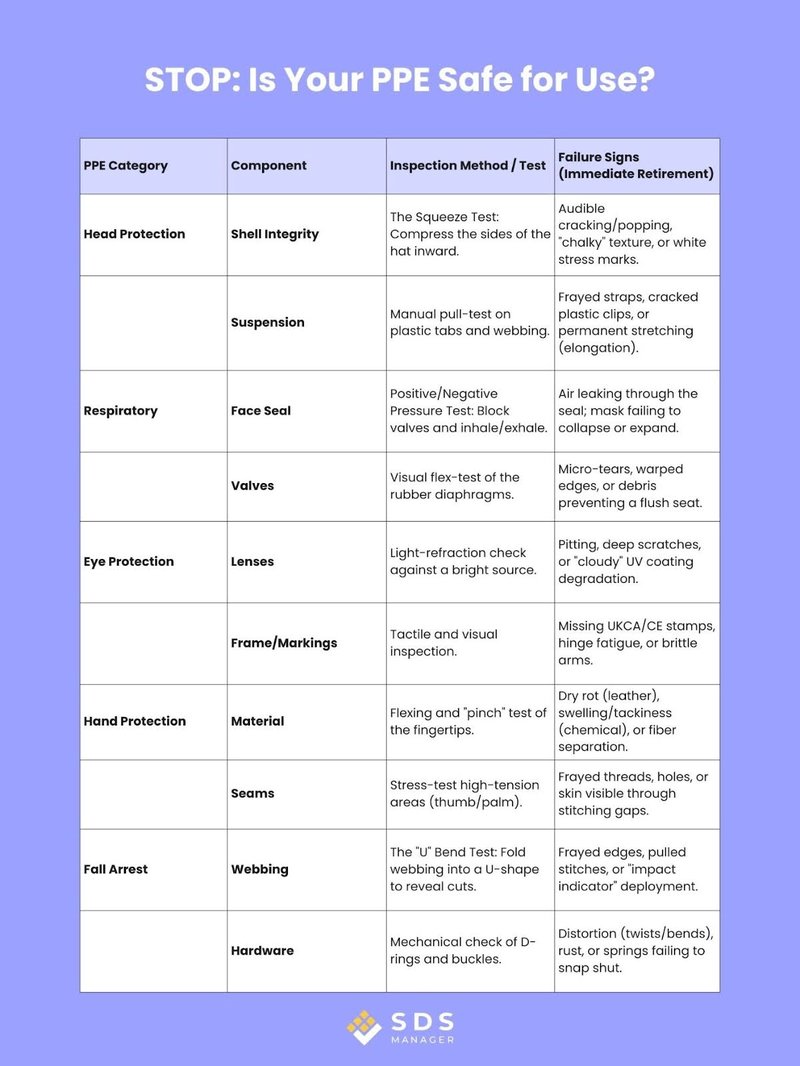
PPE Inspection Checklist: Identifying Hidden Defects
Visual inspection alone is insufficient. Look for mechanical and material degradation.
Hard Hats
- Perform a squeeze test to detect molecular brittleness
- Inspect suspension systems for elongation or cracking
- Check manufacturing date against service life guidelines
Respirators
- Conduct positive and negative pressure seal checks
- Inspect for facepiece distortion or particulate saturation
- Examine valves for micro-tears
Safety Glasses
- Look for lens pitting or UV coating degradation
- Confirm AS/NZS markings remain legible
- Check temple arms for hinge fatigue
Gloves
- Inspect leather for dry rot or fiber separation
- Assess chemical gloves for swelling or tackiness
- Evaluate stitching integrity
Subtle degradation often precedes catastrophic failure. Download the PPE inspection checklist below for easy referral.
| PPE Item | Signs of Damage or Defect | Action Required |
|---|---|---|
| Hard Hat | Cracks, brittleness, UV fading | Remove, tag, replace |
| Respirator | Seal failure, valve malfunction | Quarantine, fit-test new unit |
| Safety Glasses | Pitting, coating loss, structural fracture | Replace immediately |
| Gloves | Chemical permeation, stitching failure | Destroy and replace |
| Welding Helmet | Delayed ADF response, flickering lens | Remove from service, verify certification |
The Destruction Policy: Preventing Unauthorized Reuse
Discarding gear in the bin is a safety liability. Unchecked equipment looks functional to others, leading to "scavenging." This recirculates dangerous, decommissioned gear into the workplace.
To maintain a zero-tolerance safety culture, you must render gear physically unusable.
Standard destruction protocols:
- Respiratory Protection: Cut the headbands and slice through the filter material.
- Hand Protection: Sever the fingers or cuffs. This prevents "light task" reuse of chemically contaminated leather.
- Head Protection: Drill a hole through the crown. This creates an immediate visual cue that structural integrity is void.
- Eye Protection: Snap the temple arms and deeply score the lenses.
- Fall Protection: Cut the webbing near the D-ring. Never leave a harness capable of supporting weight.
Place failed gear in a locked, red "Quarantine" bin. A Safety Officer should verify the failure and log the serial number.
Why Workers Keep Using Damaged PPE
Workers sometimes continue using worn or compromised gear just to complete a task. Over time, this behavior becomes normal. Small defects stop feeling urgent. Risk becomes routine.
This pattern is called normalization of deviance. It starts with “It’s just a small crack.” It ends with preventable injury.
Supervisors set the tone. If leaders replace damaged equipment immediately, teams will follow that standard. If leaders ignore defects, workers will too.
A cracked visor is not cosmetic damage. It is an early failure signal.
Legal Consequences of Using Defective or Damaged PPE
Allowing continued use of known defective equipment can lead to:
- Regulatory notices and fines under WHS Regulations
- Increased liability in injury investigations
- Denied insurance claims
Regulators assess whether hazards were known and ignored. Documentation often determines outcome.
Compliance is not paperwork. It is documented hazard control.
Conclusion
Protective equipment is engineered to fail safely under defined limits. Once those limits are exceeded, the protection is compromised.
If PPE is damaged, stop work.
If PPE is defective, remove it from circulation.
If PPE reaches end of life, replace it proactively.
Safety systems succeed when reporting is immediate, replacement is structured, and destruction prevents reuse.
Protection only works when integrity is intact.

Samiha Fairooz Audrika

Samiha is a workplace safety expert and writer at SDS Manager. She translates complex safety standards into clear, practical guidance rooted in real-world challenges and industry insight. Her work helps businesses strengthen compliance, protect workers, and make safer decisions with confidence.