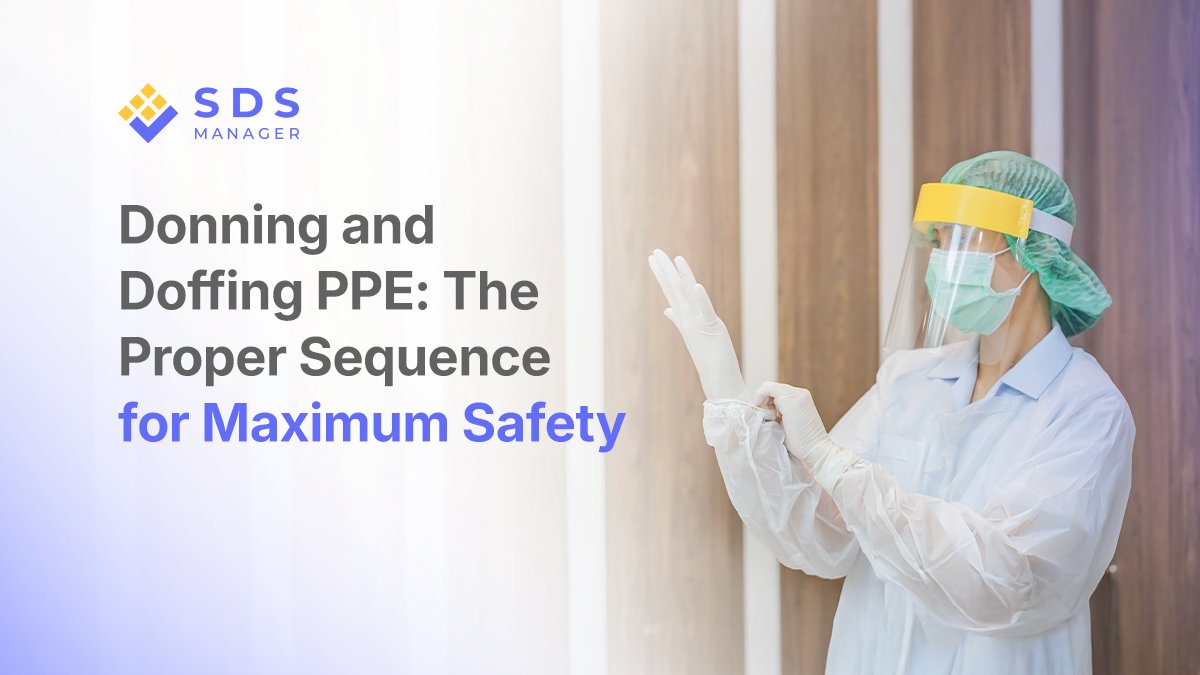
Personal Protective Equipment (PPE) only protects you when it is worn and removed correctly. In chemical safety, you can always find the PPE requirements in section 8 of a safety data sheet. It is important you read it carefully before you start donning PPE.
Using the right sequence for putting on and taking off PPE reduces contamination risks and significantly lowers workplace injury and illness rates.
This article acts as a practical guide for you on how to put on and take off PPE in the right order.
What Is Donning and Doffing of PPE?
Donning refers to the systematic process of putting on protective equipment before exposure to hazards.
Doffing is the controlled removal of that equipment after completing the task..
These are defined safety procedures designed to:
- Create a physical barrier between you and workplace hazards
- Prevent contamination during and after tasks
- Protect coworkers and shared environments
According to the Australian Commission on Safety and Quality in Health Care, the process of removing (doffing) PPE carries the highest risk of self-contamination. Making a strictly followed, standardised sequence vital for worker safety in healthcare and high-risk environments.
For HSE professionals, mastering these processes is fundamental to risk control, not just procedural compliance.
What Is the Proper Order of Donning PPE?
The correct sequence of donning PPE ensures that each item is secured without contaminating another.
You must wash your hands or use alcohol-based sanitizer before touching any PPE. The protective progression starts with foundational layers and ends with sealing components that must not be adjusted later.
The widely accepted donning PPE order looks like this:
1. Protective clothing or coveralls
The gown or coverall is almost always the first item donned to protect the torso and arms. This forms your primary barrier against splashes, dust, and particulates. Ensure full coverage and closure.
2. Foot protection (If required)
If the environment requires disposable shoe covers, they are typically donned after protective covers. Safety shoes or boots should be worn early to avoid stepping into hazards while unprotected.
In clinical settings, shoe covers are often put on after the gown. In industrial settings, safety boots are often already on, and boot covers are applied after coveralls.
3. Respiratory protection
Put your mask or respirator on before your goggles or hood. This makes sure nothing gets in the way of a tight seal against your skin. For respirators (like N95s), perform a seal check by exhaling sharply to ensure no air escapes the edges.
4. Eye and face protection
Place goggles or face shield over the face and eyes and adjust to fit. Goggles or face shields protect mucous membranes from airborne or splashed contaminants.
5. Hand protection
Gloves go on last, allowing you to handle remaining items without contamination. It should be pulled over the cuffs of the gown/coverall to ensure no skin is exposed.
This structured approach ensures no exposed areas remain and minimizes the risk of compromising sterile or clean components.
Safe Work Australia emphasizes that when multiple items of PPE are worn, they must be compatible. If the items are put on in the wrong order, they may not fit together properly. For example, safety glasses can break the airtight seal of a respirator. This interference makes the equipment ineffective and means it no longer meets legal safety standards.
What Is the Correct Order of Doffing PPE?
Removing PPE requires more caution than putting it on. The goal is to avoid transferring contaminants from equipment to skin or clothing. The proper sequence of doffing PPE is as follows:
1. Gloves
Gloves are typically the most contaminated item and should be removed first using the "glove-to-glove, skin-to-skin" technique. This method ensures that your bare hands never touch the dirty exterior of the glove, preventing immediate cross-contamination.
2. Eye and face protection
Only touch the "clean" parts, like the earpieces or the headband at the back. Reach behind your head and pull the gear straight forward and away from your face. This keeps any dust or splashes on the front from falling into your eyes.
3. Protective clothing
Carefully unfasten any ties or zippers and roll the garments downward and inward to trap contaminants inside the fabric.
By turning the clothing inside out as you remove it, you ensure that the "dirty" side is contained and no longer poses a risk to your skin or the environment.
4. Respiratory protection
Remove your mask or respirator only after leaving the hazardous zone to ensure you do not inhale any lingering airborne particles.
Always grasp the bottom ties or elastics first, followed by the top ones, and pull the mask straight forward away from your face without touching the filter material.
5. Foot protection
This is taken off last if heavily exposed, especially in chemical or biological environments.
Carefully step out of the covers or boots directly into a "clean zone" and immediately perform thorough hand hygiene once the process is complete.
Hand hygiene must immediately follow PPE removal. Use soap and water or an alcohol-based sanitizer to thoroughly clean your hands. This significantly reduces your chance of exposure to hazards.
What Are the 6 Rules of PPE Use?
Regardless of industry or role, six core principles govern effective PPE use.
1. PPE must match the hazard
PPE selection must be based on risk assessments, not convenience or habit.
2. Fit is non-negotiable
Ill-fitting equipment provides a false sense of security.
3. PPE must be inspected before use
Defective gear compromises protection immediately.
4. Users must be trained
Untrained use often leads to misuse or dangerous shortcuts.
5. PPE must be maintained and stored properly
Contaminated or damaged equipment is worse than none at all.
6. PPE is the last line of defense
Engineering and administrative controls always come first.
In accordance with Safe Work Australia and the WHS Regulations, employers must manage risks by following the Hierarchy of Control. This legal framework mandates that PPE is the last level of protection and must only be relied upon when higher-order controls are not reasonably practicable.
Why Knowing the Correct PPE Sequence Matters
Understanding the proper sequence is not about memorization. It is about breaking the chain of exposure.
Here is why this knowledge directly affects safety outcomes:
- Reduces cross-contamination between tasks and work zones
- Prevents self-exposure during high-risk removal moments
- Improves compliance with regulatory and audit requirements
- Protects coworkers, not just the individual wearer
- Reinforces safety culture through disciplined behavior
Conclusion
Protective equipment only delivers its value when used with discipline and understanding.
Knowing how to put on and remove PPE in the correct sequence transforms PPE from a checkbox into a true risk control measure.
When PPE becomes a practiced system rather than an afterthought, safety stops being reactive and starts becoming proactive.
Sequence brings predictability. Predictability brings fewer errors. Fewer errors mean fewer exposures.

Samiha Fairooz Audrika

Samiha is a workplace safety expert and writer at SDS Manager. She translates complex safety standards into clear, practical guidance rooted in real-world challenges and industry insight. Her work helps businesses strengthen compliance, protect workers, and make safer decisions with confidence.