

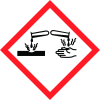

Note: Ingredients listed on restricted chemical lists
EC/CAS
111-76-2
Name of the chemical
Ethylene glycol monobutyl ether (EGBE)
Concentration
N/A
EC/CAS
1310-58-3
Name of the chemical
potassium hydroxide
Concentration
10-30%
General Information
Revision date
2018-02-20
Product name
Rip Tide
1.2.1 Relevant identified uses
Heavy Duty Cleaner / Degreaser
Manufacturer Name
Wechem, Inc
Emergency telephone
1-800-535-5053
Icons in SDS


Company Information
company name
Wechem, Inc
GHS Information
Signal word
DANGER
Hazard Codes
Hazard statements (CLP)
H312, H314, H317, H318, H332
Hazard statements
Code
Statements
H312
Harmful in contact with skin
Section 2
SECTION 2: Hazards identification
GHS Classification in Accordance with 29 CFR 1910 (OSHA HCS): Classification of the Substance or Mixture
Signal word
DANGER
Hazard statements
H312 - Harmful in contact with skin H332 - Harmful if inhaled H314 - Causes severe skin burns and eye damage H318 - Causes serious eye damage H317 - May cause an allergic skin reaction
Precautionary statements
P280 - Wear protective gloves/protective clothing/eye protection/face protection. P301+310 - IF SWALLOWED: Immediately call a POISON CENTER or doctor/physician. P301+330+331 - IF SWALLOWED: Rinse mouth. Do NOT induce vomiting. P303+361+353 - IF ON SKIN (or hair): Remove/Take off immediately all contaminated clothing. Rinse skin with water/shower. SDS Page 2 of 7 P304+340 - IF INHALED: Remove victim to fresh air and keep at rest in a position comfortable for breathing. P305+351+338 - IF IN EYES: Rinse continuously with water for several minutes. Remove contact lenses if present and easy to do. Continue rinsing. P310 - Immediately call a POISON CENTER or doctor/physician. P363 - Wash contaminated clothing before reuse. P501 - Dispose of contents/container in accordance with all local, regional and international regulations.
Principle Routes of Exposure
Skin absorption, eye, inhalation, ingestion Target Organs: NA Inhalation: Generated mist may be severely irritating and cause damage to respiratory tract Skin Contact: Causes burns with prolonged contact. Eye Contact: Will cause burns with prolonged contact. Ingestion: Harmful or fatal if swallowed.
2.1 Classification of the substance or mixture
GHS Classification in Accordance with 29 CFR 1910 (OSHA HCS): Health, Acute toxicity, 4 Dermal Health, Acute toxicity, 4 Inhalation Health, Skin corrosion/irritation, 1 B Health, Serious Eye Damage/Eye Irritation, 1 Health, Respiratory or skin sensitization, 1 Skin



