



Note: Ingredients listed on restricted chemical lists
General Information
Revision date
2020-07-04
Product name
Dichloroisocyanuric acid, sodium salt
Product Synonyms
1-Sodium-3,5-dichloro-s-triazine-2,4,6-trione; Dichloro-s-triazine-2,4,6-(1H,3H,5H)-trione
CAS No.
2893-78-9
Emergency telephone
+64 9 980 6780
Icons in SDS


Company Information
company name
Thermo Fisher Scientific New Zealand Ltd
e-mail address of the competent person responsible for the Safety Data Sheet
NZinfo@thermofisher.com
GHS Information
Signal word
Danger
Hazard Codes
Hazard statements (CLP)
H272, H302, H313, H315, H319, H333, H335, H400, H410, H421, H433
Hazard statements
Code
Statements
H272
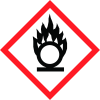
May intensify fire; oxidizer
H302
Harmful if swallowed
H313
May be harmful in contact with skin
H315
Causes skin irritation
H319
Causes serious eye irritation
H333
May be harmful if inhaled
H335
May cause respiratory irritation
H400
Very toxic to aquatic life
H410
Very toxic to aquatic life with long lasting effects
Section 2
SECTION 2: Hazards identification
GHS Classification Classification under Work Safe New Zealand 5.1.1B - Oxidising substances that are liquids or solids: medium hazard 6.1D - Substances that are acutely toxic (Oral) 6.4A - Substances that are irritating to the eye 6.1E - Substances that are acutely toxic (Inhalation) 9.1A - Substances that are very ecotoxic in the aquatic environment 6.1E - Substances that are acutely toxic (Dermal) 6.3A - Substances that are irritating to the skin 9.2A - Substances that are very ecotoxic in the soil environment 9.3C - Substances that are harmful to terrestrial vertebrates Classified as hazardous according to criteria of EPA New Zealand HSNO Approval Number HSR001324
Physical hazards
Oxidizing solids Category 2
Health hazards
Acute Oral Toxicity Category 4 Acute Dermal Toxicity Category 5 Acute Inhalation Toxicity - Dusts and Mists Category 5 Skin Corrosion/Irritation Category 2 Serious Eye Damage/Eye Irritation Category 2 Specific target organ toxicity - (single exposure) Category 3
Environmental hazards
Acute aquatic toxicity Category 1 Chronic aquatic toxicity Category 1
Signal word
Danger
Hazard statements
H272 - May intensify fire; oxidizer H302 - Harmful if swallowed H319 - Causes serious eye irritation H335 - May cause respiratory irritation H400 - Very toxic to aquatic life H410 - Very toxic to aquatic life with long lasting effects H313 - May be harmful in contact with skin H333 - May be harmful if inhaled H315 - Causes skin irritation H421 - Very toxic to the soil environment H433 - Harmful to terrestrial vertebrates
Precautionary statements
P210 - Keep away from heat/sparks/open flames/hot surfaces. - No smoking P220 - Keep/Store away from clothing/ combustible materials P221 - Take any precaution to avoid mixing with combustibles P261 - Avoid breathing dust/fume/gas/mist/vapors/spray P264 - Wash face, hands and any exposed skin thoroughly after handling P270 - Do not eat, drink or smoke when using this product P271 - Use only outdoors or in a well-ventilated area P280 - Wear protective gloves/protective clothing/eye protection/face protection P304 + P340 - IF INHALED: Remove victim to fresh air and keep at rest in a position comfortable for breathing P305 + P351 + P338 - IF IN EYES: Rinse cautiously with water for several minutes. Remove contact lenses, if present and easy to do. Continue rinsing P312 - Call a POISON CENTER or doctor/physician if you feel unwell P330 - Rinse mouth P370 + P378 - In case of fire: Use CO2, dry chemical or foam for extinction P403 + P233 - Store in a well-ventilated place. Keep container tightly closed P501 - Dispose of contents/ container to an approved waste disposal plant
Further information
Lachrymator (substance which increases the flow of tears) Contact with acids liberates toxic gas


