




Note: Ingredients listed on restricted chemical lists
EC/CAS
9004-70-0
Name of the chemical
Nitrocellulose
Concentration
N/A
EC/CAS
121-14-2
Name of the chemical
2,4-Dinitrotoluene
Concentration
N/A
EC/CAS
122-39-4
Name of the chemical
Diphenylamine
Concentration
N/A
General Information
Revision date
2019-01-31
Product name
Benchmark 8208
Product name
Benchmark 8208
Identification on the label/Trade name
POWDER SMOKELESS
Product Synonyms
Propellant BM8208; AR2210 V02
1.2.1 Relevant identified uses
Propellant for use in centrefire ammunition
Emergency telephone
03 5742 2200
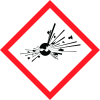
Icons in SDS
Company Information
company name
Thales Australia Mulwala Facility
e-mail address of the competent person responsible for the Safety Data Sheet
team@steveswholesale.nz
GHS Information
Signal word
Danger
Hazard Codes
Hazard statements (CLP)
H203, H302, H312, H332, H341, H350, H361, H370, H373, H411
Hazard statements
Code
Statements
H203
Explosive; fire, blast or projection hazard
Section 2
2.1 Classification of the substance or mixture
HAZARDOUS CHEMICAL. DANGEROUS GOODS. According to the WHS Regulations and the ADG Code. CHEMWATCH HAZARD RATINGS Min Max Flammability 1 Toxicity 2 0 = Minimum Body Contact 2 1 = Low 2 = Moderate Reactivity 3 3 = High Chronic 3 4 = Extreme Poisons Schedule Not Applicable Explosive Division 1.3, Acute Toxicity (Oral) Category 4, Acute Toxicity (Dermal) Category 4, Acute Toxicity (Inhalation) Category 4, Germ cell mutagenicity [1] Category 2, Carcinogenicity Category 1B, Reproductive Toxicity Category 2, Specific target organ toxicity - single exposure Category 1, Specific target organ toxicity - repeated exposure Category 2, Chronic Aquatic Hazard Category 2 Legend: 1. Classified by Chemwatch; 2. Classification drawn from HSIS; 3. Classification drawn from Regulation (EU) No 1272/2008 - Annex VI
Signal word
DANGER
Hazard statements
H203 Explosive; fire, blast or projection hazard. H302 Harmful if swallowed. H312 Harmful in contact with skin. H332 Harmful if inhaled. H341 Suspected of causing genetic defects. H350 May cause cancer. H361 Suspected of damaging fertility or the unborn child. H370 Causes damage to organs. H373 May cause damage to organs through prolonged or repeated exposure. H411 Toxic to aquatic life with long lasting effects.
Prevention
P201 Obtain special instructions before use. P210 Keep away from heat/sparks/open flames/hot surfaces. - No smoking. P230 Keep wetted with phlegmatizer. P250 Do not subject to grinding/shock/sources of friction. P260 Do not breathe dust/fume/gas/mist/vapours/spray. P271 Use only outdoors or in a well-ventilated area. P280 Wear protective gloves/protective clothing/eye protection/face protection. P281 Use personal protective equipment as required. P240 Ground/bond container and receiving equipment.
Response
P307+P311 IF exposed: Call a POISON CENTER or doctor/physician. P308+P313 IF exposed or concerned: Get medical advice/attention. P363 Wash contaminated clothing before reuse. P370+P380 In case of fire: Evacuate area. P372 Explosion risk in case of fire. P373 DO NOT fight fire when fire reaches explosives. P391 Collect spillage. P301+P312 IF SWALLOWED: Call a POISON CENTER or doctor/physician if you feel unwell. P302+P352 IF ON SKIN: Wash with plenty of soap and water.
Storage
P405 Store locked up. P401 Store according to local regulations for explosives.
Disposal
P501 Dispose of contents/container in accordance with local regulations.


