





General Information
Version
1.0
Revision date
2023-01-05
Product name
2,2-Dimethylpropylmagnesium choride, 1M in DEE
Substance name
2,2-Dimethylpropylmagnesium choride, 1M in DEE
Product Synonyms
Neopentylmagnesium chloride, 1M in DEE
CAS No.
13132-23-5
supplier name
SynQuest Laboratories, Inc. Inc
Icons in SDS


Company Information
company name
SynQuest Laboratories, Inc. Inc
e-mail address of the competent person responsible for the Safety Data Sheet
info@synquestlabs.com
GHS Information
Signal word
Danger
Hazard Codes
Hazard statements (CLP)
H200, H225, H261, H302, H314, H318, H335, H336, H351
Hazard statements
Code
Statements
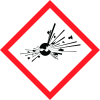
H200
Unstable Explosive
Section 2
SECTION 2: Hazards identification
Classification of the substance or mixture GHS US classification Unstable explosives Flammable liquids Category 2 Substances and mixtures which in contact with water H200 Unstable explosive H225 Highly flammable liquid and vapor emit flammable H261 In contact with water releases flammable gas gases Category 2 Acute toxicity (oral) Category 4 H302 Harmful if swallowed Skin corrosion/irritation Category 1 H314 Causes severe skin burns and eye damage Serious eye damage/eye irritation Category 1 H318 Causes serious eye damage Carcinogenicity Category 2 H351 Suspected of causing cancer Specific target organ toxicity – Single exposure, Category 3, Narcosis H336 May cause drowsiness or dizziness Specific target organ toxicity – Single exposure, Category 3, H335 May cause respiratory irritation Respiratory tract irritation Full text of H statements : see section 16
2.2 Label elements
GHS US labeling
Signal word
Danger
Hazard statements
H200 - Unstable explosive H225 - Highly flammable liquid and vapor H261 - In contact with water releases flammable gas H302 - Harmful if swallowed H314 - Causes severe skin burns and eye damage H318 - Causes serious eye damage H335 - May cause respiratory irritation H336 - May cause drowsiness or dizziness H351 - Suspected of causing cancer
Precautionary statements
P201 - Obtain special instructions before use. P202 - Do not handle until all safety precautions have been read and understood. P210 - Keep away from heat, hot surfaces, sparks, open flames and other ignition sources. No smoking. P223 - Do not allow contact with water. P231+P232 - Handle under inert gas. Protect from moisture. P233 - Keep container tightly closed. P240 - Ground/Bond container and receiving equipment. P241 - Use explosion-proof electrical/ventilating/lighting equipment P242 - Use only non-sparking tools. P243 - Take precautionary measures against static discharge. P260 - Do not breathe dust/fume/gas/mist/vapors/spray. P264 - Wash skin thoroughly after handling P270 - Do not eat, drink or smoke when using this product. P271 - Use only outdoors or in a well-ventilated area. P280 - Wear protective gloves/protective clothing/eye protection/face protection. P301+P312 - If swallowed: Call a POISON CENTER or doctor/ physician if you feel unwell P301+P330+P331 - If swallowed: rinse mouth. Do NOT induce vomiting. P303+P361+P353 - If on skin (or hair): Take off immediately all contaminated clothing. Rinse skin with water/shower. P304+P340 - If inhaled: Remove person to fresh air and keep comfortable for breathing. P305+P351+P338 - IF IN EYES: Rinse cautiously with water for several minutes. Remove contact lenses, if present and easy to do. Continue rinsing. P308+P313 - If exposed or concerned: Get medical advice/attention. P310 - Immediately call a POISON CENTER or doctor/ physician P321 - Specific treatment (see supplemental first aid instructions on this label) P330 - Rinse mouth. P335+P334 - Brush off loose particles from skin. Immerse in cool water/wrap in wet bandages. P363 - Wash contaminated clothing before reuse. P370+P378 - In case of fire: Use dry sand, dry chemical or alcohol-resistant foam to extinguish P372 - Explosion risk in case of fire. P373 - DO NOT fight fire when fire reaches explosives. P380 - Evacuate area. P401 - Store in accordance with local regulations on explosives. P402+P404 - Store in a dry place. Store in a closed container. P403+P233 - Store in a well-ventilated place. Keep container tightly closed. P403+P235 - Store in a well-ventilated place. Keep cool. P405 - Store locked up. P501 - Dispose of contents/container to an approved waste disposal plant
Other hazards which do not result in classification
Reacts violently with water. May form explosive peroxides.
Ingredient(s) with unknown acute toxicity
No additional information available
2.1 Classification of the substance or mixture
GHS US classification Unstable explosives H200 Unstable explosive Flammable liquids Category 2 H225 Highly flammable liquid and vapor Substances and mixtures which in contact with water emit flammable H261 In contact with water releases flammable gas gases Category 2 Acute toxicity (oral) Category 4 H302 Harmful if swallowed Skin corrosion/irritation Category 1 H314 Causes severe skin burns and eye damage Serious eye damage/eye irritation Category 1 H318 Causes serious eye damage Carcinogenicity Category 2 H351 Suspected of causing cancer Specific target organ toxicity – Single exposure, Category 3, Narcosis H336 May cause drowsiness or dizziness Specific target organ toxicity – Single exposure, Category 3, H335 May cause respiratory irritation Respiratory tract irritation Full text of H statements : see section 16


