


Note: Ingredients listed on restricted chemical lists
EC/CAS
62571-55-5
Name of the chemical
Octane, 8-azido-1,1,1,2,2,3,3,4,4,5,5,6,6-tridecafluoro
Concentration
≤100
General Information
Version
1.1
Revision date
2026-06-09
Product name
1-Azido-1H,1H,2H,2H-perfluorooctane
Substance name
1-Azido-1H,1H,2H,2H-perfluorooctane
Product Synonyms
8-Azido-1,1,1,2,2,3,3,4,4,5,5,6,6-tridecafluorooctane
CAS No.
62571-55-5
supplier name
SynQuest Laboratories, Inc
Icons in SDS


Company Information
company name
SynQuest Laboratories, Inc
e-mail address of the competent person responsible for the Safety Data Sheet
info@synquestlabs.com
GHS Information
Signal word
Danger
Hazard Codes
Hazard statements (CLP)
H240, H315, H319, H335
Hazard statements
Code
Statements
H240
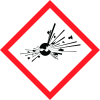
Heating may cause an explosion
Section 2
SECTION 2: Hazards identification
Classification of the substance or mixture GHS US classification Self-Reactive substances and mixtures, Type A H240 Heating may cause an explosion. Skin corrosion/irritation, Category 2 H315 Causes skin irritation. Serious eye damage/eye irritation, Category 2A H319 Causes serious eye irritation. Specific target organ toxicity – Single exposure, Category 3, H335 May cause respiratory irritation. Respiratory tract irritation Full text of H statements : see section 16
2.2 Label elements
GHS US labeling
Signal word
Danger
Hazard statements
H240 - Heating may cause an explosion H315 - Causes skin irritation H319 - Causes serious eye irritation H335 - May cause respiratory irritation
Precautionary statements
P210 - Keep away from heat, hot surfaces, sparks, open flames and other ignition sources. No smoking. P234 - Keep only in original packaging. P240 - Ground/Bond container and receiving equipment. P261 - Avoid breathing fumes, mist, spray, vapors. P264 - Wash hands, forearms and face thoroughly after handling. P271 - Use only outdoors or in a well-ventilated area. P280 - Wear protective gloves. P302+P352 - If on skin: Wash with plenty of soap and water P304+P340 - If inhaled: Remove person to fresh air and keep comfortable for breathing. P305+P351+P338 - If in eyes: Rinse cautiously with water for several minutes. Remove contact lenses, if present and easy to do. Continue rinsing P312 - Call a POISON CENTER or doctor/physician if you feel unwell P321 - Specific treatment (see supplemental first aid instruction on this label). P332+P313 - If skin irritation occurs: Get medical advice or attention. P337+P313 - If eye irritation persists: Get medical advice or attention. P362+P364 - Take off contaminated clothing and wash it before reuse. P370+P372+P380+P373 - In case of fire: Explosion risk. Evacuate area. DO NOT fight fire when fire reaches explosives. P403 - Store in a well-ventilated place. P403+P233 - Store in a well-ventilated place. Keep container tightly closed. P405 - Store locked up. P411 - Store at temperatures not exceeding the recommended value . P420 - Store separately. P501 - Dispose of contents and/or container to hazardous or special waste collection point, in accordance with local, regional, national and/or international regulations. 2.3. Hazards associated with known or reasonably anticipated uses No additional information available
Other hazards which do not result in classification
Heating may cause an explosion. 2.5. Unknown acute toxicity No additional information available
2.1 Classification of the substance or mixture
GHS US classification Self-Reactive substances and mixtures, Type A H240 Heating may cause an explosion. Skin corrosion/irritation, Category 2 H315 Causes skin irritation. Serious eye damage/eye irritation, Category 2A H319 Causes serious eye irritation. Specific target organ toxicity – Single exposure, Category 3, H335 May cause respiratory irritation. Respiratory tract irritation Full text of H statements : see section 16


