


Note: Ingredients listed on restricted chemical lists
EC/CAS
90-72-2
Name of the chemical
2,4,6-tris(dimethylaminomethyl)phenol
Concentration
N/A
General Information
Revision date
2017-04-21
Product name
Solid Bond 330 - Part B
CAS No.
90-72-2
1.2.1 Relevant identified uses
Ambient temperature curing agent formulation for mixing with Solid Bond 330 Part A. Solid Bond 330 Kit is used in areas such as fiberglass reinforced laminating
supplier name
Solid Solutions Group
Emergency telephone
(03) 6579-2044 (Mon - Fri, 9am - 5pm, AEST
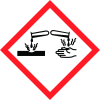
Icons in SDS


Company Information
company name
Solid Solutions Group
GHS Information
Signal word
Danger
Hazard Codes
Hazard statements (CLP)
H314, H334
Hazard statements
Code
Statements
H314
Causes severe skin burns and eye damage
Section 2
SECTION 2: Hazards identification
This material is hazardous according to health criteria of Safe Work Australia.
Signal word
Danger
2.1 Classification of the substance or mixture
Skin Corrosion/Irritation - Category 1C Serious Eye Damage/Irritation - Category 1 Sensitisation - Respiratory - Category 1B
Hazard statements
H314 Causes severe skin burns and eye damage. H334 May cause allergy or asthma symptoms or breathing difficulties if inhaled.
Prevention
P102 Keep out of reach of children. P103 Read label before use. P260 Do not breathe dust, fume, gas, mist, vapours or spray. P264 Wash hands, face and all exposed skin thoroughly after handling. P280 Wear protective clothing, gloves, eye/face protection and suitable respirator. P285 In case of inadequate ventilation wear respiratory protection.
Response
P101 If medical advice is needed, have product container or label at hand. P301+P330+P331 IF SWALLOWED: Rinse mouth. Do NOT induce vomiting. P303+P361+P353 IF ON SKIN (or hair): Remove/Take off immediately all contaminated clothing. Rinse skin with water/shower. P304+P341 IF INHALED: If breathing is difficult, remove victim to fresh air and keep at rest in a position comfortable for breathing. P305+P351+P338 IF IN EYES: Rinse cautiously with water for several minutes. Remove contact lenses, if present and easy to do. Continue rinsing. P310 Immediately call a POISON CENTER or doctor/physician. P342+P311 If experiencing respiratory symptoms: Call a POISON CENTER or doctor/physician. P363 Wash contaminated clothing before reuse.
Storage
P405 Store locked up.
Precautionary statements
P501 Dispose of contents/container in accordance with local, regional, national and international regulations. Poison Schedule: S5. Caution
Classifications
Classified as Dangerous Goods by the criteria of the "Australian Code for the Transport of Dangerous Goods by Road & Rail" and the "New Zealand NZS5433: Transport of Dangerous Goods on Land". Dangerous Goods Class: 8



