

Note: Ingredients listed on restricted chemical lists
EC/CAS
231-100-4/7439-92-1
Name of the chemical
Blei, massiv: [Partikeldurchmesser ≥ 1 mm]
Concentration
>= 0.90 - < 2.90 %
Listed in
EC/CAS
233-660-5/10294-40-3
Name of the chemical
Barium chromate
Concentration
< 2.80 %
EC/CAS
215-235-6/1314-41-6
Name of the chemical
Orange lead (lead tetroxide)
Concentration
< 1.20 %
EC/CAS
231-846-0/7758-97-6
Name of the chemical
Bleichromat (790/2009)
Concentration
< 0.30 %
EC/CAS
236-542-1/13424-46-9
Name of the chemical
Bleiazid
Concentration
N/A
General Information
Revision date
2021-04-05
Product name
Primadet(R)
Product Synonyms
EZ Stoper®, Dual Stoper®, EZ Ringer®, LP Primadet®, EZ
1.2.1 Relevant identified uses
Mining and civil explosive detonator
Emergency telephone
+44 (0)1235 239 670 (Europe, Israel, Africa, Americas
Icons in SDS


Company Information
company name
Sasol Chemicals, a division of Sasol South Africa Ltd
e-mail address of the competent person responsible for the Safety Data Sheet
sasolchem.info.sa@sasol.com
GHS Information
Signal word
Danger
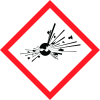
Hazard Codes
Hazard statements (CLP)
H201
Hazard statements
Code
Statements
H201
Explosive; mass explosion hazard
Section 2
2.1 Classification of the substance or mixture
REGULATION (EC) No 1272/2008
Classifications
Explosives Division 1.1
2.2 Label elements
REGULATION (EC) No 1272/2008
Signal word
Danger
Hazard statements
H201 Explosive; mass explosion hazard.
Prevention
P210 Keep away from heat/ sparks/ open flames/ hot surfaces. No smoking. P240 Ground and bond container and receiving equipment. P250 Do not subject to grinding/ shock/ friction. P280 Wear protective gloves/ protective clothing/ eye protection/ face protection.
Response
P370 + P380 In case of fire: Evacuate area. P372 Explosion risk in case of fire. P373 DO NOT fight fire when fire reaches explosives.
Storage
P401 Store in accordance with local regulations.
Disposal
P501 Dispose of contents/ container to an approved waste disposal plant.
2.3 Other hazards
This substance/mixture contains no components considered to be either persistent, bioaccumulative and toxic (PBT), or very persistent and very bioaccumulative (vPvB) at levels of 0.1% or higher.


