

Note: Ingredients listed on restricted chemical lists
EC/CAS
1310-73-2
Name of the chemical
sodium hydroxide
Concentration
>=98-100%
General Information
Revision date
2021-09-06
Product name
Caustic Soda
Chemical name
Sodium hydroxide
CAS No.
1310-73-2
Emergency telephone
1-800-424-9300, +1-703-527-3887
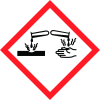
Icons in SDS

Company Information
company name
Redox Ltd
GHS Information
Signal word
Danger
Hazard Codes
Hazard statements (CLP)
H290, H314
Hazard statements
Code
Statements
H290
May be corrosive to metals
Section 2
SECTION 2: Hazards identification
Poisons Schedule (Aust) Schedule 6 Globally Harmonised System Redox Ltd Australia New Zealand Malaysia Corporate Office Sydney Phone +61 2 9733 3000 Adelaide Auckland Kuala Lumpur Locked Bag 15 Minto NSW 2566 Australia Fax +61 2 9733 3111 Brisbane Christchurch USA 2 Swettenham Road Minto NSW 2566 Australia E-mail sydney@redox.com Melbourne Hawke’s Bay Los Angeles All Deliveries: 4 Holmes Road Minto NSW 2566 Australia Web www.redox.com Perth UK Oakland ABN 92 000 762 345 Sydney London Mexico Saltillo
2.1 Classification of the substance or mixture
Hazardous according to the criteria of the Globally Harmonised System of Classification and Labelling of Chemicals (GHS)
Hazard categories
Corrosive to Metals - Category 1 Skin Corrosion/Irritation - Category 1A Serious Eye Damage/Irritation - Category 1
Signal word
Danger
Hazard statements
H290 May be corrosive to metals. H314 Causes severe skin burns and eye damage. AUH071 Corrosive to the respiratory tract
Prevention
P280 Wear protective gloves/protective clothing/eye protection/face protection. P260 Do not breathe dusts or mists.
Response
P303 + P361 + P353 IF ON SKIN (or hair): Take off immediately all contaminated clothing. Rinse skin with water or shower. P310 Immediately call a POISON CENTER or doctor. P305 + P351 + P338 IF IN EYES: Rinse cautiously with water for several minutes. Remove contact lenses, if present and easy to do. Continue rinsing. P390 Absorb spillage to prevent material-damage. P301 + P330 + P331 IF SWALLOWED: Rinse mouth. Do NOT induce vomiting. P363 Wash contaminated clothing before reuse. P304 + P340 IF INHALED: Remove victim to fresh air and keep comfortable for breathing.
Storage
P406 Store in corrosive resistant container with a resistant inner liner. P405 Store locked up.
Disposal
P501 Dispose of contents/container in accordance with local / regional / national / international regulations. National Transport Commission (Australia) Australian Code for the Transport of Dangerous Goods by Road & Rail (ADG Code)
Classifications
Dangerous Goods according to the criteria of the Australian Code for the Transport of Dangerous Goods by Road & Rail (ADG Code) Environmental Protection Authority (New Zealand) Hazardous Substances and New Organisms Amendment Act 2015
HSNO Classifications
Health 6.1D Substances that are acutely toxic - Harmful 8.1A Substances that are corrosive to metals 8.2B Substances that are corrosive to dermal tissue UN PGII 8.3A Substances that are corrosive to ocular tissue



