



Note: Ingredients listed on restricted chemical lists
EC/CAS
7732-18-5
Name of the chemical
Water, distilled, conductivity or of similar purity H2O
Concentration
N/A
General Information
Revision date
2023-06-01
Product name
Ammonium Persulphate Solution
Product Synonyms
No Data Available
Chemical name
Ammonium persulfate, aqueous solution
1.2.1 Relevant identified uses
Oxidising agent
Emergency telephone
+61-2-97333000, +64-9-2506222...
Icons in SDS


Company Information
company name
Redox Ltd
GHS Information
Signal word
Danger
Hazard Codes
Hazard statements (CLP)
H272, H302, H315, H317, H319, H334, H335
Hazard statements
Code
Statements
H272
May intensify fire; oxidiser
Section 2
SECTION 2: Hazards identification
Poisons Schedule (Aust) Not Scheduled Redox Ltd Australia New Zealand Malaysia Corporate Office Sydney Phone +61 2 9733 3000 Adelaide Auckland Kuala Lumpur Locked Bag 15 Minto NSW 2566 Australia Fax +61 2 9733 3111 Brisbane Christchurch USA 2 Swettenham Road Minto NSW 2566 Australia E-mail sydney@redox.com Melbourne Hawke’s Bay Los Angeles All Deliveries: 4 Holmes Road Minto NSW 2566 Australia Web www.redox.com Perth UK Oakland ABN 92 000 762 345 Sydney London Mexico Saltillo Globally Harmonised System Hazard Classification Hazardous according to the criteria of the Globally Harmonised System of Classification and Labelling of Chemicals (GHS)
Hazard categories
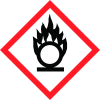
Oxidising Liquids - Category 3 Acute Toxicity (Oral) - Category 4 Skin Corrosion/Irritation - Category 2 Serious Eye Damage/Irritation - Category 2 Sensitisation (Respiratory) - Category 1 Sensitisation (Skin) - Category 1 Specific Target Organ Toxicity (Single Exposure) - Category 3 Pictograms
Signal word
Danger Hazard Statements H272 May intensify fire; oxidizer H302 Harmful if swallowed H315 Causes skin irritation H317 May cause an allergic skin reaction H319 Causes serious eye irritation H334 May cause allergy or asthma symptoms or breathing difficulties if inhaled H335 May cause respiratory irritation
Prevention
P261 Avoid breathing mist/vapours/spray. P270 Do not eat, drink or smoke when using this product. P272 Contaminated work clothing should not be allowed out of the workplace. P271 Use only outdoors or in a well-ventilated area. P210 Keep away from heat, hot surfaces, sparks, open flames and other ignition sources. No smoking. P220 Keep away from clothing and other combustible materials. P284 Wear respiratory protection. P280 Wear protective gloves/protective clothing/eye protection/face protection.
Response
P370 + P378 In case of fire: Use water jets for extinction. P342 + P311 If experiencing respiratory symptoms: Call a POISON CENTER/doctor for emergency medical advice. P302 + P352 IF ON SKIN: Wash with plenty of water. P337 + P313 If eye irritation persists: Get medical attention. P333 + P313 If skin irritation or rash occurs: Get medical attention. P312 Call a POISON CENTER or doctor if you feel unwell. P330 Rinse mouth. P305 + P351 + P338 IF IN EYES: Rinse cautiously with water for several minutes. Remove contact lenses, if present and easy to do. Continue rinsing. P304 + P340 IF INHALED: Remove victim to fresh air and keep comfortable for breathing. P362 + P364 Take off contaminated clothing and wash it before reuse.
Storage
P403 + P233 Store in a well-ventilated place. Keep container tightly closed. P405 Store locked up.
Disposal
P501 Dispose of contents/container in accordance with local / regional / national / international regulations. National Transport Commission (Australia) Australian Code for the Transport of Dangerous Goods by Road & Rail (ADG Code)
Classifications
Dangerous Goods according to the criteria of the Australian Code for the Transport of Dangerous Goods by Road & Rail (ADG Code) Safe Work Australia
2.1 Classification of the substance or mixture
Hazardous according to the criteria of the Globally Harmonised System of Classification and Labelling of Chemicals (GHS) Hazard Categories Oxidising Liquids - Category 3 Acute Toxicity (Oral) - Category 4 Skin Corrosion/Irritation - Category 2 Serious Eye Damage/Irritation - Category 2 Sensitisation (Respiratory) - Category 1 Sensitisation (Skin) - Category 1 Specific Target Organ Toxicity (Single Exposure) - Category 3 Pictograms Signal Word Danger Hazard Statements H272 May intensify fire; oxidizer. H302 Harmful if swallowed. H315 Causes skin irritation. H317 May cause an allergic skin reaction. H319 Causes serious eye irritation. H334 May cause allergy or asthma symptoms or breathing difficulties if inhaled. H335 May cause respiratory irritation.



