


Note: Ingredients listed on restricted chemical lists
EC/CAS
868-77-9
Name of the chemical
2-hydroxyethyl methacrylate
Concentration
29%
EC/CAS
128-44-9
Name of the chemical
1,2-benzisothiazol-3(2H)-one 1,1-dioxide, sodium salt
Concentration
4%
EC/CAS
98-82-8
Name of the chemical
Cumol (2022/692)
Concentration
≤1%
General Information
Revision date
2019-08-01
Product name
THREADLOCKER PC 271
Emergency telephone
1-800-535-5053
Icons in SDS


Company Information
company name
PRO CHEM, INC
GHS Information
Signal word
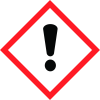
SYMBOL
Hazard Codes
Hazard statements (CLP)
H315, H317, H319, H335, H351, H373
Hazard statements
Code
Statements
H315
Causes skin irritation
Section 2
SECTION 2: Hazards identification
GHS CLASSIFICATION
Signal word
SYMBOL Carcinogenicity: Category 2 WARNING STOT Repeated Exposure: Category 2 Skin Irritant: Category 2 Eye Irritant: Category 2A Skin Sensitization: Category 1 STOT Single Exposure: Category 3 HAZARD-DETERMINING COMPONENTS OF LABELING 2-hydroxyethyl methacrylate Polyglycol dimethacrylate Dimethylbenzyl hydroperoxide 2'-phenylacetohydrazide HAZARD STATEMENTS H315: Causes skin irritation H319: Causes serious eye irritation H317: May cause an allergic skin reaction H351: Suspected of causing cancer H335: May cause respiratory irritation H373: May cause damage to organs through prolonged or repeated exposure
Prevention
P260: Do not breathe dust/fume/gas/mist/vapors/spray. P261: Avoid breathing dust/fume/gas/mist/vapors/spray. P264: Wash face, hands and any exposed skin thoroughly after handling. P271: Use only outdoors or in a well-ventilated area. P272: Contaminated work clothing must not be allowed out of the workplace. P280: Wear protective gloves/protective clothing/eye protection/face protection.
Response
P304+P340 IF INHALED Remove person to fresh air and keep comfortable for breathing P305+P351+P338 IF IN EYES: Rinse cautiously with water for several minutes. Remove contact lenses, if present and easy to do. Continue rinsing. P308+P313 IF EXPOSED OR CONCERNED Get medical advice/attention P312: Call a poison center/doctor if you feel unwell. P314: Get medical advice/attention if you feel unwell. P362+P364: Take off contaminated clothing and wash it before reuse. P332+P313 If skin irritation occurs Get medical advice/attention P333+P313 If skin irritation or rash occurs Get medical advice/attention P321: Specific treatment (see on this label). P337+P313 If eye irritation persists Get medical advice/attention P363: Wash contaminated clothing before reuse.
Storage
P403+P233: Store in a well-ventilated place. Keep container tightly closed. P405: Store locked up.
Disposal
P501: Dispose of contents/container in accordance with local/regional/national/international regulations.
Additional information
8.5% of the mixture consists of component(s) of unknown toxicity.
2.1 Classification of the substance or mixture
SIGNAL WORD: SYMBOL: Carcinogenicity: Category 2 WARNING STOT Repeated Exposure: Category 2 Skin Irritant: Category 2 Eye Irritant: Category 2A Skin Sensitization: Category 1 STOT Single Exposure: Category 3 HAZARD-DETERMINING COMPONENTS OF LABELING: 2-hydroxyethyl methacrylate Polyglycol dimethacrylate Dimethylbenzyl hydroperoxide 2'-phenylacetohydrazide HAZARD STATEMENTS: H315: Causes skin irritation. H319: Causes serious eye irritation. H317: May cause an allergic skin reaction. H351: Suspected of causing cancer. H335: May cause respiratory irritation. H373: May cause damage to organs through prolonged or repeated exposure.



